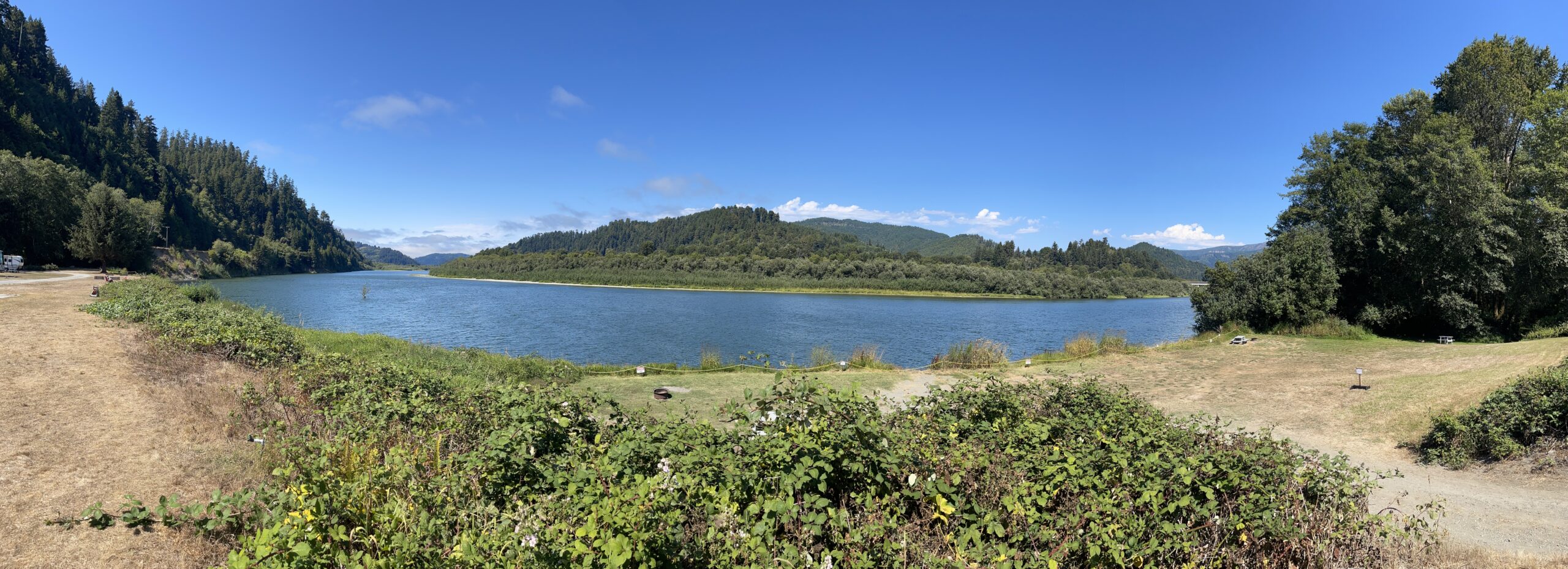
The west sure had an abundance of natural beauty, and northern California certainly has its share. As I leave Oregon and venture into California for my 11 stop tour around the state, I’m in awe of all the amazing mountains and beautiful Pacific ocean coast that exists here. So, come along for the ride and lets explore the most populous state in America that some 40 million people call home.
Klamath, CA
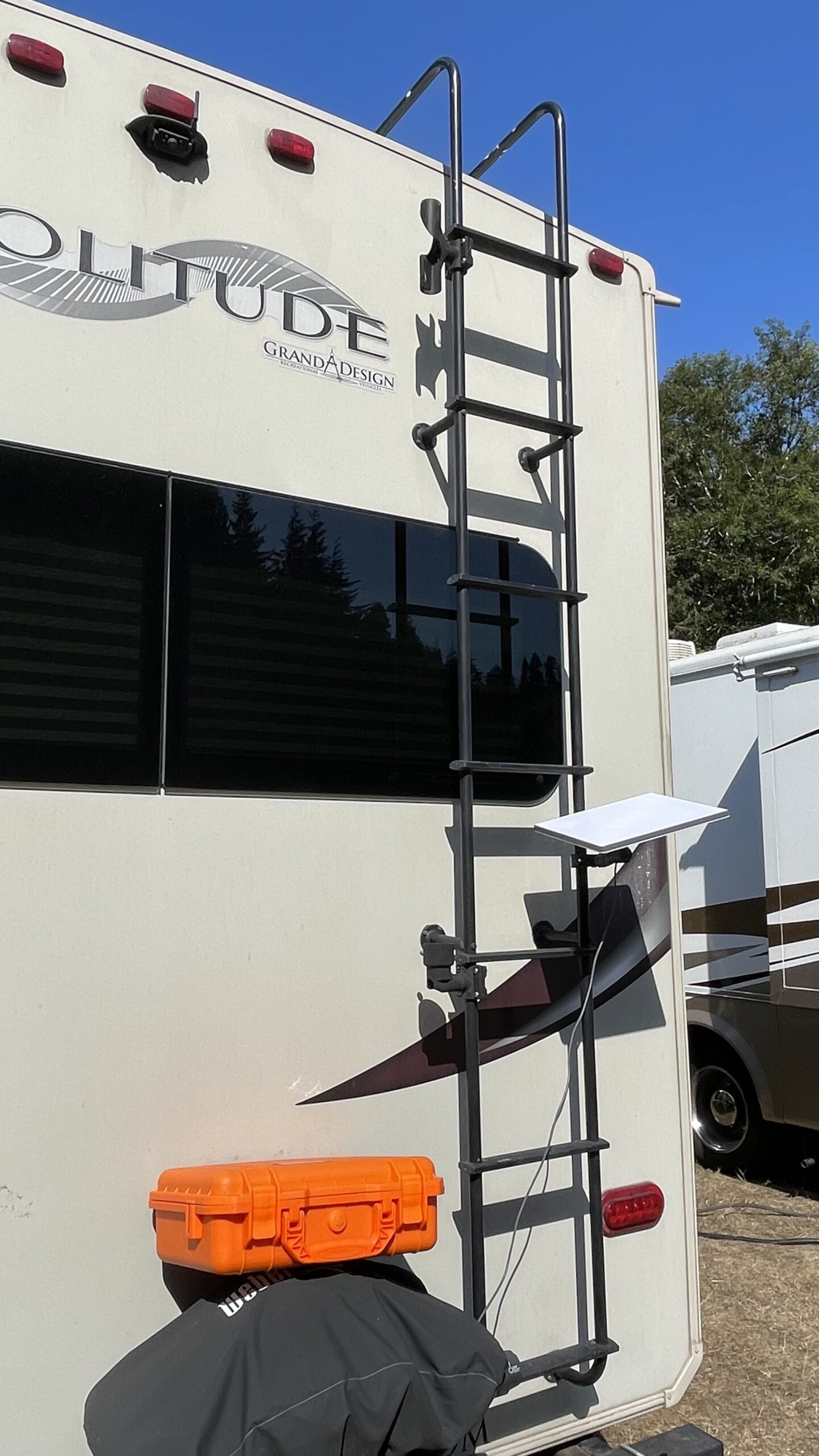 My first stop in California takes me about 35 miles south of the Oregon boarder to the town of Klamath. This community of just over 1,000 residents sits along coastal route CA-101, as well as on the Klamath River. It was however, a most definite rural area. This became oh so evident soon after I arrived at the campground. I have a fairly standard, mostly muscle memory at this point, process that I follow when arriving at a new campground. Unhooking and leveling the RV is my first task, followed by electrical, water, and sewer connections. Then it’s insides turn where I put out the slides, put items back out to their proper place from their temporary travel locations, then connect and test my cellular Internet options. Alas, all three of my options (T-Mobile, AT&T, Verizon) were all non existent. In fact, my phone which runs on the Verizon network was also DOA. The campground had WiFi, but a quick connection to it followed by some testing, proved that to be a virtually worthless option. So, it was time to break out the big guns! Back when I was in Florida during the winter I purchased a Starlink Mini dish to have as a last resort option for just this use case. I learned the hard way last year that not having this option could result in a stay completely void of Internet, and that simply can NOT happen. So, I retrieved the satellite dish from its travel case, connected the dish to my outside ladder, ran the connection cable out through a window, made the connection, then began the alignment process. It wasn’t long before I had a 40MB down/15MB up connection that was more than adequate for my needs. Wahoo! Starlink to the rescue!
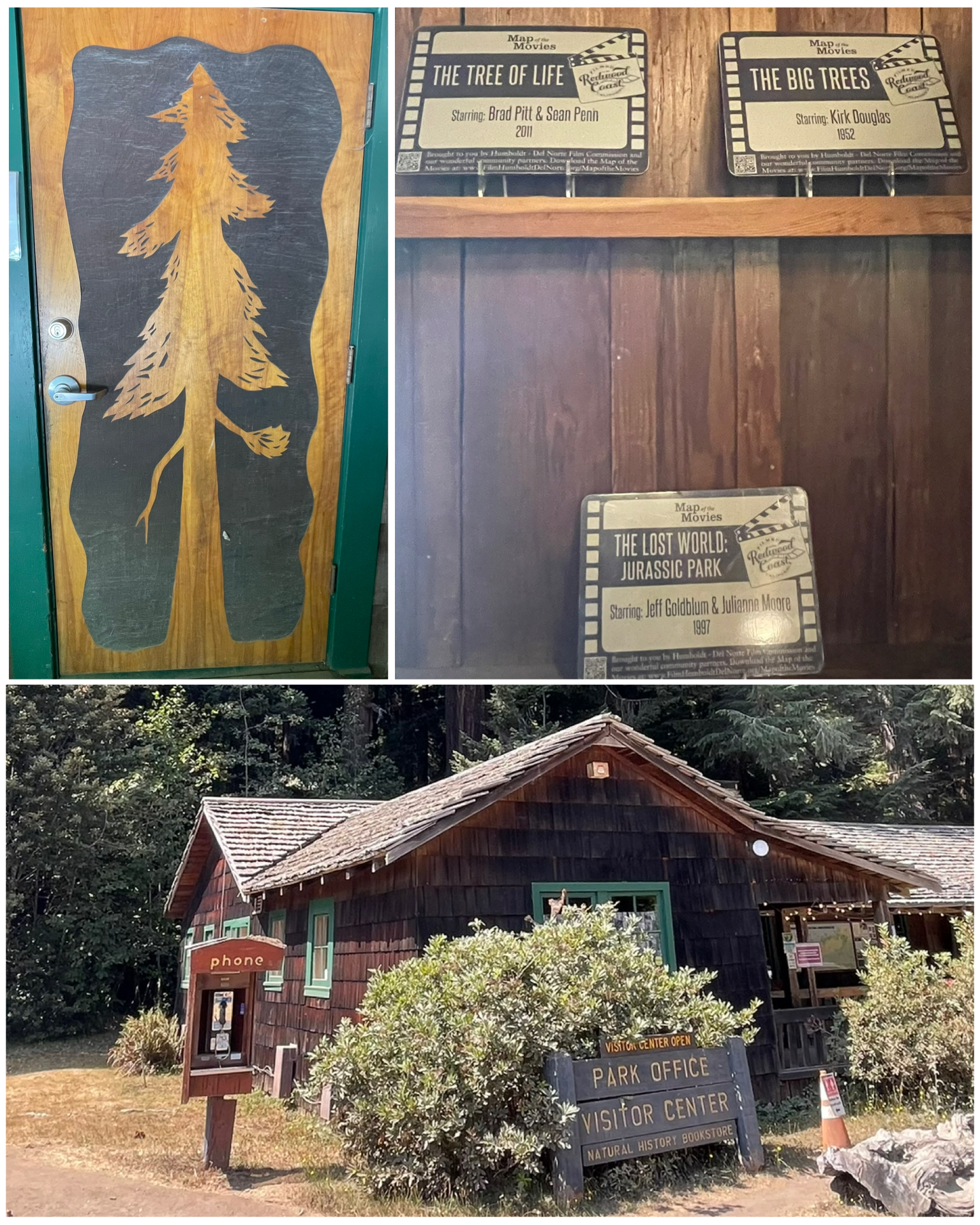 Now that I had Internet service, I could begin the process of figuring out what there was to see around here. First and foremost I had entered the region known as the Redwood National Forest – home to some really big trees. I started my visit by stopping in at the visitor center where I got my National Park book stamped. One of the doors in the visitor center was very interesting and had a tree carving in it (at right, top left). Inside the center were lots of your typical visitor info, including these three signs that indicated three movies had been filmed in the park – the 2011
 Brad Pitt/Sean Penn film “The Tree of Life”, the 1997 Jeff Goldblum/Julianne Moore film “The Lost World: Jarassic Park”, and the 1952 Kirk Douglas film “The Big Trees”. Sadly, I’ve not seen any of these films, so I’ll have to add them to my list.
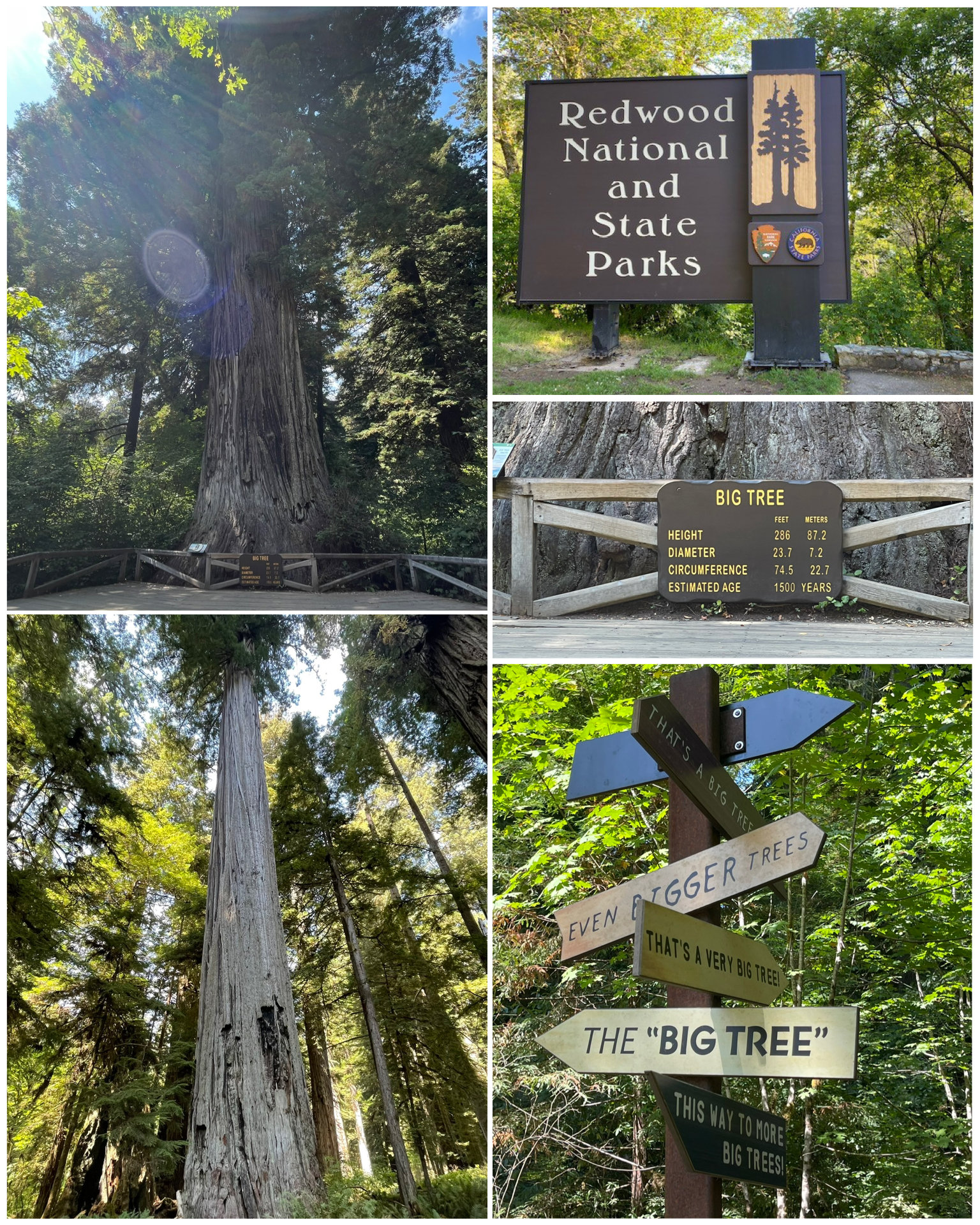
Next, I travelled into the forest to check out some of the trees. Oh my God, they are ginormous! I’ve never in my life seen anything so big around and so tall. In particular, this tree simply named “Big Tree” (at left, top left) is over 23 feet in diameter, 286 feet tall, and estimated to be 1,500 years old. Incredible! There was a nice trail that led deeper into the forest, with signage leading to lots of other big trees. As you wandered down the trail, there was nothing but giant tree after giant tree. It was so amazing. You’ve never really appreciated just how massive these trees are from the pictures. So, you’ll just have to make a visit for yourself to see them in person. Highly recommended!
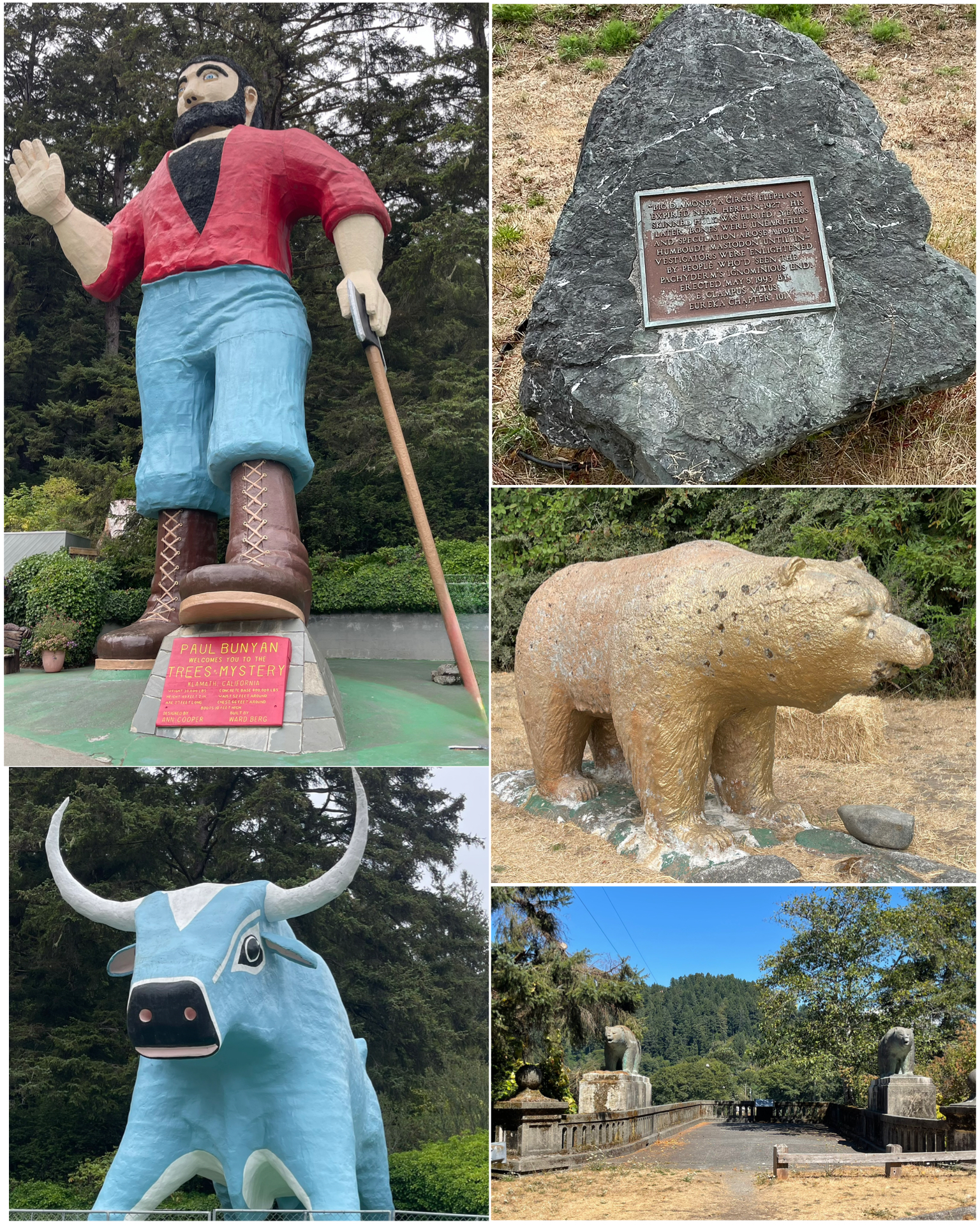 Next I chased after a few Roadside items that were in the area. First up was this rock with plaque that was commissioned in 1993 to mark the spot where a circus elephant had died and was burried in the area back in 1927. In addition to memorializing the elephant’s death, the plaque also tells an interesting story. Apparently years after the elephant had died and was buried, it’s bones were unearthed, and believed to be that of an ancient mastodon. They thought they had made a historical discovery until they were made aware that it was simply elephant bones from residents who were familiar with the circus event. Oh well – better luck next time. Next was this golden bear (at right, center right) that was one of four which once flanked at each end of the Douglas Bridge. Most of the bridge was destroyed by the great Christmas flood of 1964 – which also happens to have destroyed much of the town of Klamath. One side of the original bridge remains as a sort of a memorial (at right, bottom right). A new bridge was constructed and now has four new bears – two each on both ends similar to the original. Last up, these two giant fiberglass statues of Paul Bunyan and his trusty blue ox sidekick companion Babe. These guys are located in the parking lot to to a local tourist venue called Trees of Mystery. Paul is over 49 feet tall, waves, moves his head, blinks his eyes, and even talks. The tourist trap began in 1931 as natural history theme park called Wonderland Redwood Park, then later Kingdom of Trees. Today, it features a lots of big trees, a gondola sky ride a museum, underwater restaurant, and a massive gift shop. Needless to say, I got pics of the characters then quickly moved on.
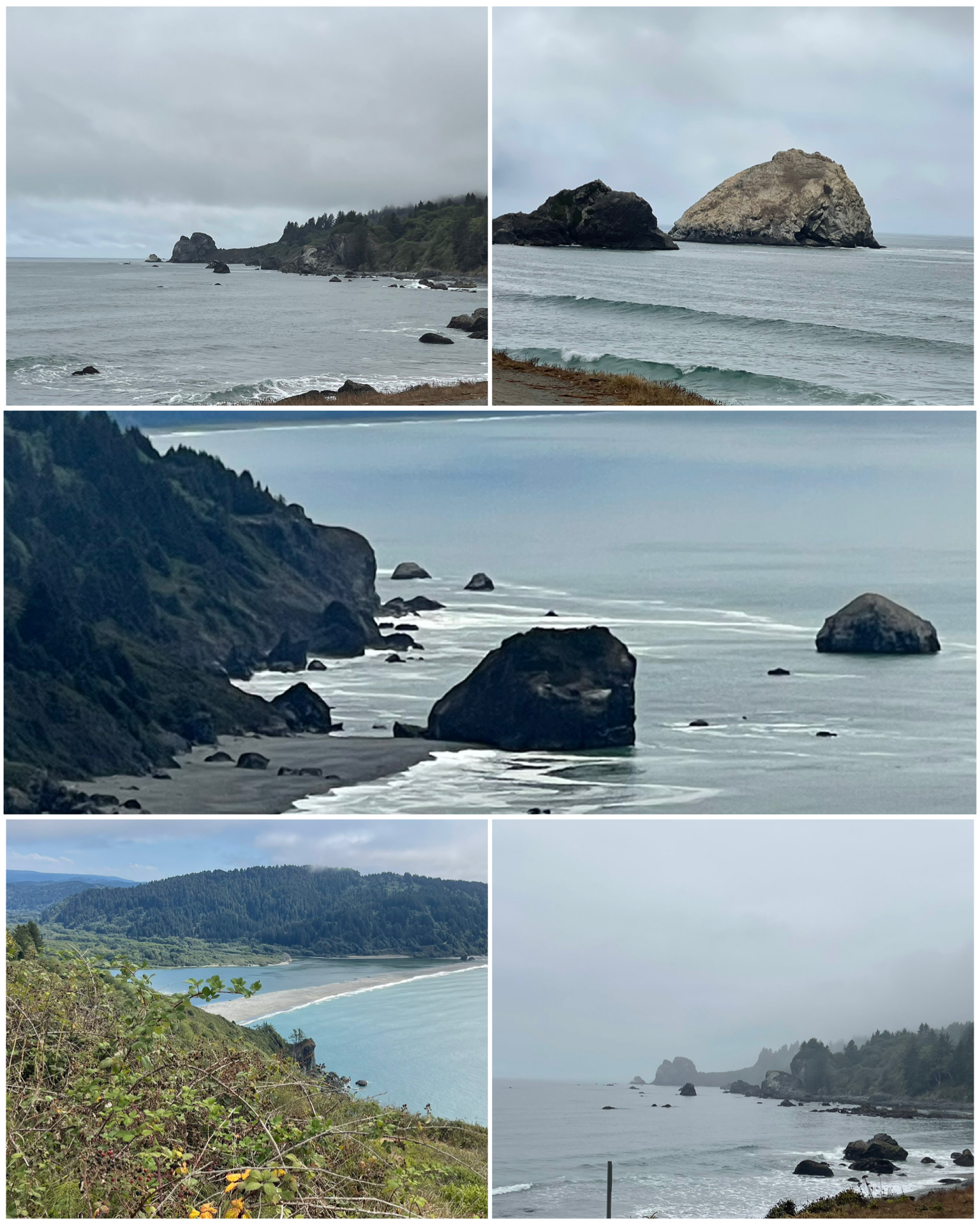 Next I checked out the Pacific coastline and the connection to the Klamath River. Consistent with much of the Pacific coast, there were lots of rough and rock-filled coastal areas. It was quite beautiful and picturesque despite the somewhat foggy day. The Klamath river begins at Klamath Falls in Oregon, and runs over 250 miles into northern California – traveling through the Cascade and Klamath mountain ranges. It eventually runs to the california coast where it empties into the
 Pacific Ocean (at left, bottom right). It is the third largest salmon and steelhead producing river on the west coast.
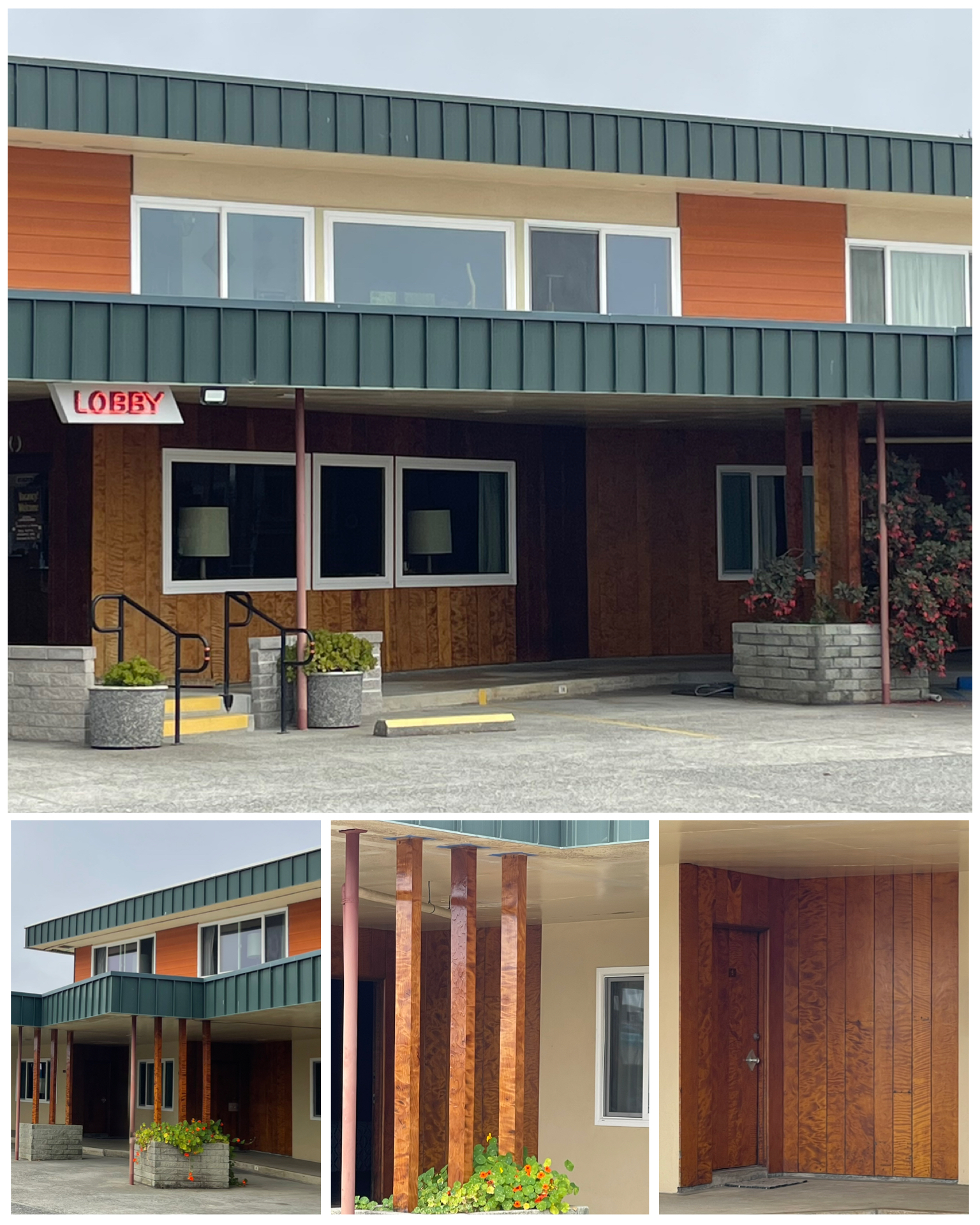
My next stop was a visit to Curly Redwood Lodge. From the roadway, this 36-room motor lodge doesn’t look all that special. But, upon closer inspection, it is truly beautiful. It’s claim to fame is that all the wood features that encompass the entire facility was sourced from a single curly redwood tree. The tree from the Klamath River region was felled in 1952, and produced 57,000 board feet of lumber. Its known as a Curly redwood due to its unusual and beautiful grain. Indeed, if you look closely at these pictures, you will see the stunning woodgrain that highlights this particular wood. The lodge was completed in 1957, and has been operating as a unique tourist stop ever since. Most definitely unique!
Weed, CA
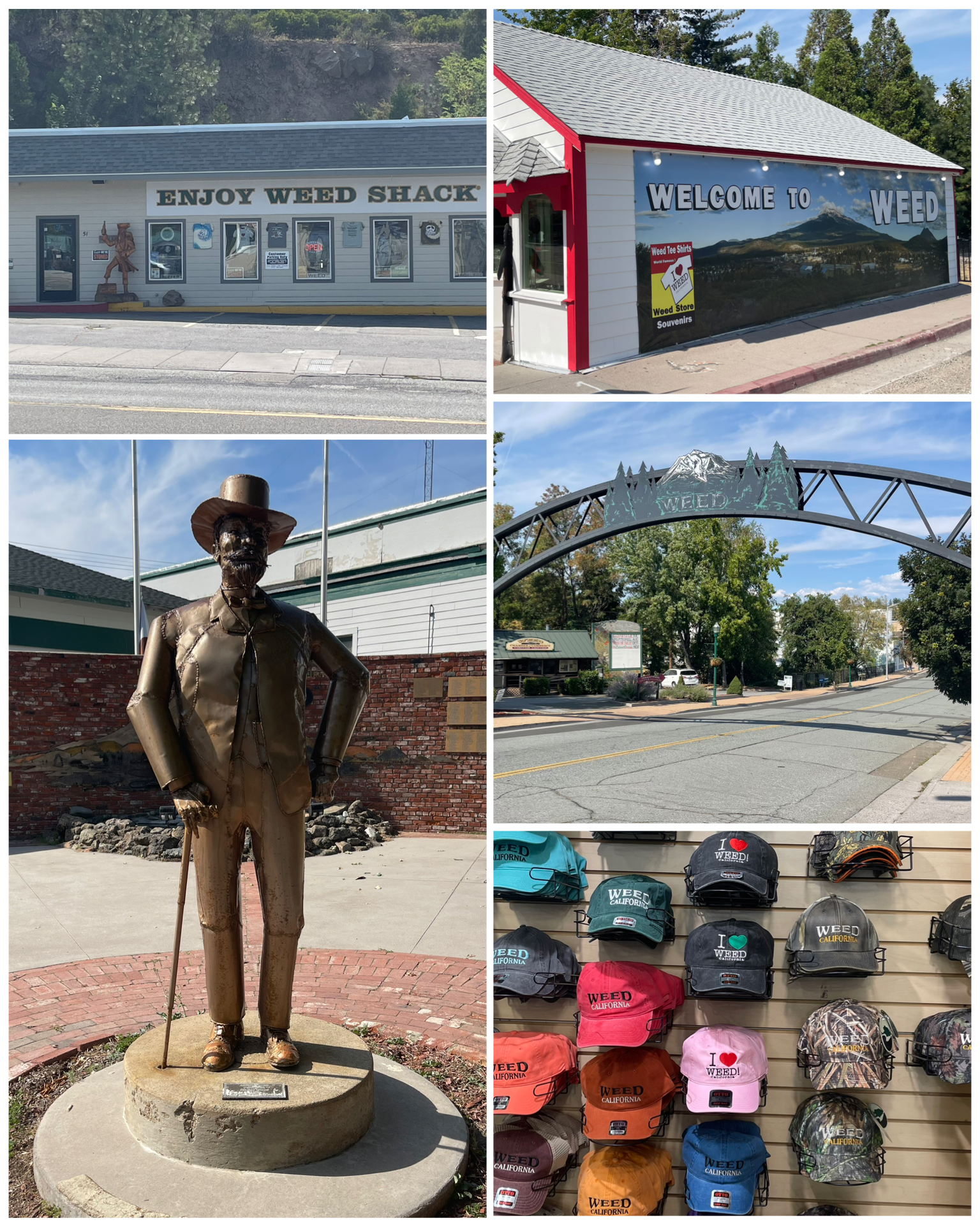 85 miles to the east we find Weed, CA. Their city moto is “Weed like to welcome you” – too funny! They also seem to have fully adopted the other meaning of weed – specifically 420 cannabis. A small rural town with a population of just over 2,800, it was once a thriving lumber town from its founding in 1901 through the 1980s. Today, it is mostly reliant on tourism for survival. So, with a name like Weed, you might as well embrace it. Walking around town, there were many little gift shops that played on the name Weed to create lots of “Weed” trinkets and mementos. A welcoming archway featuring the town’s name spans across Main Street, while a small park downtown features a statue of Abner Weed – the town’s founder and successful lumberman. The surrounding brickwork was built from bricks sourced from his once thriving lumber mill. What I found most interesting as I walked around town, was that I did not see a single weed dispensary. Seems to me a town like Weed, which has obviously very much leveraged its name, should have an actual weed store or two in town. Especially since weed is both medically and recreationally legal in the state of California. When I asked one of the shop keeps
 why there were no dispensaries, she indicated there were in fact two in town, but they are tucked away off the main drag. After all, they want the town to be family friendly!
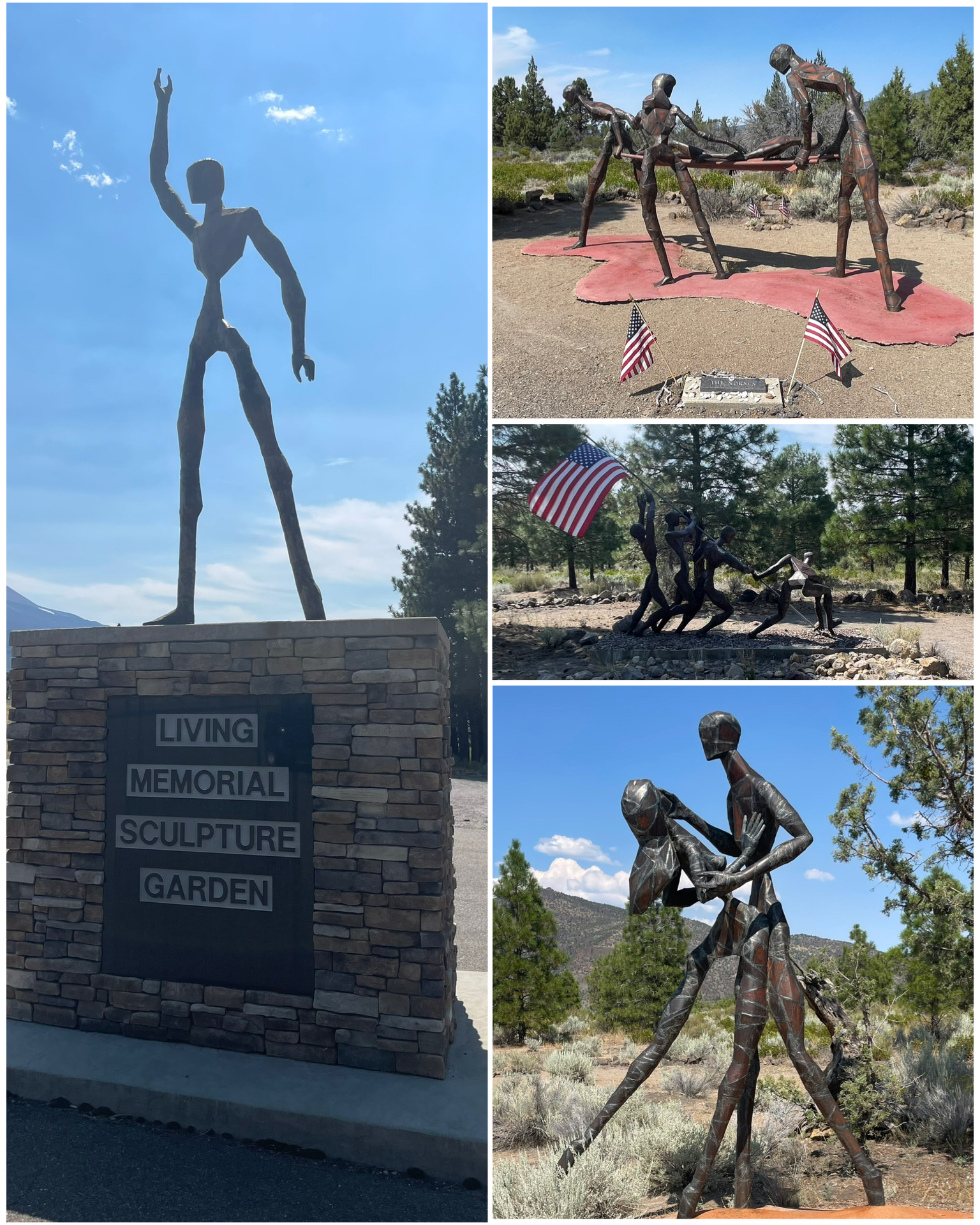
About 15 miles to the northeast on highway 97 is a park dedicated to veterans that also features a series of amazing sculptures. Known as the Living Memorial Sculpture Garden, there are over a dozen amazing art pieces featuring humanoid like figures depicting various veteran causes and recognizes several wars. Situated on 136 acres of land provided by the USDA Forest Service, the garden was founded by a group of veterans in 1988 and is proudly maintained by the Kiwanis Club of Weed/Lake Shastina. One of the pieces titled “The Nurses” (at right, top right) features two people tending to a wounded warrior on a stretcher, while another titled “Coming Home” (at right, bottom right) represents the family joy of a returning soldier. Lastly, the art piece titled “The Greatest Generation” (at right, center right) pays homage to the iconic raising of the flag on Mt Suribachi Iwo Jima during World War II. A truly incredible sculpture garden that I thoroughly enjoyed walking through. Check out my full photos link below to see several more of these amazing sculptures.
Shingletown, CA
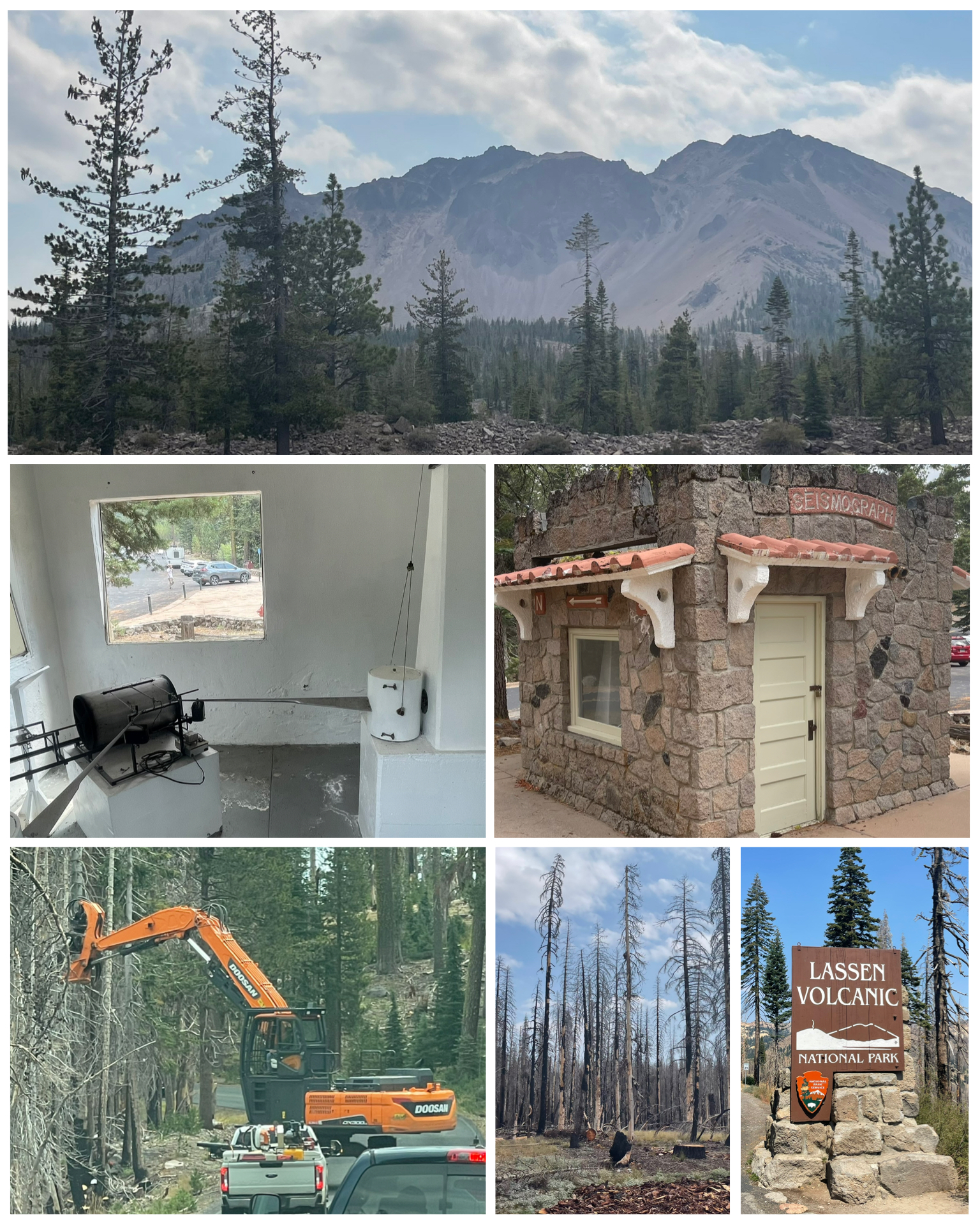 Just over 100 miles to the southeast is the town of Shingletown. Another rural town with a population of just over 2,400, it is located in the hills at the base of Mt Lassen and is known as the Gateway to Lassen. Indeed, it was Lassen Volcanic National Park that was on my agenda to explore while I was here. Home to Lassen Peak, the worlds the largest plug dome volcano, the park was first designated as a National Monument by President Theodore Roosevelt in 1907, later to be expanded and redesignated as a National Park in 1916. My visit started with a stop to get a pic of the park sign, followed by a stop at the visitor center. On the way, I could see lots of forest area that had been burned – no doubt from a past forest fire. In fact there was a work crew that was taking down some of the charred trees along the park access road. At the visitor center, there was an interesting little building that
 housed a vintage seismograph – once used to measure ground shaking and earthquake activity. From the looks of it, it hadn’t been used in quite a long time. Definitely an antique!
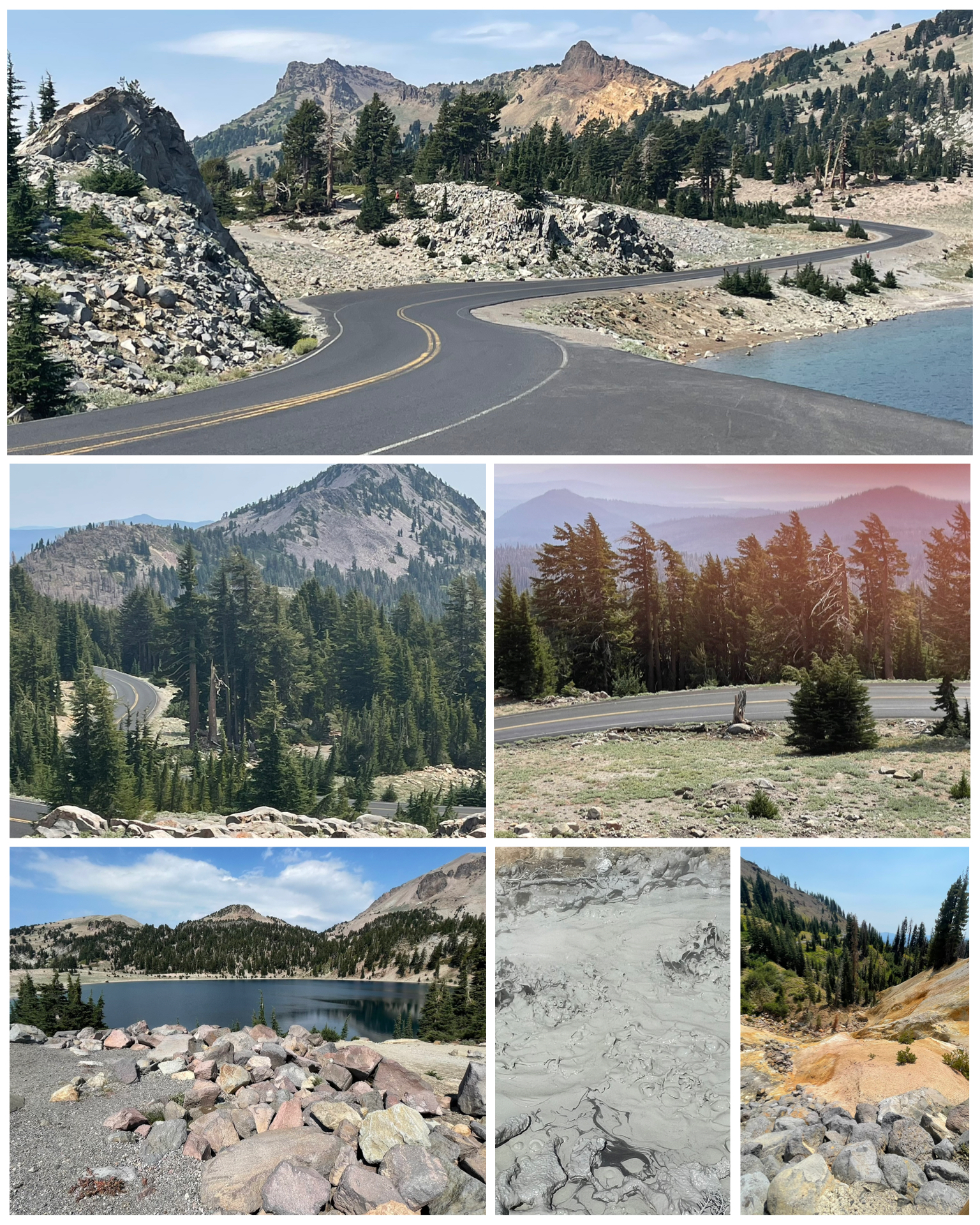
Next, I would drive the very winding road along the parks driving tour. Overall it was a very beautiful and scenic drive passing lots of mountains, volcanic rock, even a mountain lake. There were also geothermic areas featuring both steam and ponds of bubbling goo – similar to what you might see at Yellowstone. It was a very enjoyable day driving through this very scenic National Park.
As I was heading back to the campground from Lassen NP, the GPS had taken me on a particular back road that was littered with black rock – presumed to be remnants of a volcanic explosion hundreds or maybe even thousands of years ago. I mean, it was everywhere, lining both sides of the street! As I was driving, I got the idea of maybe seeing if I can find an accessible and reasonably sized one that I might be able to pickup as a souvenir. The video below, though technically may be considered evidence of a theft, highlights that souvenir hunting activity. Enjoy!
Verdi, NV
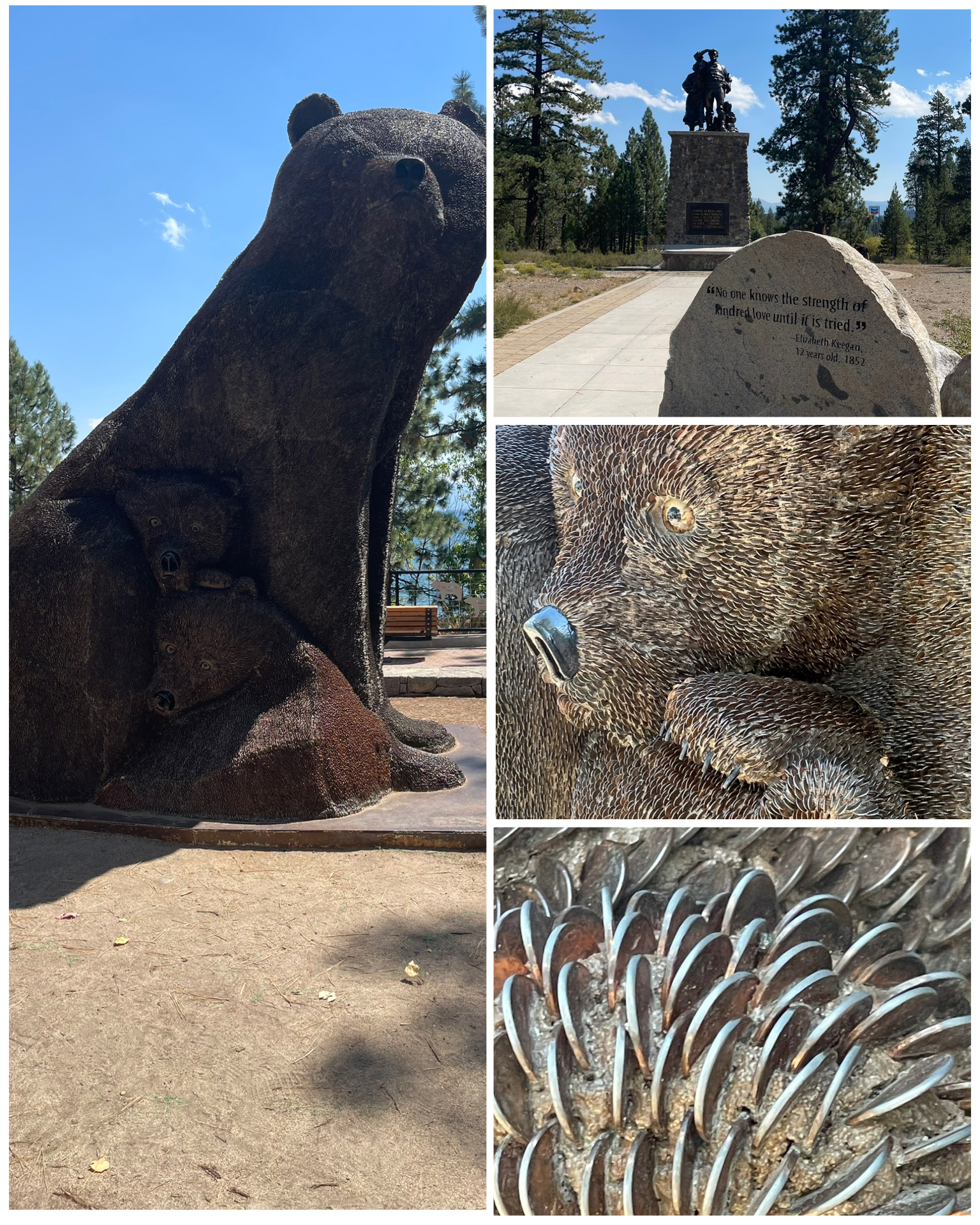 I headed further south and west, and actually slipped just a few hundred feet across the state line into Nevada to the town of Verdi. A tiny rural town with fewer than 1,500 residents, it was a perfect stop to explore the far eastern portion of CA, and a bit of western NV. My first adventure took me to the southwest, back into California, making my way to Lake Tahoe. On the way, I stopped at the visitor center to Donner Lake State Park, and saw this 1918 bronze statue (at left, top right). This spot tells the story of a group of 87 travelers known as the Donner Party who were working their way to the west via the Sierra Nevada Mountains. Unfortunately, their timing was bad and they got stuck in the mountain snow – which at points reached upwards of 22 feet deep. Only 48 survived to be rescued the following spring. Those survivors told stories of how they had to employ cannibalism – eating their deceased in order to survive. That part of the story has mostly been eliminated in favor of a more family friendly version in what is now the state park.
Next, I arrived Tahoe City to check out the town, and to see the famous lake. First up though was a visit to this really cool statue of a 12 foot mama grizzly bear, and her pair of 6 foot tall cubs. What makes this so unique is that what you see as the bears fur is actually made up of pennies – thousands and thousands of them. This piece was officially called Ursa Mater when it was created in 2017 and appeared at that year’s Burning Man festival, but was later purchased by and relocated to the town of Tahoe City and renamed as Penny Bear. Pretty cool piece!
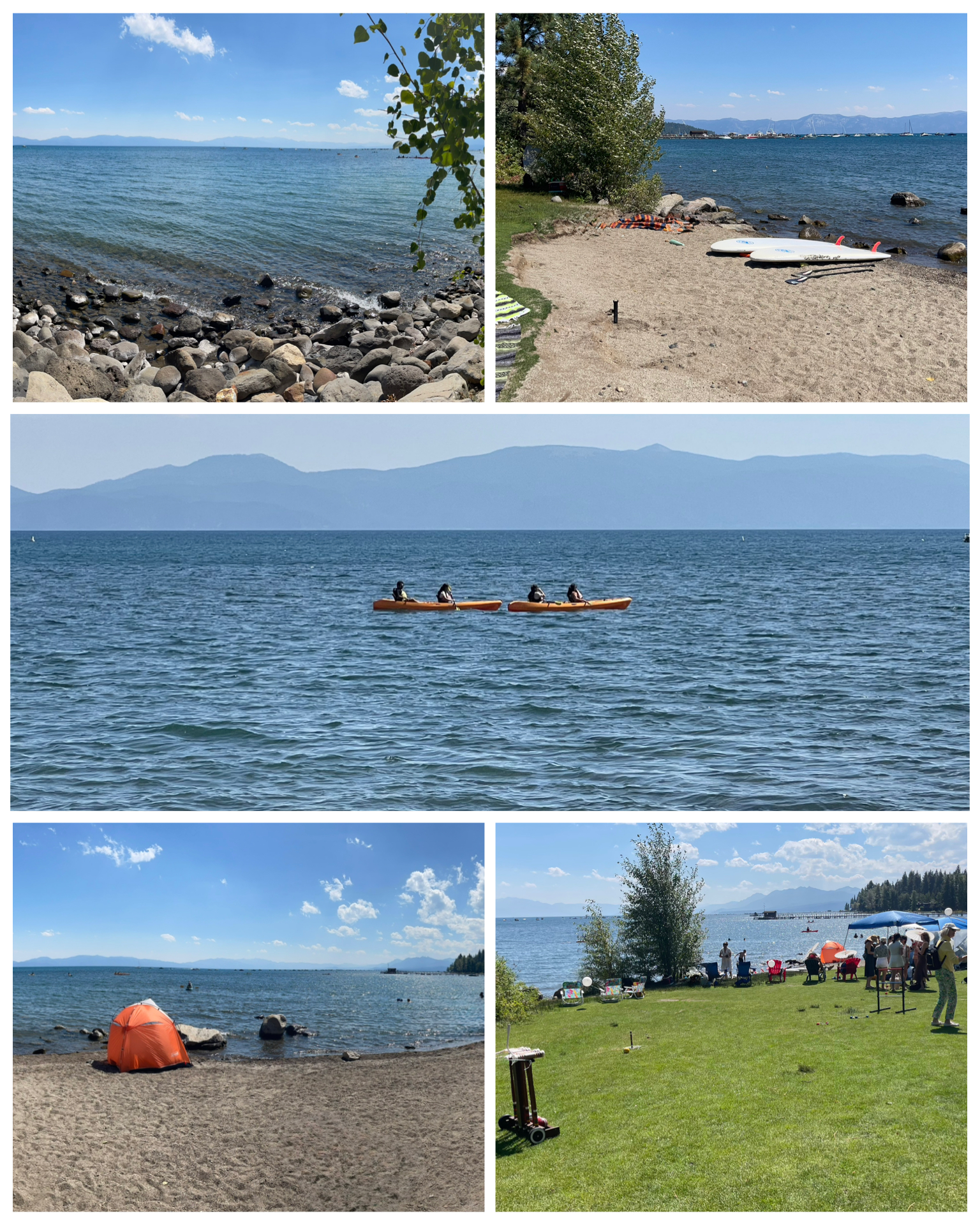 Next, I travelled down the city banks down to the shores of the lake. It was a nice sunny weekend afternoon day, so there were certainly lots of folks enjoying themselves. Located here in Sierra Nevada at some 6,200 feet of elevation, it is the largest alpine lake in North America. Also, with its over 122 million acre feet in size, it is the largest lake by volume in the United States not including the Great Lakes. It was really beautiful. There was a sandy beach area where lots of families were enjoying. Plenty of boaters in their kayaks and canoes, and even several to be on stand-up paddle boards. Definitely a recreational lake.
 Also located on the shores of the lake was a historical prison (at left, bottom left). This jail was built sometime in the 1930 or 1940s by then head peace officer Harry Jo Johanson. I think what made this jail all that more cruel and effective, is the view of the beautiful waterfront from the cells windows (at left, bottom right). Now that’s torture!
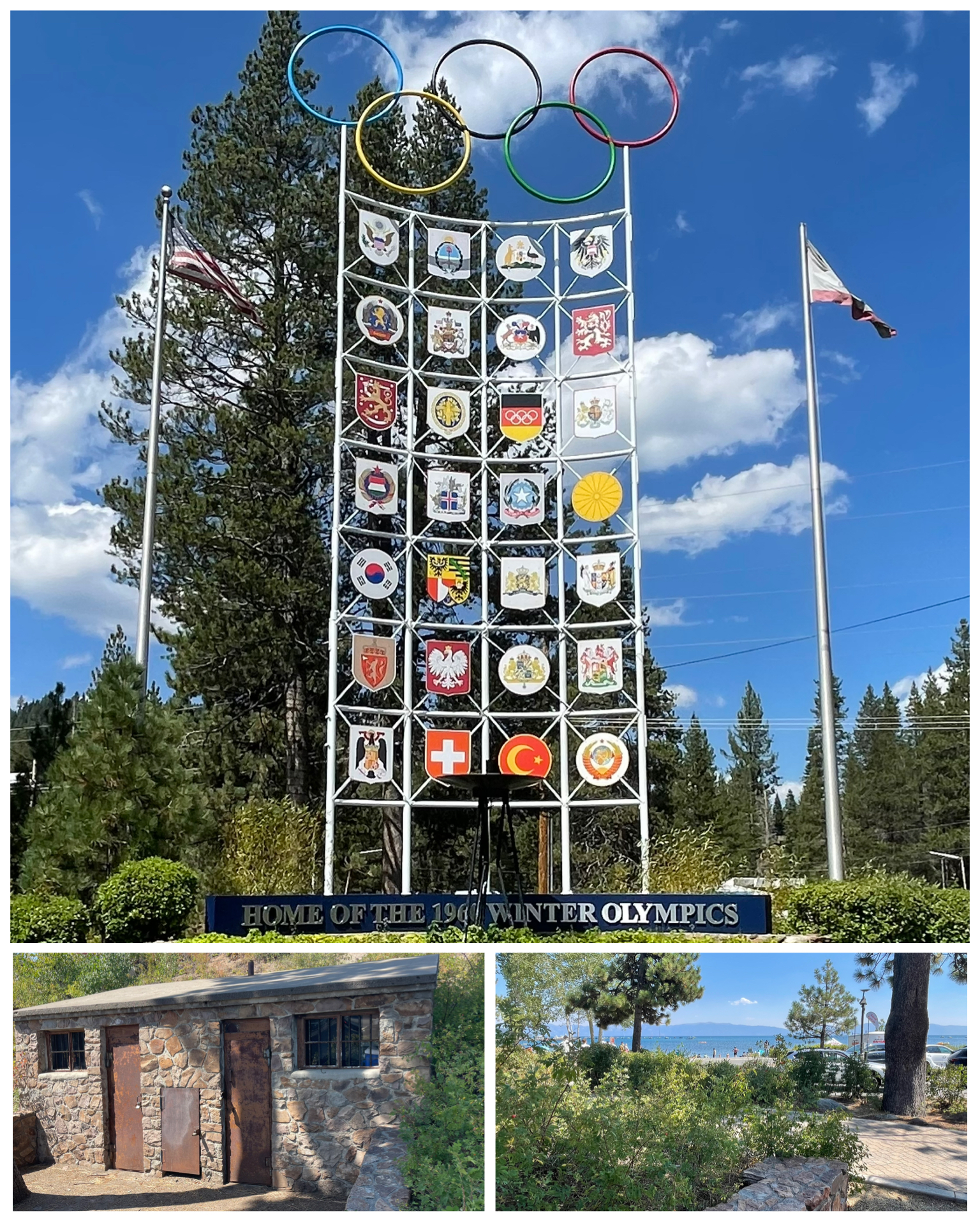
Squaw Valley (now known as Palisades Tahoe) was home to the 1960 Winter Olympics. Despite at the time being a struggling ski resort, and competing with Innsbruck, Austria, St. Moritz, Switzerland and Chamonix, France, the state’s financial backing of the 1955 bid to be the chosen city to host the 1960 winter games was successful. This large sign still remains at the entrence to what was then Olympic Village. It wasn’t a very successful competition for the United States as we came in 2nd in overall medal count, and third in gold medals behind the Soviet Union and Germany. This particular hosting event was also noteworthy as having been the first Olympics to feature a dedicated custom built Village for the athletes to live during the competition. This was necessary due to the towns limited hotel availability. Nowadays, it seems to be a standard feature with any hosting country.
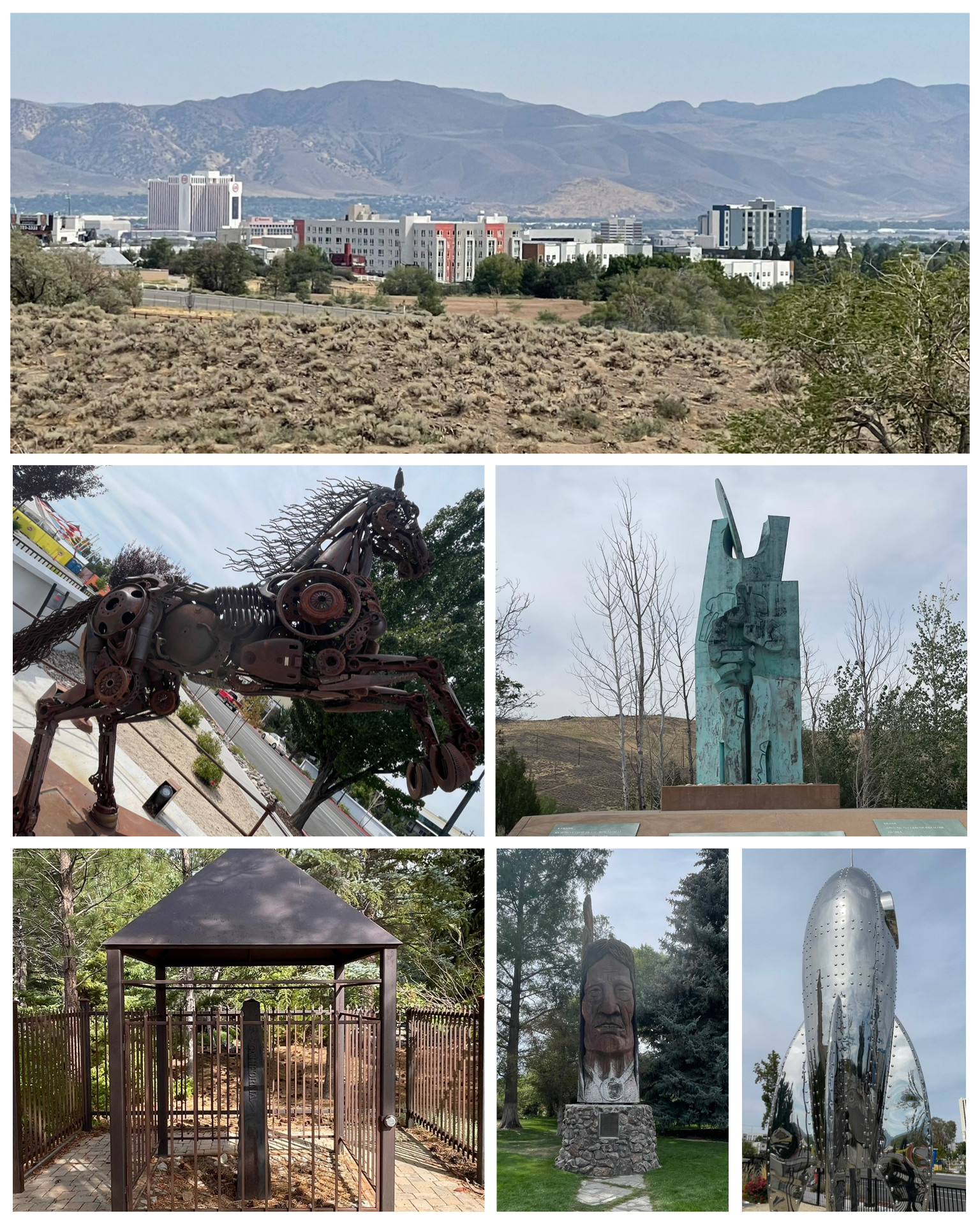 Next I headed a bit east further into Nevada to the town of Reno. There I would find a nice collection of Roadside items to check out. First up was this National Monument to the Basque Sheepherder (at right center right). This 22 foot tall green thing was unveiled in 1989, and is the work of Basque sculptor Nestor Basterretxea (don’t ask me how to pronounce it). He called it Solitude and was designed to honor the Basque immigrants who once farmed sheep in the area. What was also kinda cool from this monument was the view that it offered into downtown Reno (at right, top). Really nice! Next I drove into town to see a couple more creations – namely the Rearing Horse and Spaceship (at right, center left, and bottom right). The horse was made up of various junk metal parts and is the work of Barry Crawford, and first appeared at the 2018 Burning Man festival. Across the street was this cool spaceship – a 2023 Burning Man piece by Australian Clayton Blake. This 27 foot tall stainless steel piece is a celebration of the human spirit and their desire to explore, discover, and travel. Hmmm – sort of describes me quite well! And of course, I could not leave Nevada without checking in to see the Peter Toth Indian Head piece he did for this state. Known as Wa-Pai-Shone, this piece is located in Idlewild Park and was completed in 1986 – the 53rd entry into Peter’s Trail of the Whispering Giants series. The last item of interest I visited was just north of Verdi in the town of Floriston, CA. This cast iron obelisk (at right, bottom left) is one of only four such monuments set by Alexey Von Schmidt during his survey of the California/Nevada boundary in 1872-73, and was intended to mark the location of the 120th parallel which was the border line between the two states. In addition to these four monuments, he set stone mile posts along the entire 612 mile boundary from Oregon to the Colorado River. I chose not to find any of those mile posts in favor of just enjoying seeing this one of only four special monuments.
Petaluma, CA
My next stop was supposed to be a full week’s stay in Napa, but several days before my scheduled arrival I received an email from the campground that I had reserved, informing me that my reservation had been cancelled. Apparently there was a bad wildfire going on in Napa county, and it seems that the campground was commandeered to serve as a host facility for the firefighters and other support personnel. The fire, known as Pickett, raged for 17 days before being fully contained, burning over 6,800 acres and destroying 5 structures. So, I needed to make other arrangements. I hopped on the Internet to see what other options I might have and I decided to book something further west towards the coast in order to avoid any impact from the fire. Petaluma, just north of San Francisco, seemed like a good spot. There was a KOA there that would fit the bill. Unfortunately, its nightly rate exceeded $115 per night making for a very expensive 7-night stay. However, given the short notice, I had few choices to find someplace to stay for a week As they say – location, location, location. I guess you gotta pay for that proximity to the ocean and San Francisco.
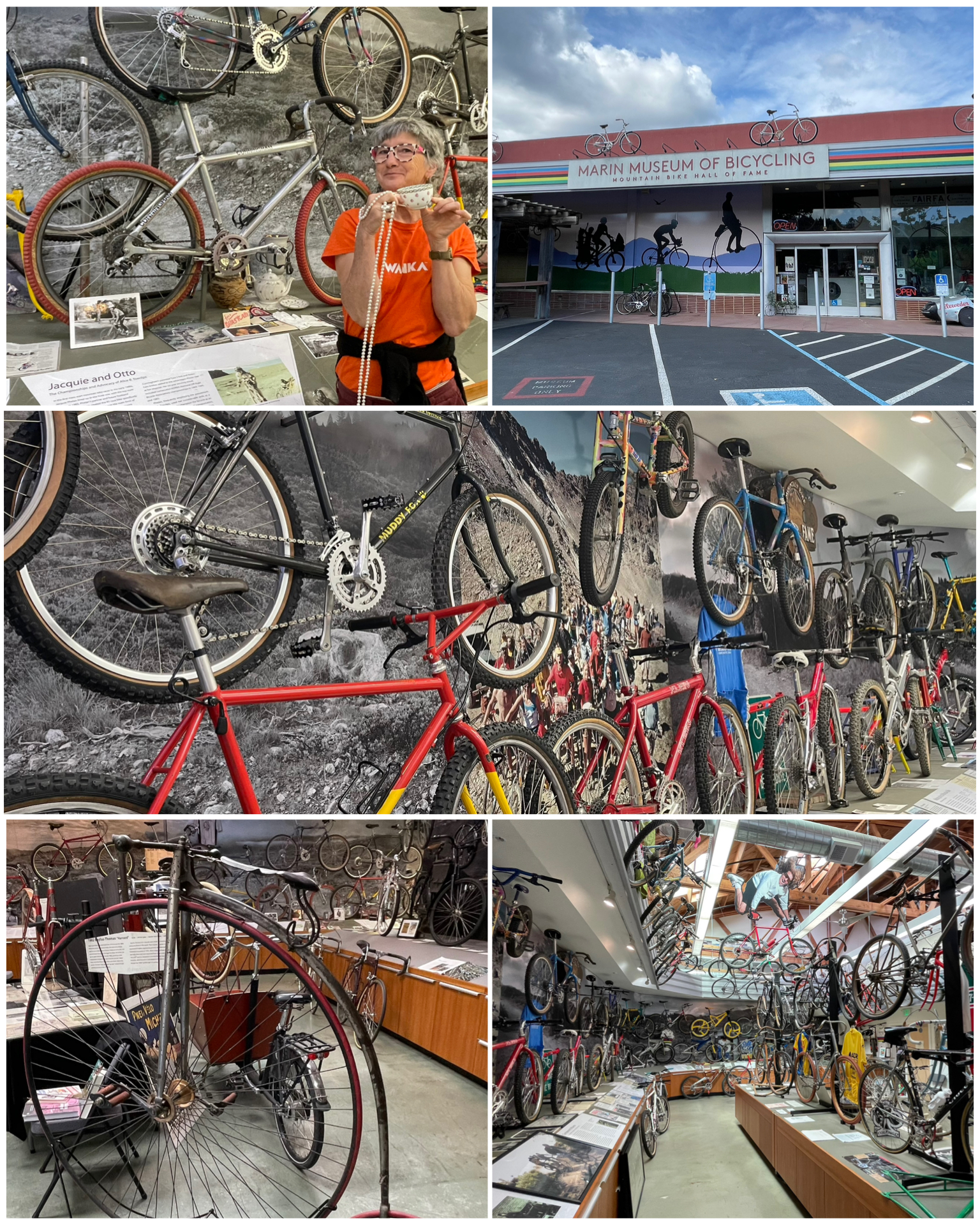 For my first tourist day, I decided to travel a bit south to Fairfax, CA to visit the Marin Museum of Bicycles and Mountain Bike Hall of Fame. It turned out to be a really interesting place, and I ended up spending several hours there enjoying a personal tour and biking history lesson from one of the museum employees. He was extremely knowledgable about biking – especially the evolution of mountain biking which was said to have originated here in Fairfax. There were lots of bikes to be seen from Clunkers (cheap street bikes that were converted to be used to ride down mountains) all the way to custom and purpose built bikes designed for the rugged terrain of downhill mountain trails. Many of the bikes in the museum were either built or owned by famous mountain bike racing pioneers such as Tom Ritchey, Joe Breeze, and Charlie Cunningham. Apparently, the museum is quite the hang out for many of these historical mountain biking figures. In fact, while I was there touring around, Jacquie Phelan popped in and joined our little group of visitors. Besides being Charlie Cunningham’s companion, she is also well known and respected within the bike racing community. Now approaching 70, she was quite the athlete back in the day and was three-time NORBA (National Off Road Bicycle Association) women’s champion in the early 80s. She also formed WOMBATS (Women’s Mountain Bike & Tea Society) for women interested more in socializing and enjoying nature. She was quite the character! The museum also hosted a private collection of antique bikes including a high wheel (at left, bottom left), and a host of others. I also watched and enjoyed a movie that told the story of recreational mountain bike racing from back in the 80s. It was very interesting! If you are interested in learning more, there’s a great similar historical video HERE.
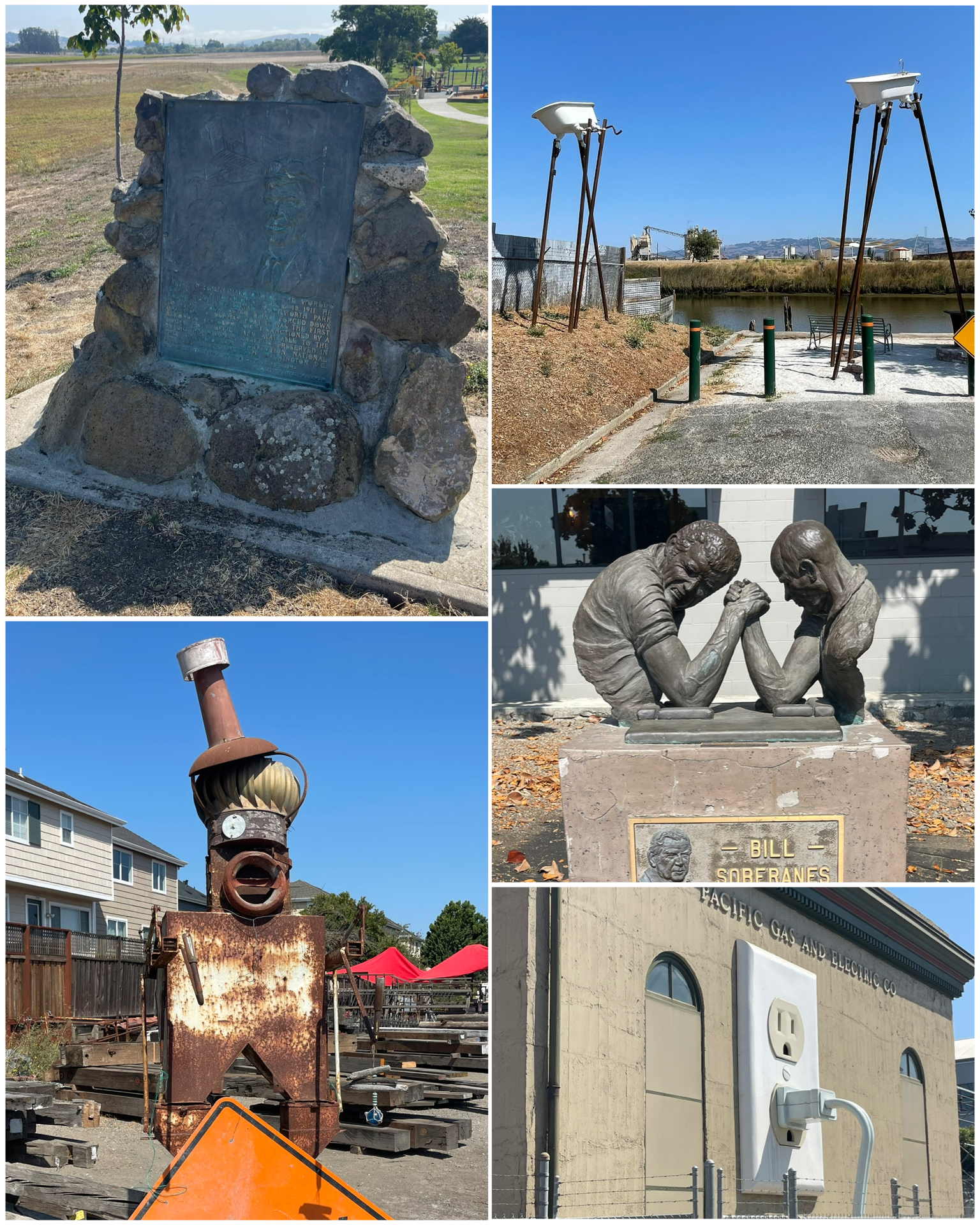 The next day I went after some Roadside attractions, starting here in Petaluma. First up was a visit to Wiseman Park where a monument exists that commemorates the first ever Air Mail flight. It was 1911 when local pilot Fred Wiseman left Petaluma destined to Santa Rosa – some 15 miles to the north, to deliver newspapers, a few pieces of mail, and some groceries. It was a flight sanctioned by the local post office, and thus became the first Air Mail delivery. The plane which was used in this historic flight is now owned by the Smithsonian National Air and Space Museum, but is on permanent loan to the National Postal Museum in Washington DC where it hangs in its atrium. Next I visited a salvage yard filled with all sorts of stuff (junk?) including this junk art tin man (at right, bottom left). There was also supposed to be a large wooden pyramid there too, but alas it was no longer. Next, I visited this pair of claw foot bath tubs sitting high up in the air on stilts. Titled “Fine Balance” and created by sculptor Brian Goggin, these tubs sit overlooking the Petaluma River, and are both loved and hated by the locals. Definitely different! Next in downtown Petaluma was this monument to the sport of arm wrestling. What began as a simple competition in a bar in 1953, has evolved to the towns hosting of the annual World Wrist Wrestling Championship each October that draws upwards of 300 strong arms who compete for the title. Last up on this tour was this giant electrical outlet and plug – created in 2015 by artist Joel Jones and fabricated by Shawn Thorsson, that sits on an exterior wall of a PG&E power substation. Very clever!
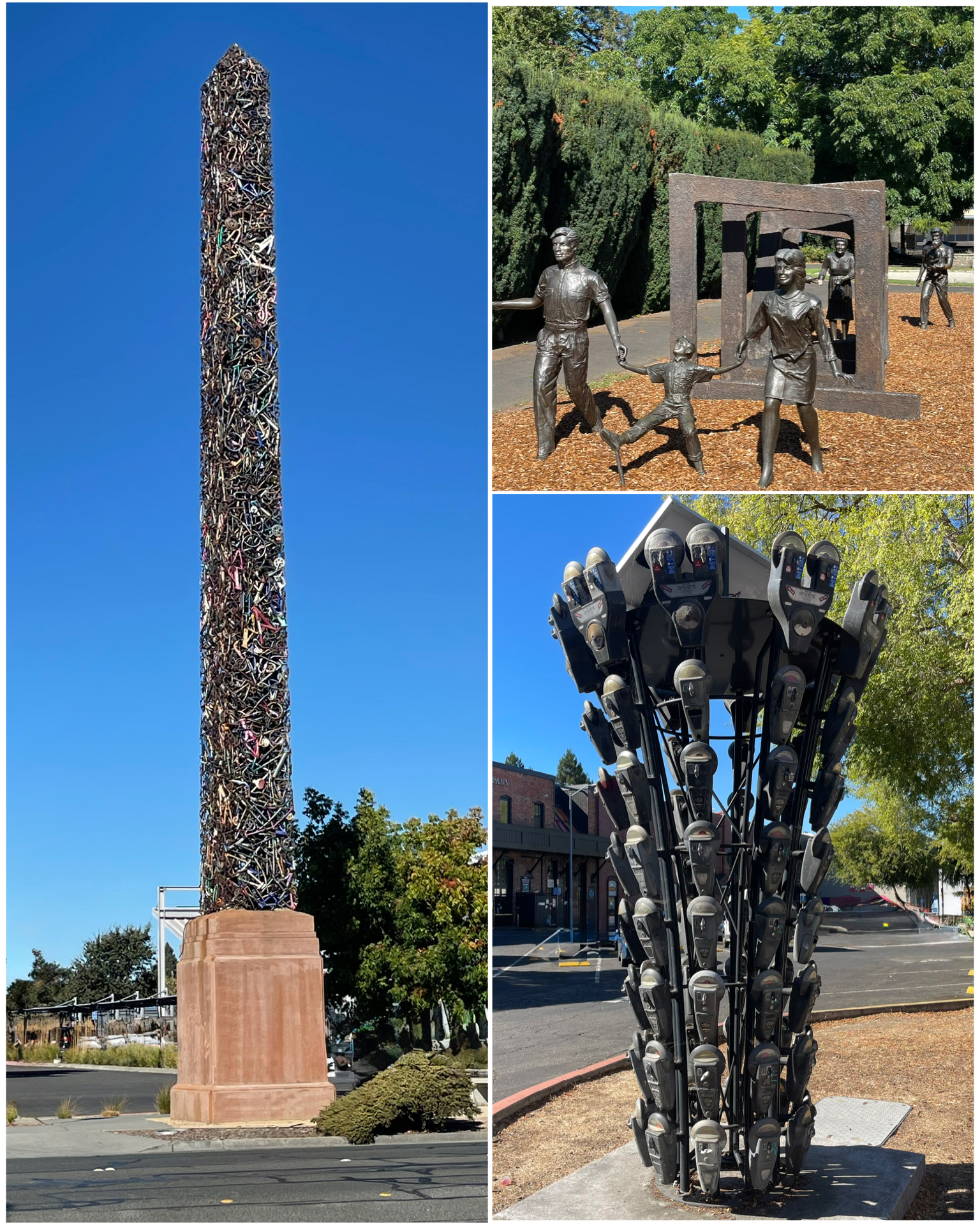 Next I headed north to Santa Rosa to check out some more Roadside items. There I would find the Cyclisk – a 65 foot tall sculpture formed of bicycle parts fused together in the shape of a giant obilisk. It is reportedly made from gears, rims, frames, and other random parts of 330 junker bicycles. It was the brainchild of artists Mark Grieve and Llana Spector – built in 2010 and added to the Santa Rosa landscape to represent the towns cultural and bike friendly atmosphere. It sure was huge! Next was this art piece made up of 80 recycled parking meters titled “Meter Made”. This was a funded public art project created in 2018, and is supposed to have LED lights which somehow are influenced by and interact with visitors at night. Not sure if that part is still working as I was there during the day. Oh well. Last up was a familiar piece that I’ve seen a few times in the past. Known as the Cancer Survivor Plaza this piece is represented with cancer patients walking through a portal on their way to recovery. Dozens of these are located in cities all over the country – several of which I have seen in past travels. Nice to see that this has made a presence all the way out here in the west.
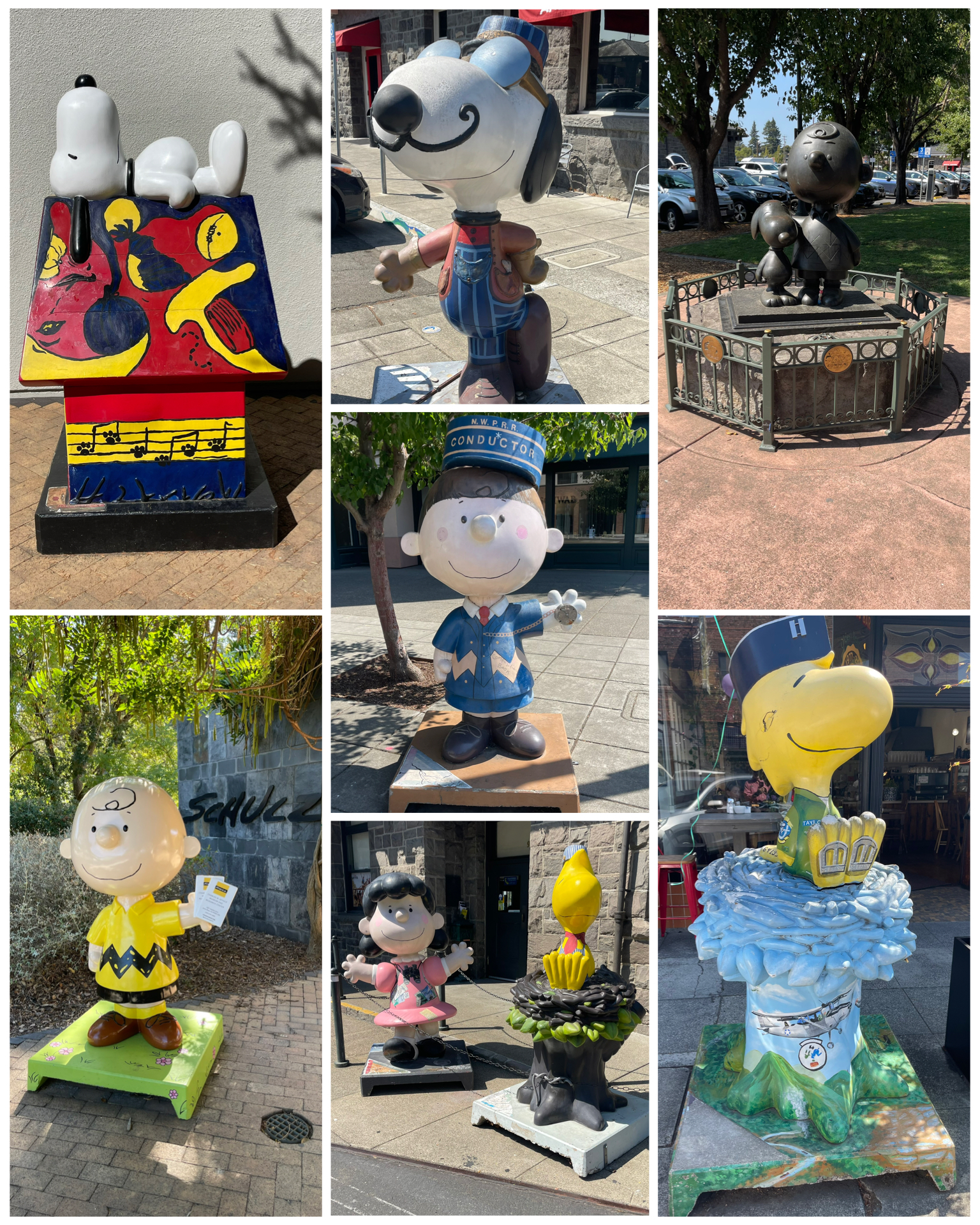 Santa Rosa is also the hometown of famed cartoonist Charles M. Schulz of Charlie Brown and the Peanuts comic strip fame. Roadside pointed to a cluster of fiberglass statues of Peanuts characters located in downtown Santa Rosa. I found several of them just wandering around town. That was until I found my way to the Chamber of Commerce building where one of the statues would be found. There, I also noticed a QR code to a website that tells more about the statues, and a finders guide to see all of them that are spread all over Sonoma County. There you will find exact location details of all 132 of the statues. Yes, you read that correct – there are 132 of these things scattered around. Clearly, I did not have the time (nor the interest frankly) to find and see them all. So, I was satisfied with my half dozen or so encounters that I did find, and I left it at that. In case you are interested, you can see where all of them are located HERE.
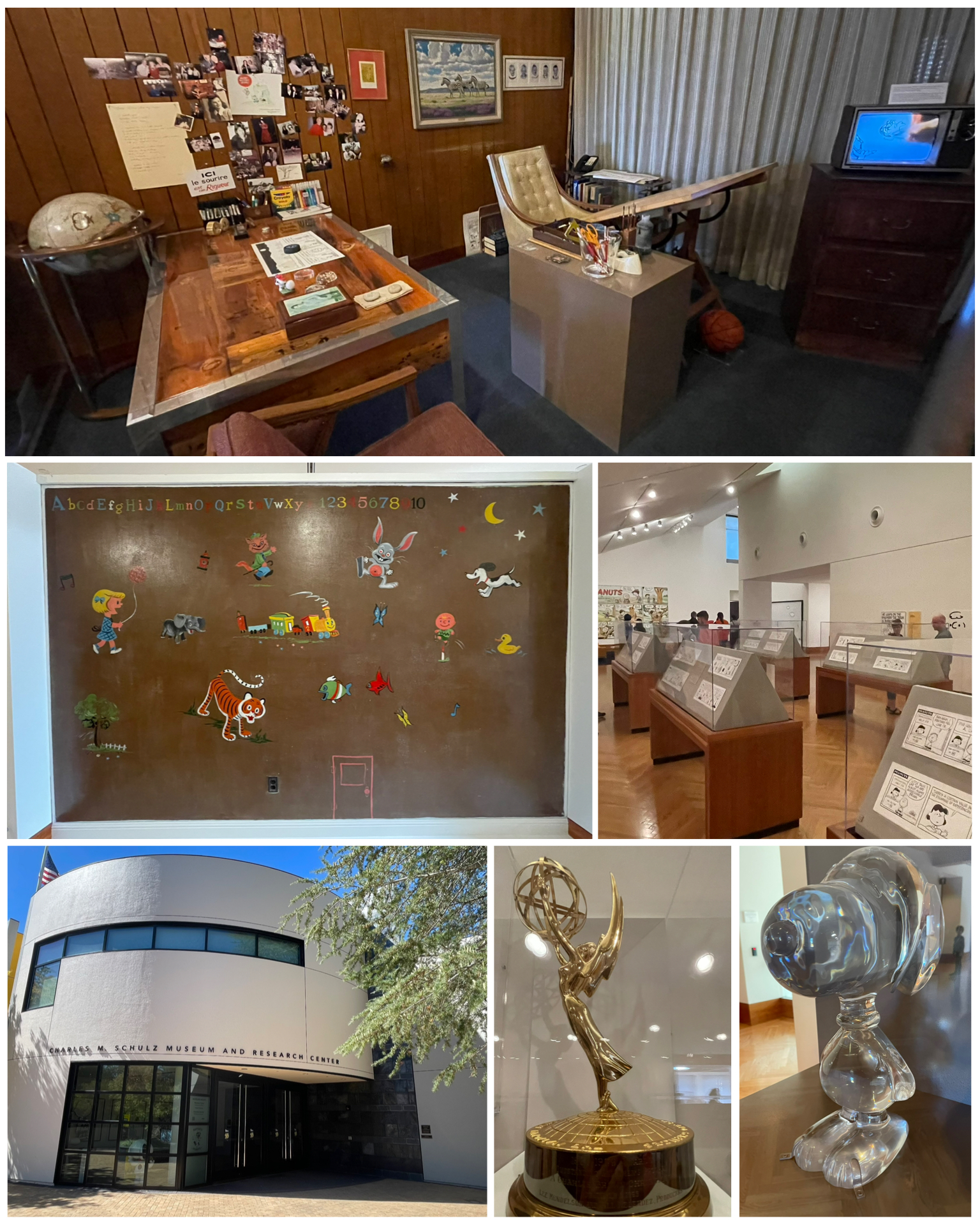 To continue with the Charles M. Schulz theme, I had to pay a visit to the Charles M. Schulz museum here in town. Schulz first moved to California in 1958 first settling down in Sebastopol. There, he built his first studio where he did most of his work. Sadly, that studio burned down in 1966. In 1969, he relocated to Santa Rosa where he lived and worked until his death in 2000. The museum featured lots of history and personal artifacts from his life. This included the recreation of his personal office and studio that would have been found in his Santa Rosa house (at left, top). Also, during his brief stay in Colorado Springs, he painted a mural on his daughter Meredith’s bedroom wall that featured images of Patty with a balloon, Charlie Brown jumping over a candlestick, and Snoopy playing on all fours. In 2001, this wall was removed and donated from that home and relocated here to become part of the museum (at left, center left). The museum also featured lots of his hand drawn cartoons and early drafts of his various Sunday paper comic strip. Also, we can see his George Foster Peabody Broadcasting Award (at left, center bottom) that he received for the 1965 classic “A Charlie Brown Christmas”. Also, this lead crystal statue of Snoopy (at left, bottom
 right) was fabricated by the French company Bacarat, and before arriving at the museum had travelled through six Japanese venues from 2000 through 2001 for the traveling exhibition “Snoopy in Museum”. It was really cool!
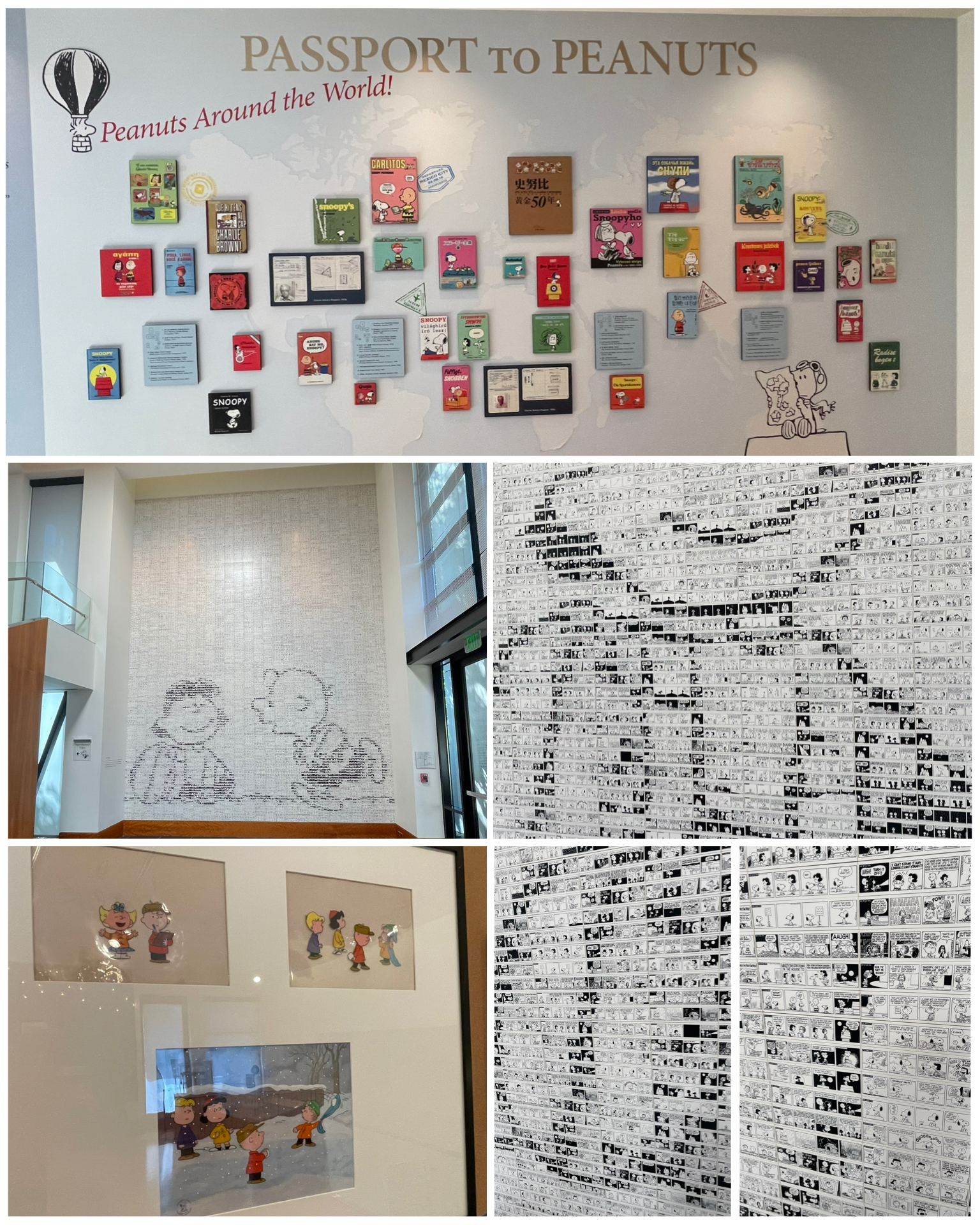
There was lots of other Peanuts things to see here in the museum. This included a collection of Peanuts books that had been written in several foreign languages (at right, top) including Greek, Portuguese, Latin, Polish, Japanese, French, Dutch, Spanish, and Filipino to name a few. Quite the collection. There were also animation cells from the many cartoon feature shows that were produced (at right, bottom left). Lastly, what was particularly cool was this full wall picture of the famous scene where Lucy holds a football for Charlie Brown to run up to and kick. From afar, it looks like just a regular picture. But, upon closer inspection, the entire picture was actually made up of various pieces of actual comic strips put together in a way that would then produce this larger pixilated image. Really well done!
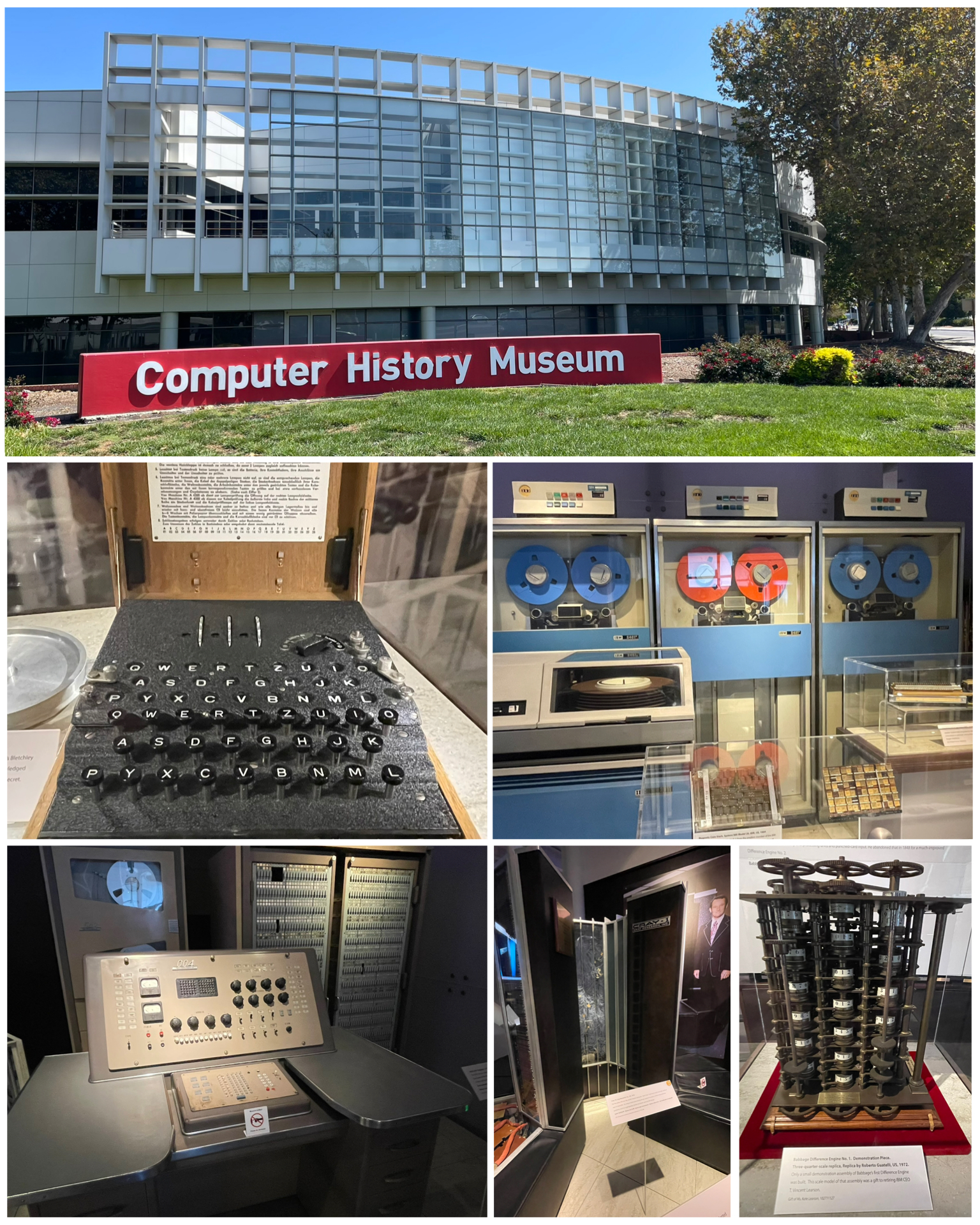 Next comes a place that has been on my bucket list for decades. Most people know that I’m a die-hard geek – having spent the majority of my career in the IT industry. I did everything from the software side as a computer programmer and software engineer, to the hardware side running a 100+ person IT support organization and also having designed, built, and managed several data centers. In the early 1990’s I had the pleasure of visiting the Boston Computer Museum. At the time, that too had always been on my must see list. It was a great visit, and I had always planned to visit again sometime in the future. Sadly, the museum closed in 1999, and all of its contents were moved to a new home that has evolved to the Computer History Museum, located in downtown Mountain View, CA. Over the subsequent decades, the museum has expanded, and today is home to the largest international collection of computing artifacts in the world. So, I was like the literal kid in a candy store. So much to see and enjoy – much of which has such historical significance in the computing industry. Of course they would have an authentic Enigma (at left, center left) a German cipher machine used during WWII. I’ve seen others before, though they were replicas. This was my first time seeing a real one. Amazing! If you are interested, a terrific video explaining how this cipher machine actually works can be found HERE. Another relic from the past was this Charles Babbage Difference Engine (at left, bottom right) – though this time, it was a replica. But, a very nicely done version. Then there were the complete computer centers with their consoles, coputing systems, storage, etc, some historical while others were reminiscent of ones I used to run and manage. I was also pleased to see a really nice Cray-1 system (at left, bottom center) developed by Seymour Cray. These early evolution supercomputers were developed in the mid 1970s, with the first Cray-1 being delivered to the Los Alamos National Laboratory. It was a unique system, round in the shape of the letter C, with its bench seating along the outside that actually covered up the power supplies and cooling systems. Today, the phone you hold in your hand has hundreds of times more computing power as did this original Cray-1 supercomputer. Now that’s progress!
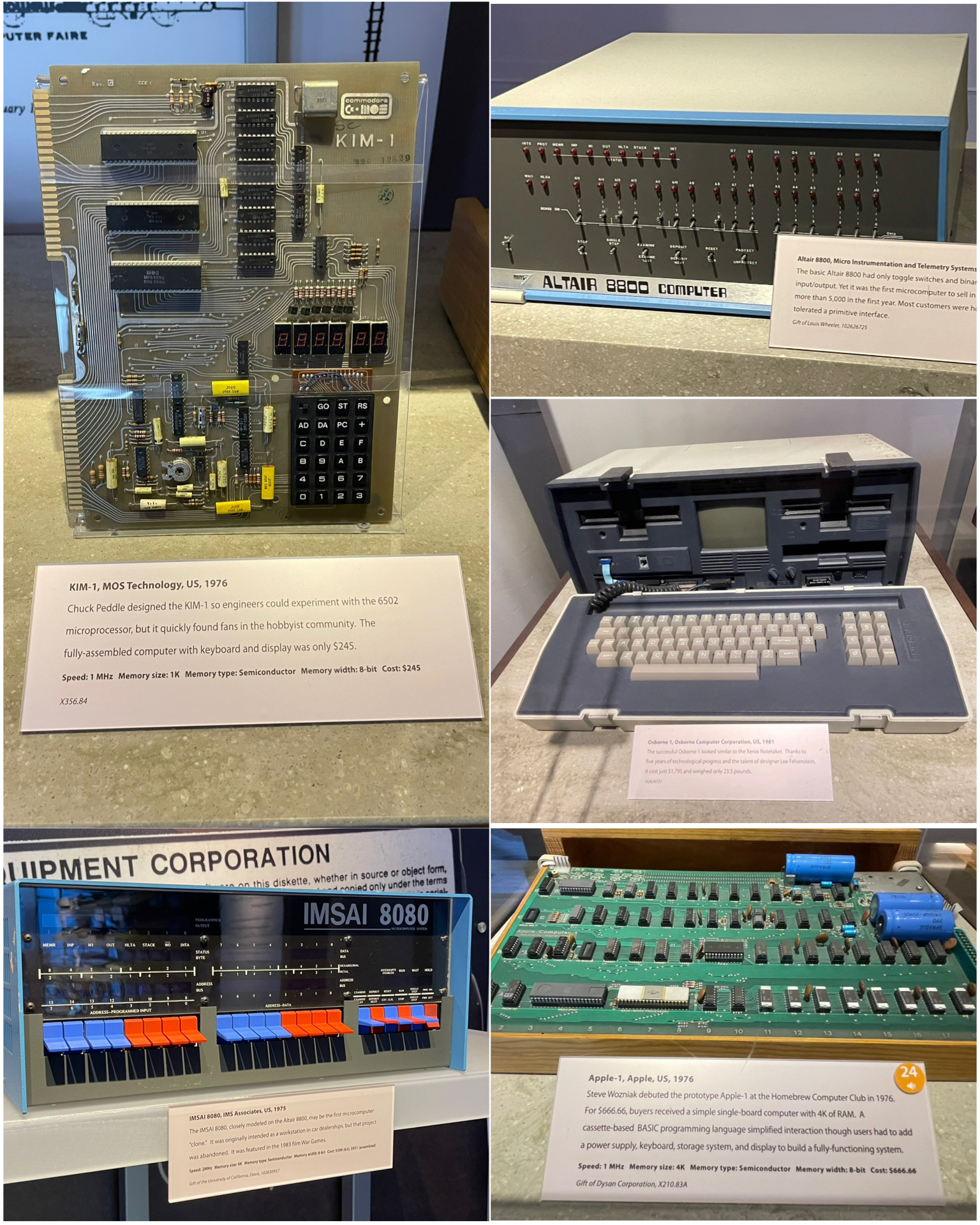 Then it was the collection of early model home/hobbyist systems that brought back so many memories. I had a mental checklist as I was walking around the museum that had systems that I was very familiar with, some of which were ones that I once owned, that I fully expected to see here in the museum. One in particular on that this was a Kim-1 (at right, top left) which was actually a computer that I was introduced to by my former father-in-law Rick. Back in the day, we used to go to the Trenton Computer Festival each year, which included a giant flea market sale of sorts with all kinds of old and classic computers for sale. At one of these visits, we came across a Kim-1 which Rick immediately recognized as he at one time had owned one. He told me all about it and it was very interesting and I never forgot it. Also on my list of what I figured I’d see was an original Osborne 1 luggable computer (at right center right). I actually owned one of these at one point in my life, and had lots of fun with it. Then there were the classic 8080 systems by Altair and IMSAI that were immediately recognizable. And of course, I expected to see an original 1976 Steve Wozniak prototype Apple-1 board, and the museum did not dissapoint (at right, bottom right).
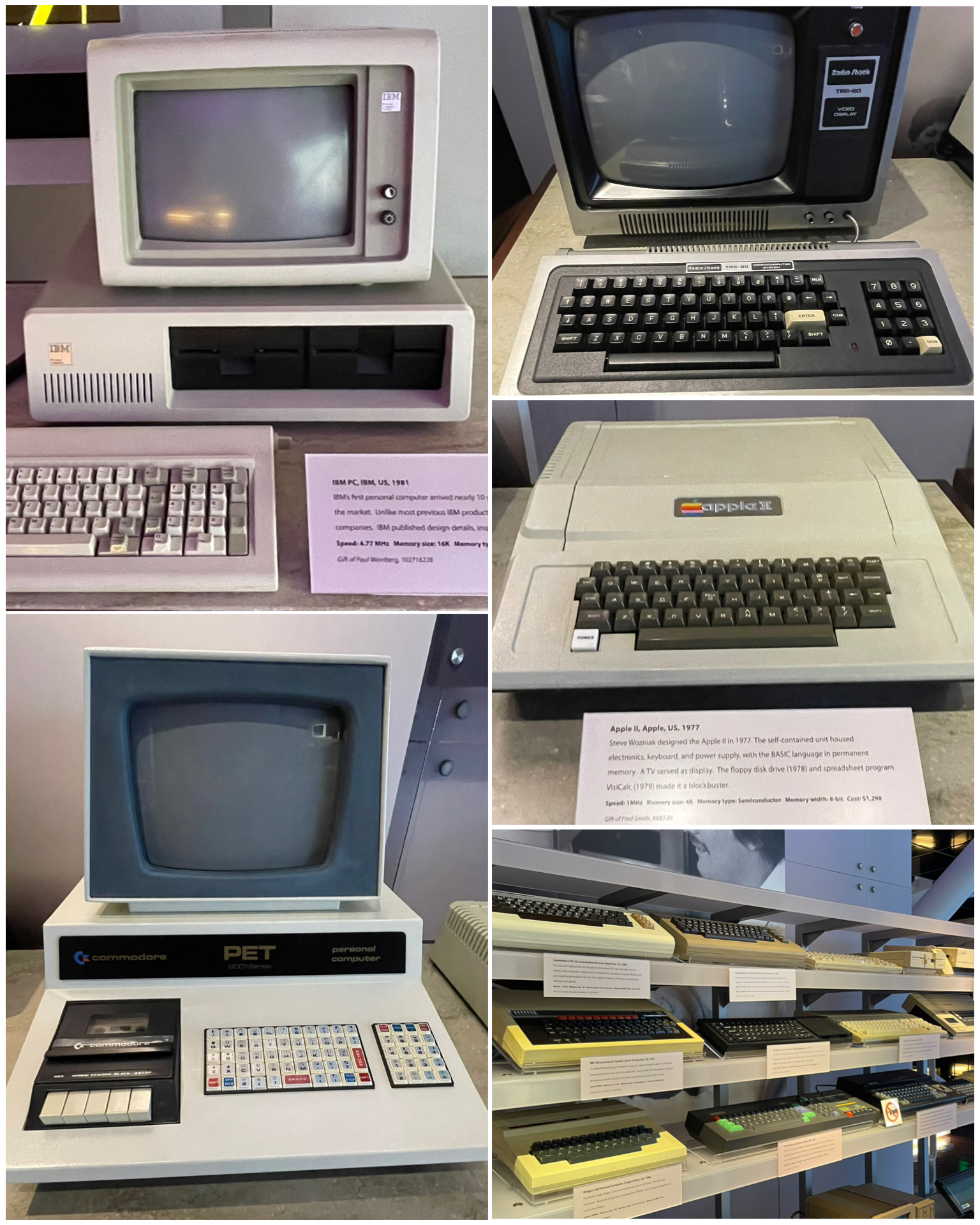 There was so much to see in this museum, I spent the better part of an entire day here. Even had lunch in their little cafe. As my tour continued, I ran across several other computers that I immediately recognized, and at one time had owned or at least played or worked with. This would include the original 1981 IBM 5150 Personal Computer (at left, top left) which pretty much was the founding father of personal computing. Its open architecture design which fostered hundreds of third-party add-ons, would also start the evolution of clones from dozens of companies. Systems more focused to the home or early education market included the Radio Shack TRS-80 (at left, top right), the Apple II (at left, center right), the Commodore PET (at left, bottom left), and a slew of other Commodore entries (VIC-20, C-64, C-128, etc) and other keyboard console models (at left, bottom right). This was such a trip down memory lane for me as I’ve easily spent tens of thousands of hours on these things over the years. Sure did bring back some wonderful memories.
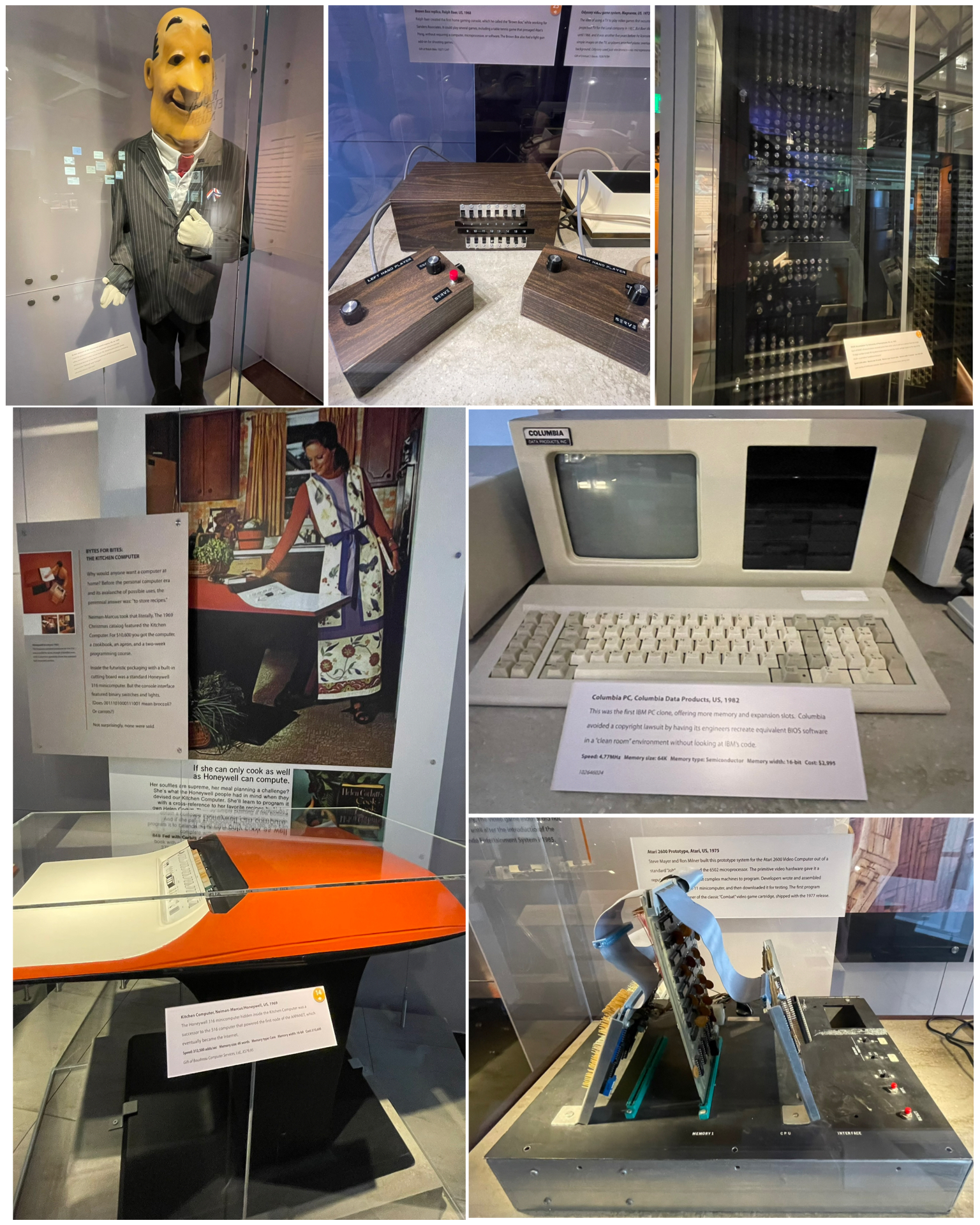 Then there was this category of things – some of which I’d never seen let alone heard of before, and a few others that were just too interesting and unique. First up was this full size character known as Jeeves (at right, top left) from the mid 1990s search engine of the same name – “Ask Jeeves”. It was later rebranded simply as ask(dot)com in 2006, only to be shut down in 2010. I recognized the character immediately, but never knew there was a life size version of him. Next, my brother Don might recognize this one from 1968 simply called the Brown Box (at right, center top). It was a gaming console developed by engineer Ralph Baer while he worked for Sanders Associates in Nashua, NH. It was later licensed to Magnavox for consumer production and became the popular game console named “Odyssey”. Now that’s a bit of history I was not aware of. Nice to see my hometown of Nashua represented here in the museum. Another interesting sort of hometown piece I got to see was this luggable/portable computer from Columbia Data Products (at right, center right). This one also brings back some hometown memories as Columbia Data was headquartered in Columbia, MD where I once lived. While I never owned one of these computers, I did have the pleasure of attending the auction of all their remaining products when the hardware portion of the company went bust in 1986. Sadly, the auction was also a bust as pretty much everything sold for way more than it was worth. Oh well. Then there was this thing (at right, bottom left) marketed as the Kitchen Computer. For a mere $10,600, you got a Honeywell minicomputer wrapped in a spacey looking giant kitchen appliance thing, complete with built-in cutting board. With it came a cookbook, apron, and a two-week programming course. It was listed in the 1969 Neiman-Marcus Christmas catalog and was to be recipe central for the busy housewife. Shockingly, none of them were actually sold. Anyone who studied computer science would likely know that the ENIAC (Electronic Numerical Integrator and Computer) was the very first programmable, electronic, general-purpose digital computer from 1945. It spent most of its operational life at Aberdeen Proving Grounds in Maryland used by the U.S. Army to calculate complex ballistics tables. This thing was a beast! It contained 18,000 vacuum tubes, 7,200 crystal diodes, 6,000 relays, 70,000 resistors, 10,000 capacitors, and approximately 5,000,000 hand-soldered joints. It weighed more than 27 tons, was roughly 10 ft tall, 3 ft deep, and 100 ft long, and occupied 300 sq ft of space. A piece of ENIAC resided here at the museum (at right, top right). Last up in this portion of the journey was the actual prototype for the Atari 2600 gaming console from 1975 (at right, bottom right). Now that looks nothing like the Atari 2600 that I remember. Needless to say, I had an amazing time visiting this museum, and took many, many pictures – all of which you can see with the link at the bottom of the blog. I’m sure glad I was able to finally get this visit checked off my bucket list. and it was such an amazing and wonderful visit. Sure brought out the geek in me!
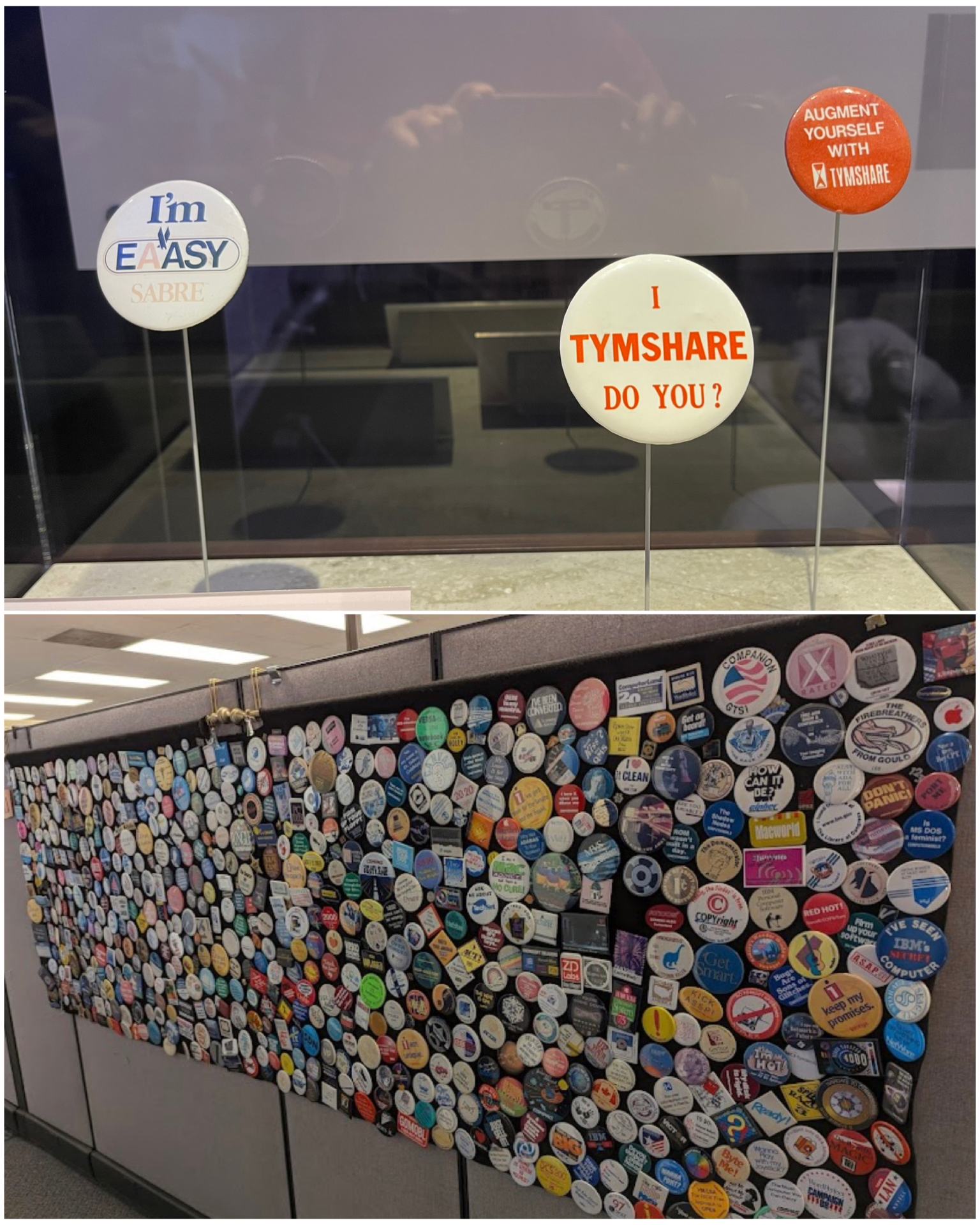 There was one other very important element of the museum that I was wanting to check out. Back in the day when I was working in the IT field, I had the pleasure of attending lots of computer shows – mostly in the Washington, DC area. During those show visits, it was common to come back home with some computer swag. Often times that was in the form of a pin-back button promoting something computer related. After attending these shows for many years, I discovered that I had amassed lots of these buttons that were at the time sitting in the bottom of a desk drawer. I decided they deserved to be displayed, so I started putting them on squares of felt held up with a small curtain rod. Well, over the many years that followed, one square got filled so I had to get another – then another. The collection grew quite large, had lots of historical significance, and took up an entire wall in my work office. When I had visited the Boston Computer Museum, I noticed they did not have many computer related buttons, so I had always planned to donate my collection to them when I eventually retired. That museum closed so that never happened. And as it turns out, even the present day Computer History Museum has few buttons in their massive collection of things computer related (at left, top). There was however another computer museum actually local to me in Maryland that was ran by Bob Roswell who was co-founder of the computer business called System Source. Bob had a love of computer history and has over the years built up quite an extensive collection of his own, and he runs a museum inside his System Source office. So, when I did actually retire, all my IT related items, including my button collection, were donated to him. Today, my button collection proudly resides in that museum in Maryland (at left, bottom)
Final Thoughts
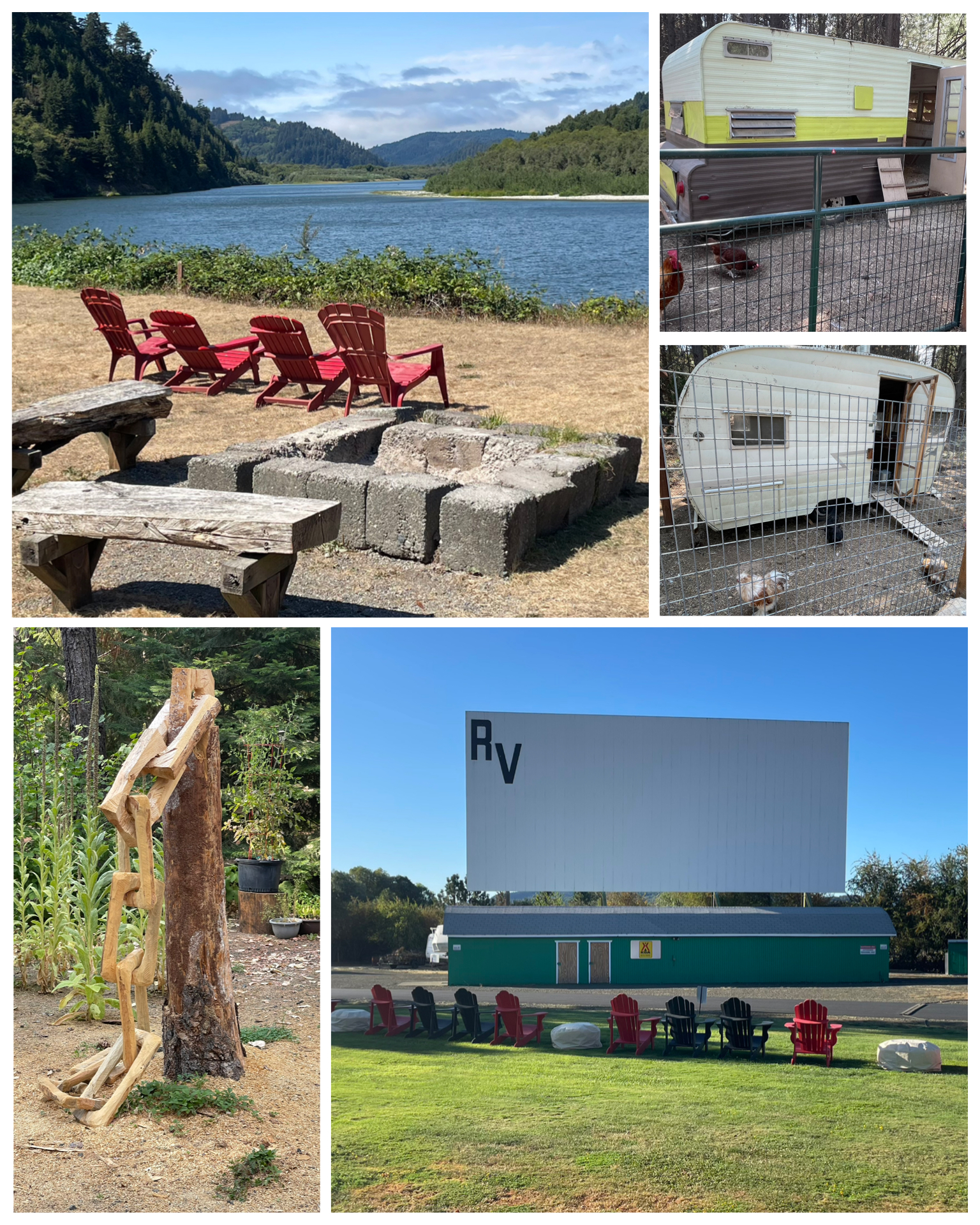 Well, I figured this would be a good stopping point for this edition. I’ve got lots more from California and beyond to share, but that will have to be in a future edition. I did, however, want to share a few interesting pictures from a few most notable campgrounds I’ve stayed in over the past couple of months. From my stay in Klamath, was this absolutely breathtaking view of the Klamath River and the mountains behind it. This was just a common sitting/campfire area within he campground. Truly amazing! My campground in Weed, CA had animals on the grounds – including these really cool chickens who lived in these RV-like hen houses (at right, top right). Pretty cool! Back in Sutherlin, OR, this campground had the best outdoor movie setup I’ve ever seen. Its screen was huge and rivaled that of an old drive-in movie theater. It was awesome! Lastly, at the campground where I stayed near Crater Lake was this very odd yet interesting tree carving (at right, bottom left). It would seem some talented artist with a chain saw cut up this tree but did it in a way to create these wooden chain links attached to each other. I have no idea how this was done, but it sure was something special! Anyway, just thought I’d share these interesting one-off pictures. Lots more to come as I wrap up my southerly route, and begin heading towards the east back to the home base for the winter. So, till then, be well and safe travels.
I only show a sampling of my adventure pictures here in the blog, and do so mostly in collage format for brevity and ease of reading. If you want to view an album containing individual full fidelity and hi-res images of all my travel pictures related to this specific blog, click the image below. Enjoy!
I’m so glad you have the Starlink dish!! Would be awful if you couldn’t set your Fantasy lineup.😉😜🏈
I really enjoyed this blog, especially the gorgeous scenery, the massive trees…wow. And I especially enjoyed your video of you souvenir hunting for the black rocks. Other than your video, doesn’t look like there were any witnesses 😊😂
I’m far from a computer geek, but I thoroughly enjoyed reading about and seeing the pictures from the Computer History Museum. Even I recognized some of the hardware!
Safe travels as you head back home for the winter. We’ll have to make a date for lunch when you get back!
Yea, Starlink sure did save the day! And you are correct, the video was the only witness to the lava rock heist. I don’t think I even passed another car along the entire road. It was definitely out in the boonies. Lunch sounds good. See ya soon.
Another great blog.. Of all the places you visited I have only been to Redwoods National Park and those trees are huge! The computer museum was also interesting to me as I also owned the Commodore models like Vic-20 and Commodore 64. Those are the machines where I started doing my genealogy with a computer There was a guy in Mass that wrote a program for the Commodore 64 called Family History which was the first program that I used.
Yea, certainly lots to see in northern CA. I didn’t know that you also went up the Commodore line too. But it makes sense for your genealogy work. Those were great systems back in the day.
Since you were in the Reno/Tahoe area, did you go to Truckee??? or had you been there before?? I recall being in that area on one of our trips because we saw Donner Pass.
Loved your pics! Especially the early computers and the Peanuts museum.
Sue
Hi Sue. I did indeed attempt to visit Truckee. However, it was a beautiful sunny weekend day and the place was packed! I wanted to see a couple of Roadside items there, but alas I had no place to park my big boy truck due to the crowds. So I had to pass it up. Looked to be a really neat town though.
Interesting blog. I know you got kicked out of Napa, but it seems you also skipped any wine tasting vineyards. I used to live in Mountain View when i lived in CA, I think one of my work mates donated some old computers to that museum. I am sure you are glad to be out of CA by now and have your fuel costs drop dramatically. Enjoy your journey east back to FL, see you after you get here,
Yea, there was so much else to see in the area I ended up not visiting any of the wineries. But I did purchase and enjoy lots of local varieties. See ya soon.