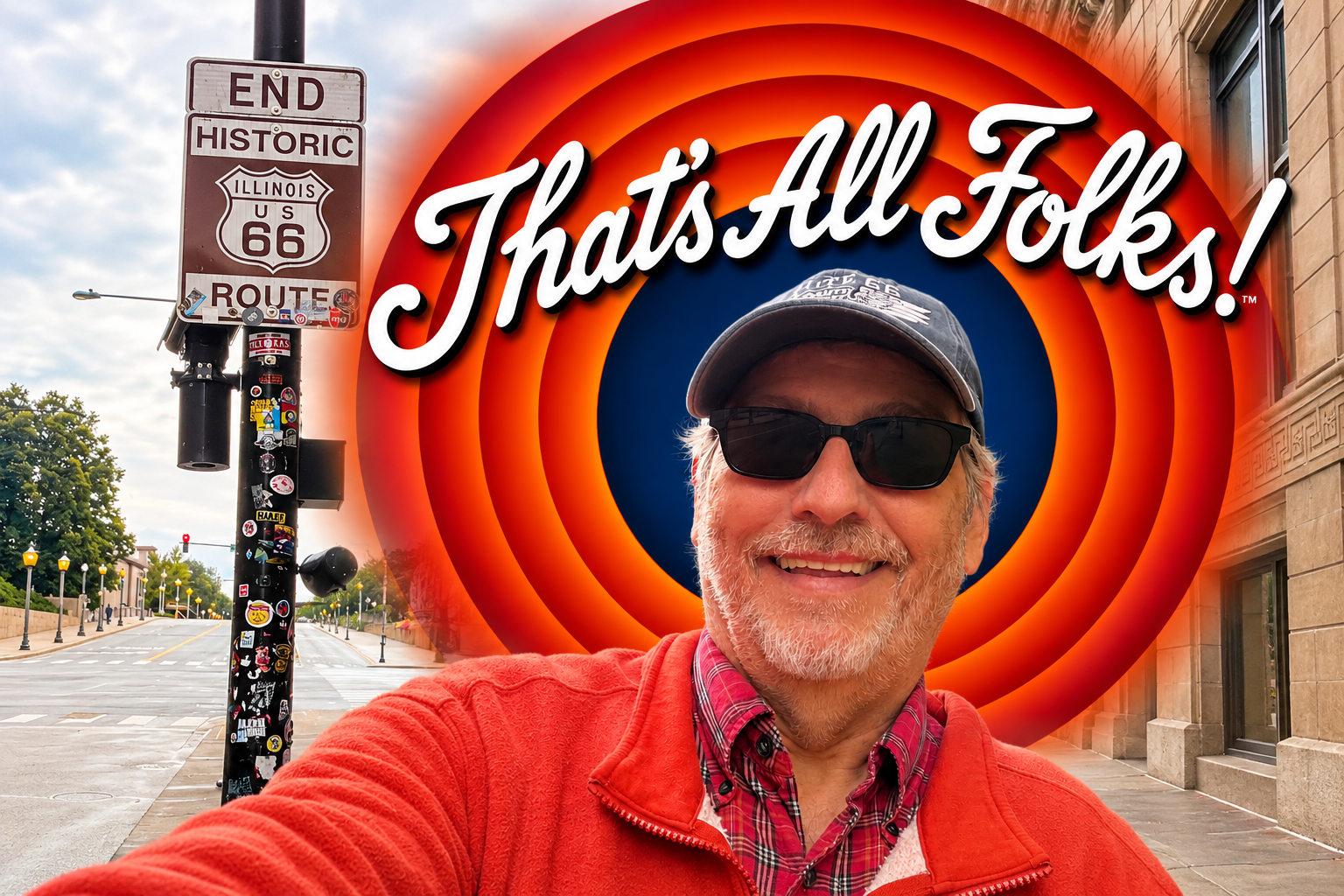
Well, that’s a wrap! This blog will be the final installment of my amazing Rt 66 trip. With three stops remaining, I’m back on schedule and will spend one week at each of the next three planned Rt 66 stops. I’ll wrap up my Missouri sightseeing, then venture into my 8th and final Rt 66 state – Illinois. So let’s get into it.
Granite City, IL
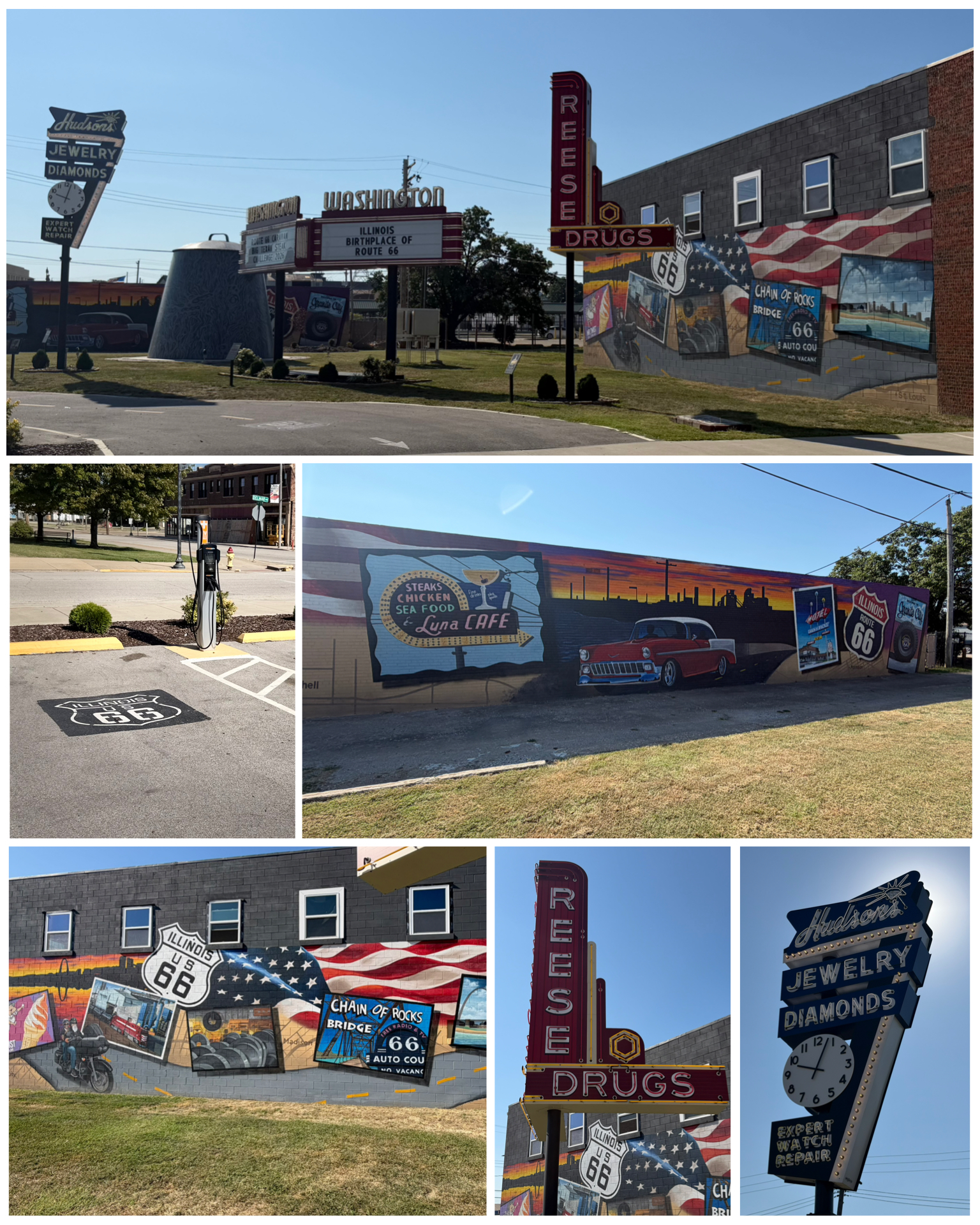 My first stop in this leg of the journey takes me to the town northeast of St. Louis – Granite City. From here I’ll explore east and west along Rt 66, taking in all there is to see. For my first day of playing tourist, I will start here in Granite City, then work my way to the west into St. Louis and beyond. First up in Granite City is a visit to It’s Electric Park. The town acquired and restored three old neon signs – one a theater marquee, and the other two from a jeweler and drug store, and in 2024 created a mini park in what was a former vacant lot (at left, top). Several Rt 66-themed murals adorn adjacent walls, while miniature versions of nearby Rt 66 attractions complete the park’s landscape. There’s even a Rt 66-themed EV charging area. Very cool!
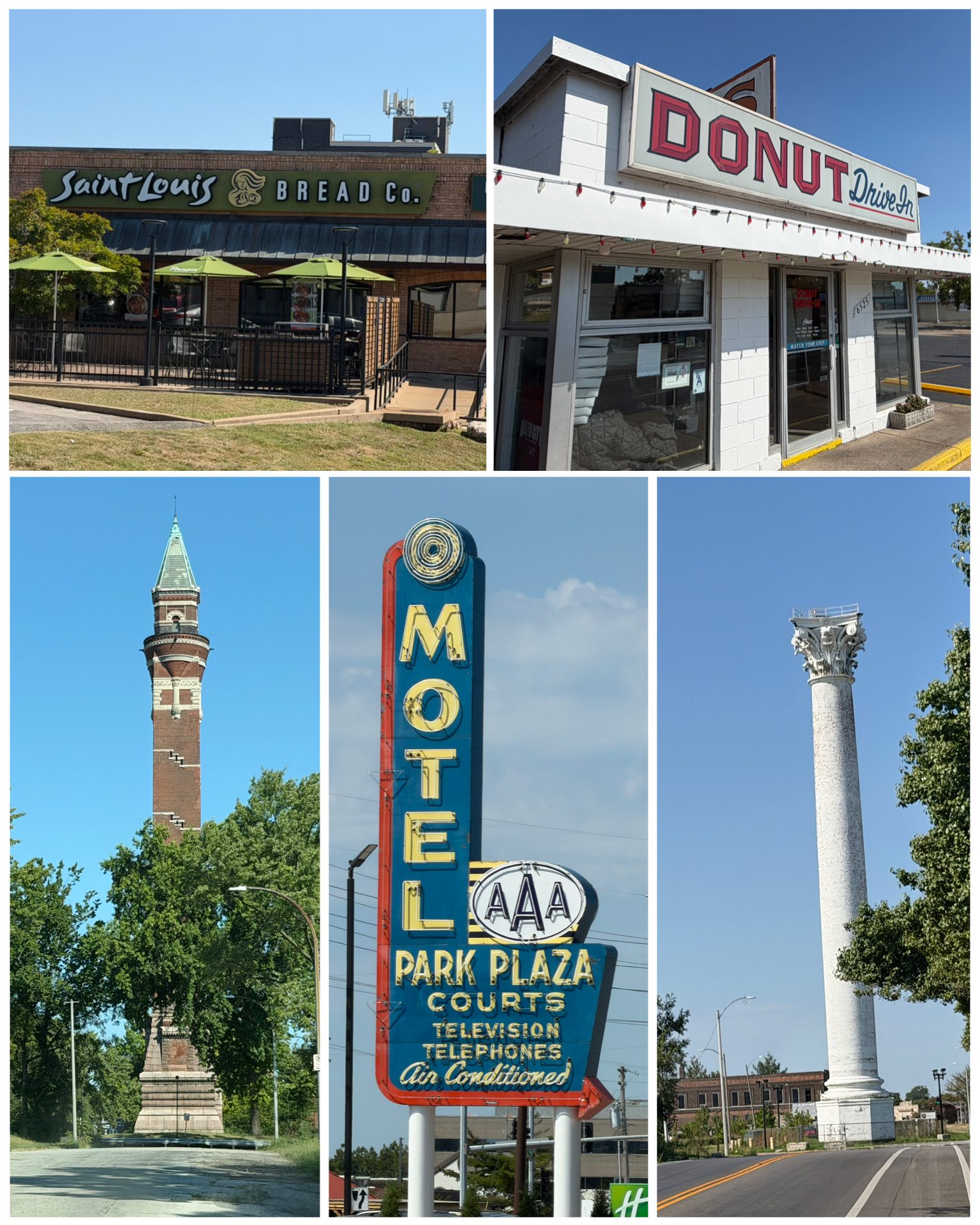 I crossed the Mississippi River into the College Hill neighborhood of St. Louis where I would get to see these two amazing water towers (at right, bottom left and right). Once numbering more than 500 across the country, these structures have become quite rare. The two here in St. Louis are among only seven remaining in the United States. They are prime examples of late 19th-century technology used to stabilize the city’s water pressure. The red tower was built in 1886 and is basically a large vertical pipe connected to the city’s water main. When the pressure was too high, the water would rise up the 194-foot pipe, and similarly, when the pressure lowered, so too would the water level in the pipe – thus keeping the pressure equalized. But instead of just having a pipe sticking up in the air, it was common to build a beautiful structure on the outside that could be enjoyed by all the residents. This particular tower was taken out of service about a century ago, and despite several possibilities of being torn down, it remains a historic centerpiece. Just a few blocks away, at 154 feet and built in the 1870s, “Old White” water tower, as it has become known, is fashioned like a Roman column – and reportedly the largest such column in the world. It served its original purpose for over 40 years, and in 1912, the water was removed and a beacon was installed on the top to guide early pilots to the nearby airport. Next it was time for a breakfast break, so what better place to stop than the Donut Drive-In. This Rt 66 venue has been serving what they call the best donuts on 66 going all the way back to 1953. It’s a small place at only 600 square feet, and they continue to make the donuts the old-fashioned way. 30 varieties of donuts are made daily, along with tarts, fritters, twists, and cinnamon rolls. I got myself a couple donuts, and in fact, they were absolutely delicious. This would be a very dangerous place to be in my hometown as I would likely frequent it all too often. While not Rt 66 related, I happened to spot this place called the Saint Louis Bread Co (at right, top left). But its colors and fonts and center logo looked all too familiar. Isn’t this Panera Bread? Well, it turns out that Panera Bread is headquartered here in St. Louis, and here in town, unlike all other locations around the world, all the stores are called Saint Louis Bread and not Panera Bread. I found that kinda interesting! Last up I visited the beautiful neon sign showcasing the Park Plaza Courts. This 1940s chain of motels was strategically placed a day’s drive apart all along Rt 66. The St. Louis Park Plaza motel was bulldozed in 1964, and its sign was apparently sold only to have been sitting in a barn for the following nearly 60 years. It was eventually uncovered and donated to the local historical society in 2020 who in turn restored and relit it in its original location – now occupied by a Holiday Inn. It was nice of that Holiday Inn to pay for its installation, maintenance, and ongoing electricity – despite it likely confusing would-be travelers staying at their branded hotel.
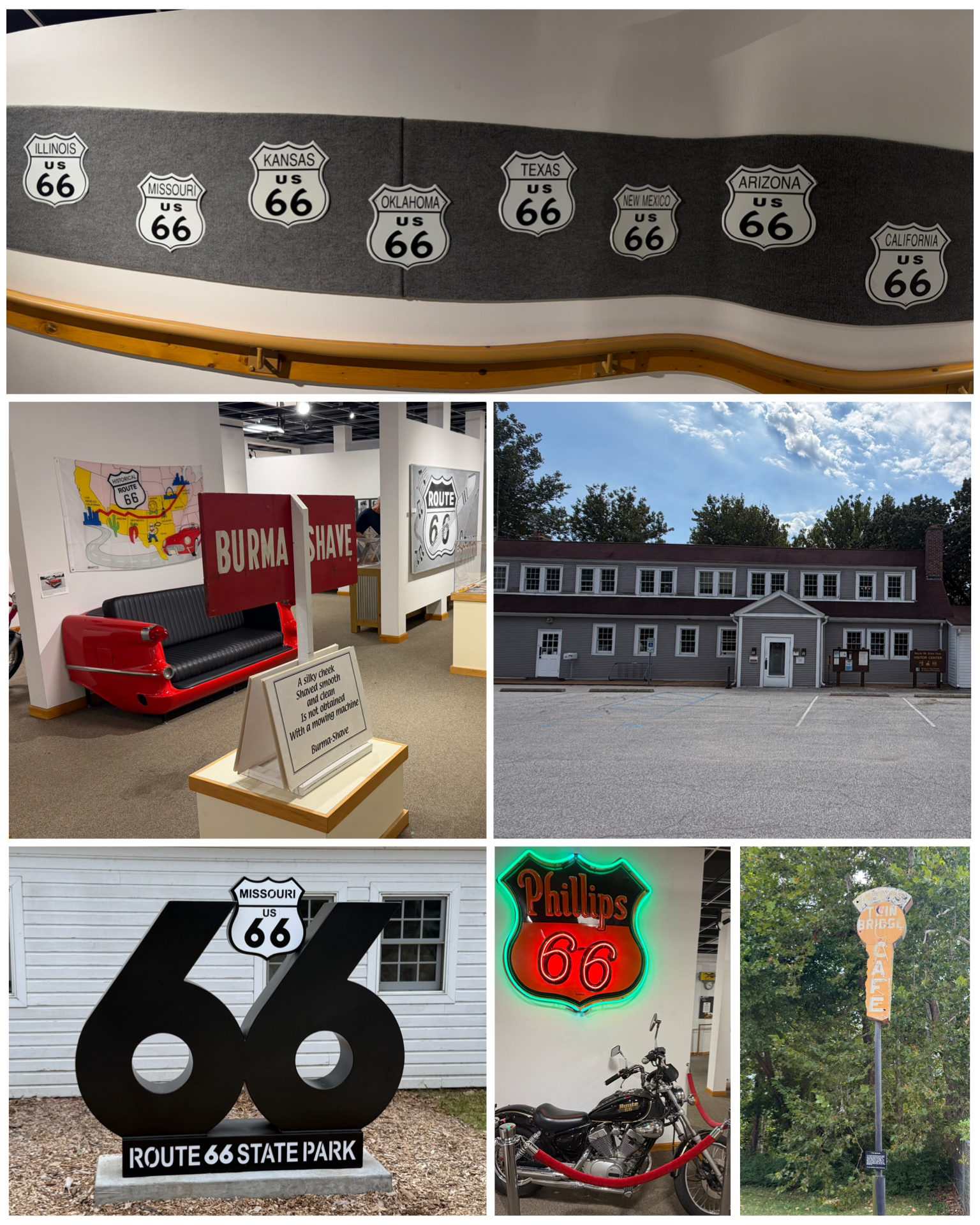 You may have figured out by now that I’m not really a fan of big cities. St. Louis was big, crowded, had lots of traffic, and had little parking areas for my monster truck. So, I saw the handful of most interesting things there were to see, then quickly moved past it to the west to visit more Rt 66 attractions without all the big city headaches. In Eureka, MO, sits the Bridgehead Inn – a 1935 roadhouse that sat on the original Rt 66 and has since been converted into a visitor center to the Route 66 State Park. The park offers hiking and biking trails, and several picnic areas nestled among the trees. A portion of the original Rt 66 runs through the park, including the historic bridge that crosses the Meramec River that once carried many a Rt 66 traveler. The visitor center also included a museum that features lots of Rt 66 artifacts and memorabilia. One of the artifacts I found most interesting was this Route 66 branded motorcycle (at left, bottom center). Apparently, from 1988 to 1990, Yamaha ran a limited production version of its Virago 250 as the Route 66 bike. Despite it being an entry-level cruising bike, it is popular among Rt 66 collectors. Interestingly, this is the first one I’ve ever seen! The museum also featured the history of the toxic town known as Times Beach. The town was found to be contaminated with dioxin which ultimately caused everyone to move and thus leave the town abandoned. It was eventually bulldozed and cleaned up to later become what is now the Route 66 State Park.
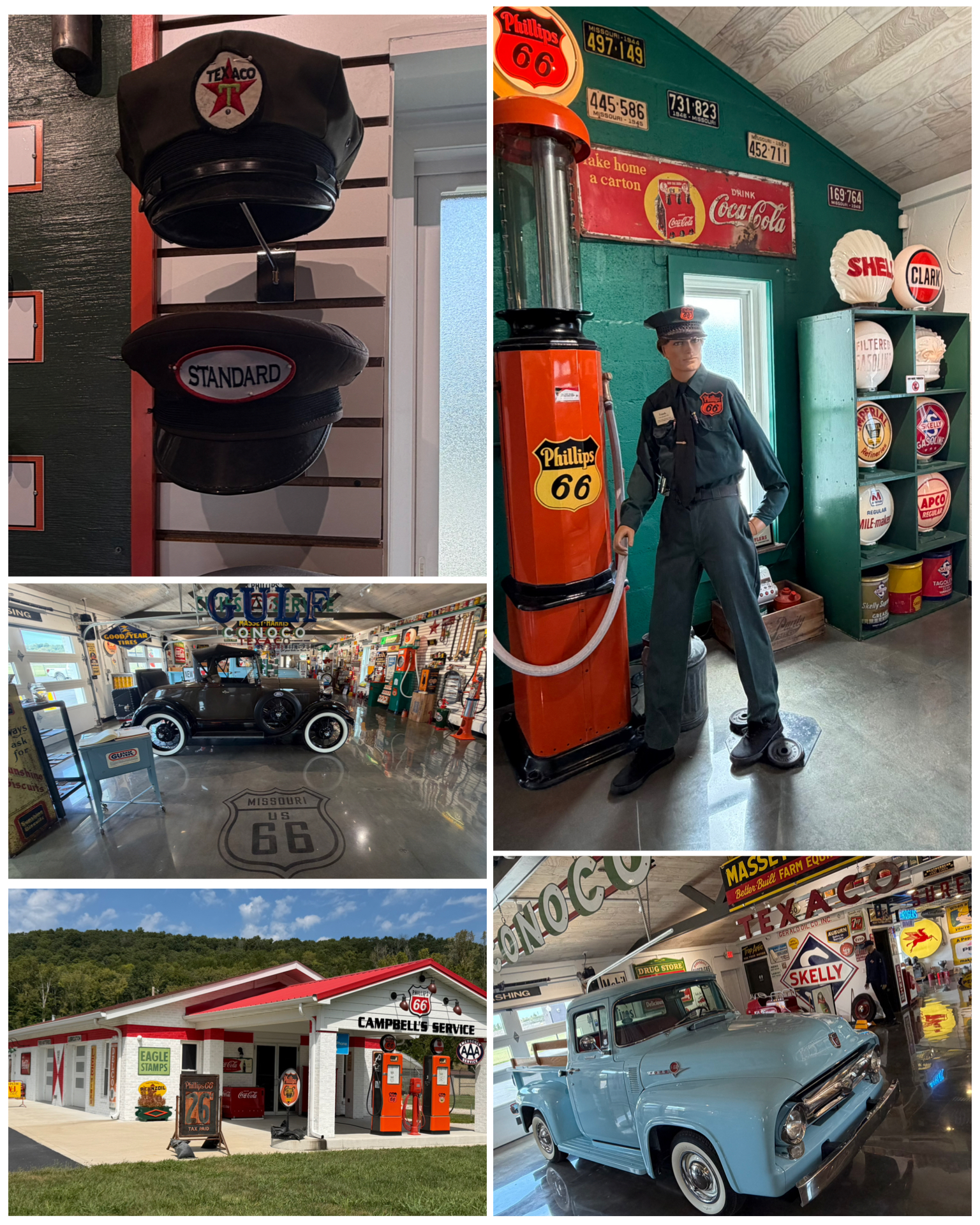 I traveled further west to Pacific, MO with a visit to Campbell’s Service Museum. And what a place it was! Larry West, owner of a local contracting business, learned that a small church facing Rt 66 had gone up for sale after its congregation had outgrown the building. Larry was a collector of old gas station memorabilia, and had recently purchased the private gas station memorabilia collection of Duane Campbell. Duane’s uncle worked for Phillips 66 back in the 30s and 40s, and as a kid, Duane spent lots of time hanging out with him and riding in his Phillips 66 truck. He grew up to love the business and all things gas station-related. As an adult, he began collecting and restoring, and over the decades, had amassed quite a large collection. But as years passed, it was time to find the collection a new home. When Larry offered to purchase the collection and set up a dedicated building right on Rt 66 in which to display it, it was an easy decision to sell. So Larry took his construction background and reengineered the old church to look like a circa 1950s gas station. What an amazing transformation – you would never in a million years think that this had once been a church. So, the combined collection is proudly and prominently displayed here for all Rt 66 travelers to see and enjoy. A truly amazing place!
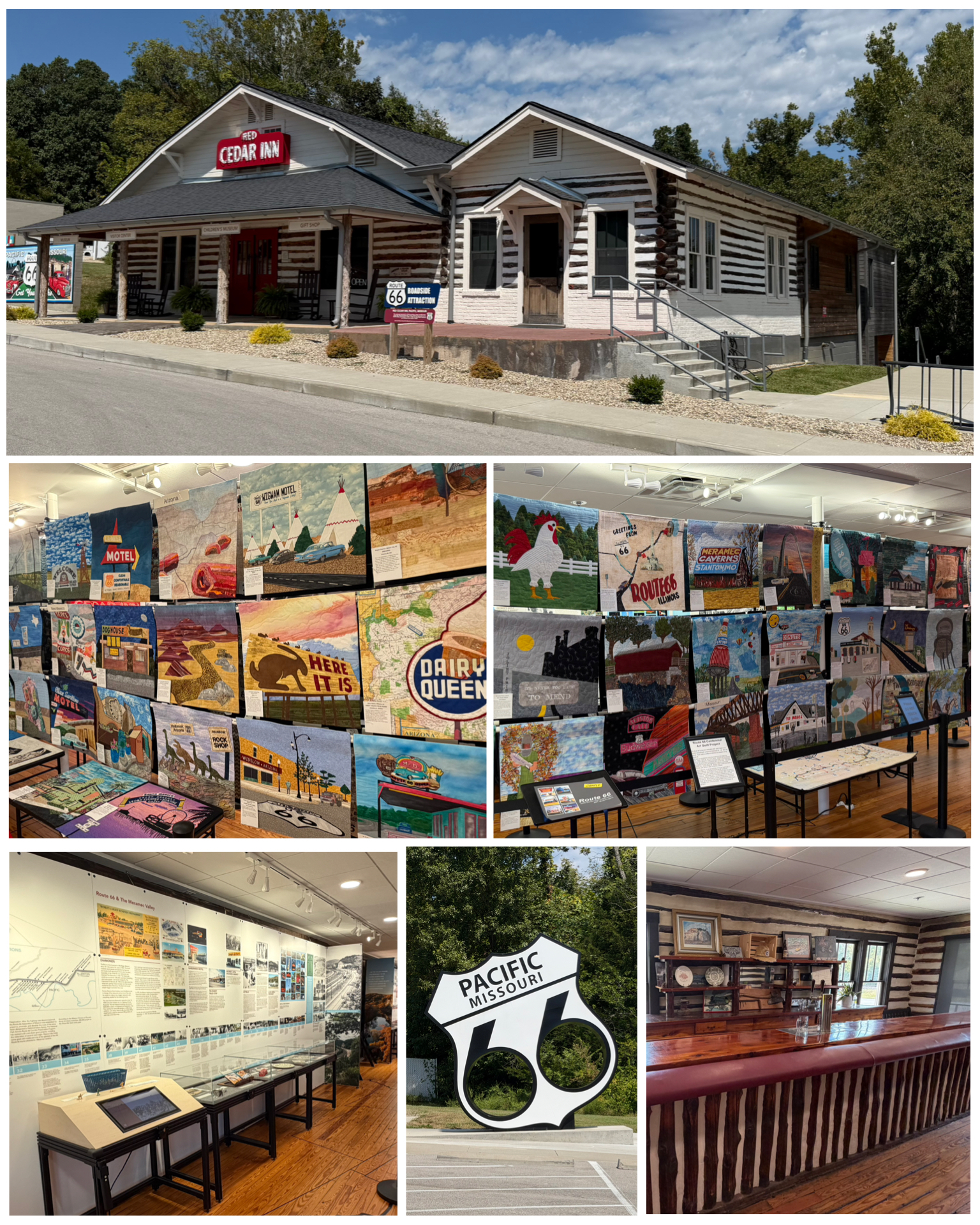 A bit further down Rt 66 but still in Pacific was the Red Cedar Inn Museum. Brothers James and Bill Smith were bootleggers back in the early 1930s. When Prohibition ended in 1933, they needed an outlet to legitimately sell their bootleg liquor. So, they built a restaurant and bar directly on Rt 66 called the Red Cedar Inn, and fashioned it out of cedar logs in a log home style with a bright red paint job to attract Mother Road travelers. It did well, operating from the mid-1930s through 1972 when it closed. It reopened in 1987, then closed again in 2005 – this time for good. The city of Pacific purchased the building in 2017 and in 2023 reopened it as a visitor center and Red Cedar Inn Museum. The museum’s exhibits detail Rt 66 history, local Pacific area history, and the history of the Red Cedar Inn, including the fully restored 1930s bar. Also by chance, the museum was featuring a limited-run exhibition featuring quilts of Rt 66. The exhibit features 66 unique 24″ x 24″ art quilts, each depicting a beloved stop along the historic highway such as the Blue Whale, Wigwam Motel, downtown Winslow, the Dog House, and many, many more. I was extremely fortunate to have the opportunity to see this exhibit as it was only to be here from mid-July through mid-September. Definitely worth seeing!
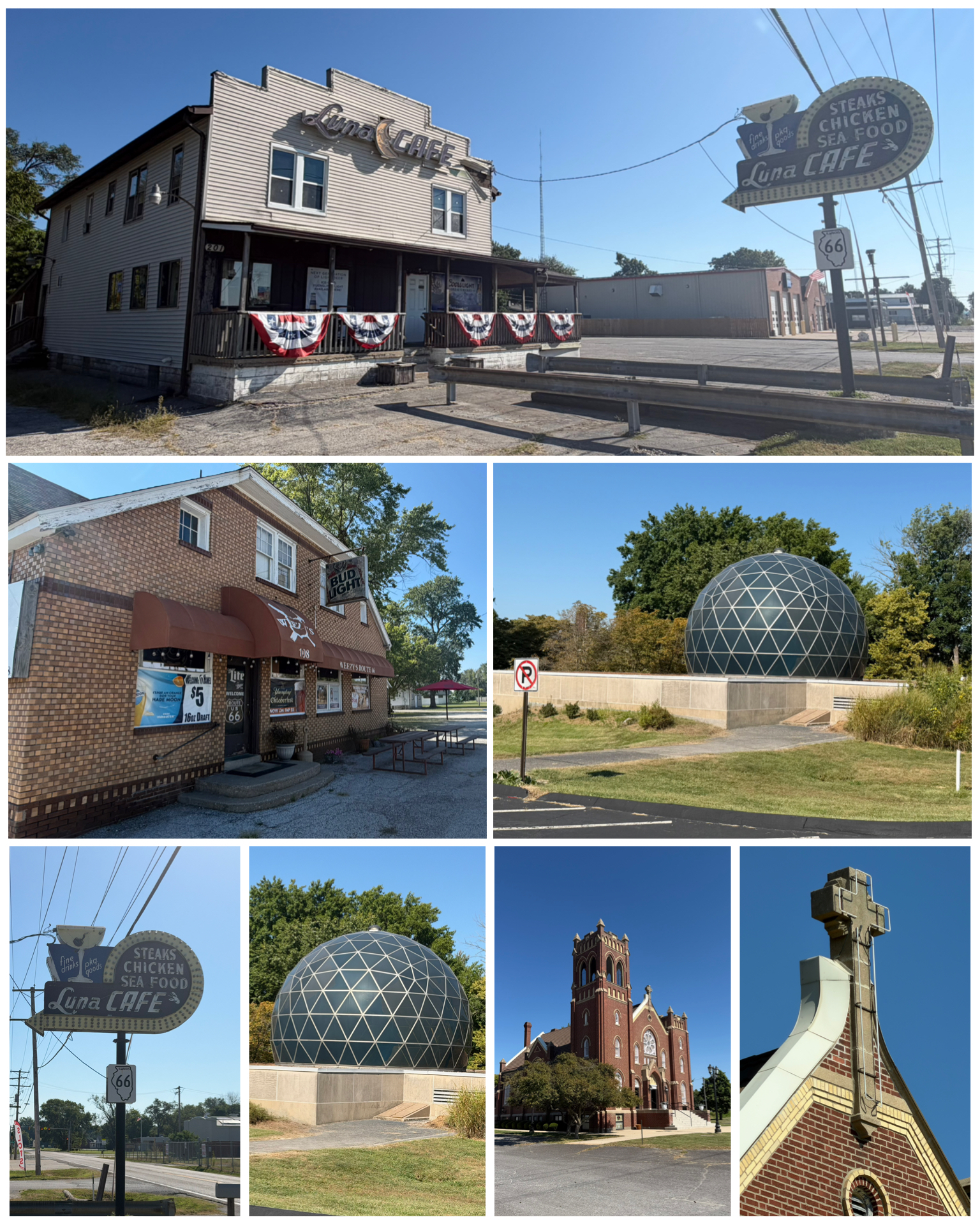 The next day, I worked my way to the east along Rt 66 just entering Illinois. First stop was in Mitchell, IL to see the Luna Cafe (at right, top and bottom left). Opened in 1924, local lore tells us that it was a favored hangout of Al “Scarface” Capone and other Midwest mobsters. It featured an illegal gambling den in the basement, and a brothel on the second floor – all things favored by early 20th century gangsters. It was even believed that when the red cherry in the neon sign’s neon Manhattan glass was lit, it meant the bordello upstairs was open. Today it’s a local hangout and a Rt 66 traveler stop and photo op point. As I continued east along Rt 66, I reached Edwardsville, IL and the Geoscope (at right, center right and bottom left center). Reportedly the only one in the world, the Geoscope was designed and built by R. Buckminster Fuller in 1971 as a nondenominational religious center. The dome’s 40-foot-wide translucent glass surface is painted with oceans and the outlines of continents, and when looking straight up at its apex, you are looking at where you are in the world. Pretty cool! Next comes Weezy’s – a roadhouse restaurant that has been in operation since 1937. It started out life as Tourist Haven, opened by George Cassens who owned a fleet of trucks, and opened the restaurant next to his truck terminal to feed his hungry drivers. He also hoped Rt 66 travelers might stop, and stop they did, helping keep the place running for decades right up to today. With all the neon gracing so many Rt 66 venues, it was no wonder that St. Paul Lutheran Church would also get on the bandwagon. It was the Brunnworth family that in the mid 1940s donated the blue neon cross in memory of their son who was killed at the Battle of Anzio. The cross adorns the Rt 66-facing front facade of the church, and has given Saint Paul’s the nickname “The Church of the Neon Cross”. Certainly fitting for a church that sits right on Rt 66.
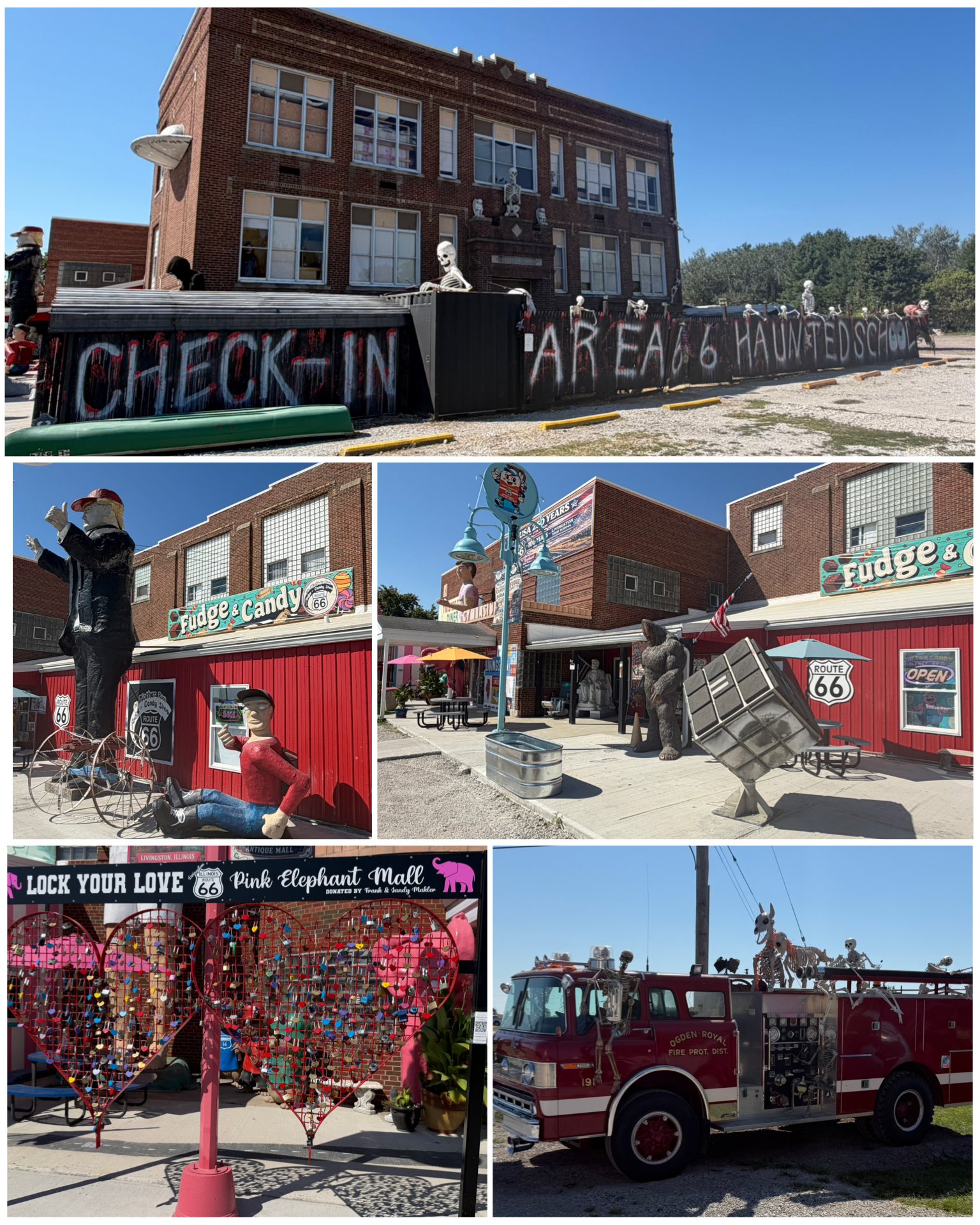 One of the things I had with me as I traveled Rt 66 was a Passport Book that featured places where you can get stamped as sort of a record book of your travels. Usually the places were well spread out along the route – different cities, different states. But one of the pages in the book featured a single stop that had no less than 4 places from which to get stamped. So of course I had to go there. Located in Livingston, IL is the Pink Elephant Mall – a combination ice cream joint, fudge factory, antique mall, and haunted house, that also features a number of giant outdoor Roadside oddities. Opened in 2005 in Livingston’s former high school, among its many oddities are a 24-foot-tall Beach Dude, and the mall’s namesake Pink Elephant – both of which briefly appeared in the 1990 horror/sci-fi flick “Flatliners”. More items were added over the years, and in 2017, a giant monolithic Donald Trump was unveiled. Fortunately, the young girl running the ice cream place not only had their stamp, but also the other 3 places as well. Great – that kept me from having to venture through this crazy place looking for them. This venue is a ways off of the actual Rt 66, but it would appear that their stamp collecting Rt 66 tourists are willing to take a bit of a detour to fill in their passport book. Nicely done marketing!
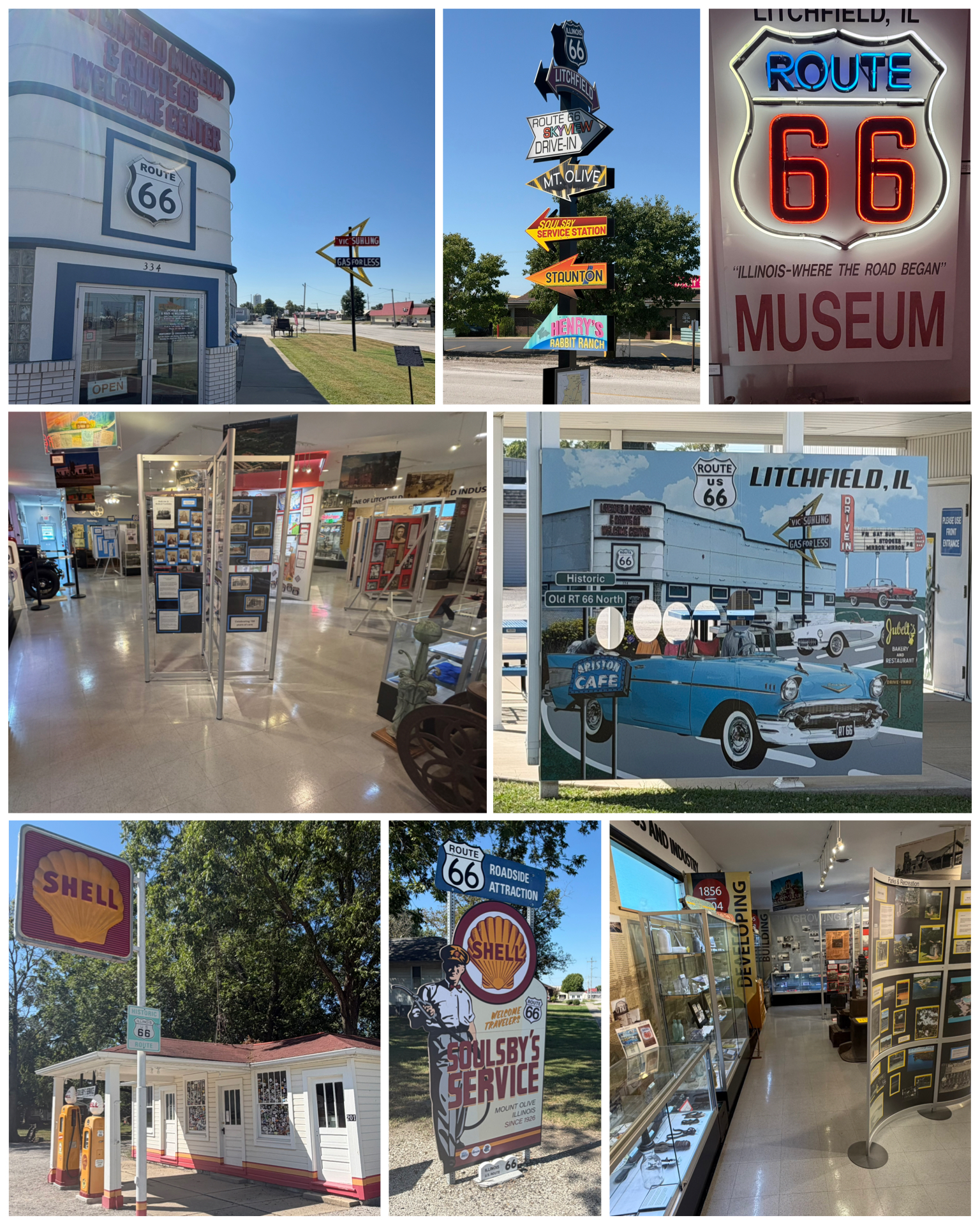 Mount Olive, IL is my next stop, and Soulsby’s Service Station (at right bottom left and center) the next place to visit. This was a fully operating Rt 66 service station from 1926 until 1991. Henry Soulsby suffered a coal mine injury and thus had to find a new career. He and his son Russell built a Shell gas station on the main highway through town – which soon thereafter, became part of Rt 66. Today it is a fully restored landmark, complete with vintage circa 1945 gas pumps, along with a mini indoor museum (which was not open when I was there). Nicely done restoration though! Litchfield, IL is up next, and home to the Litchfield Museum. Besides its Rt 66 exhibits, the museum also features a U.S. Navy practice bomb, and relics from a local Roller Derby. But it was the Rt 66 items that brought me there, and they were quite plentiful. Lots of neon signs, an old bullet-riddled Rt 66 shield, some old cars, and a cool license plate collection featuring the same plate number spanning several decades. Really cool place!
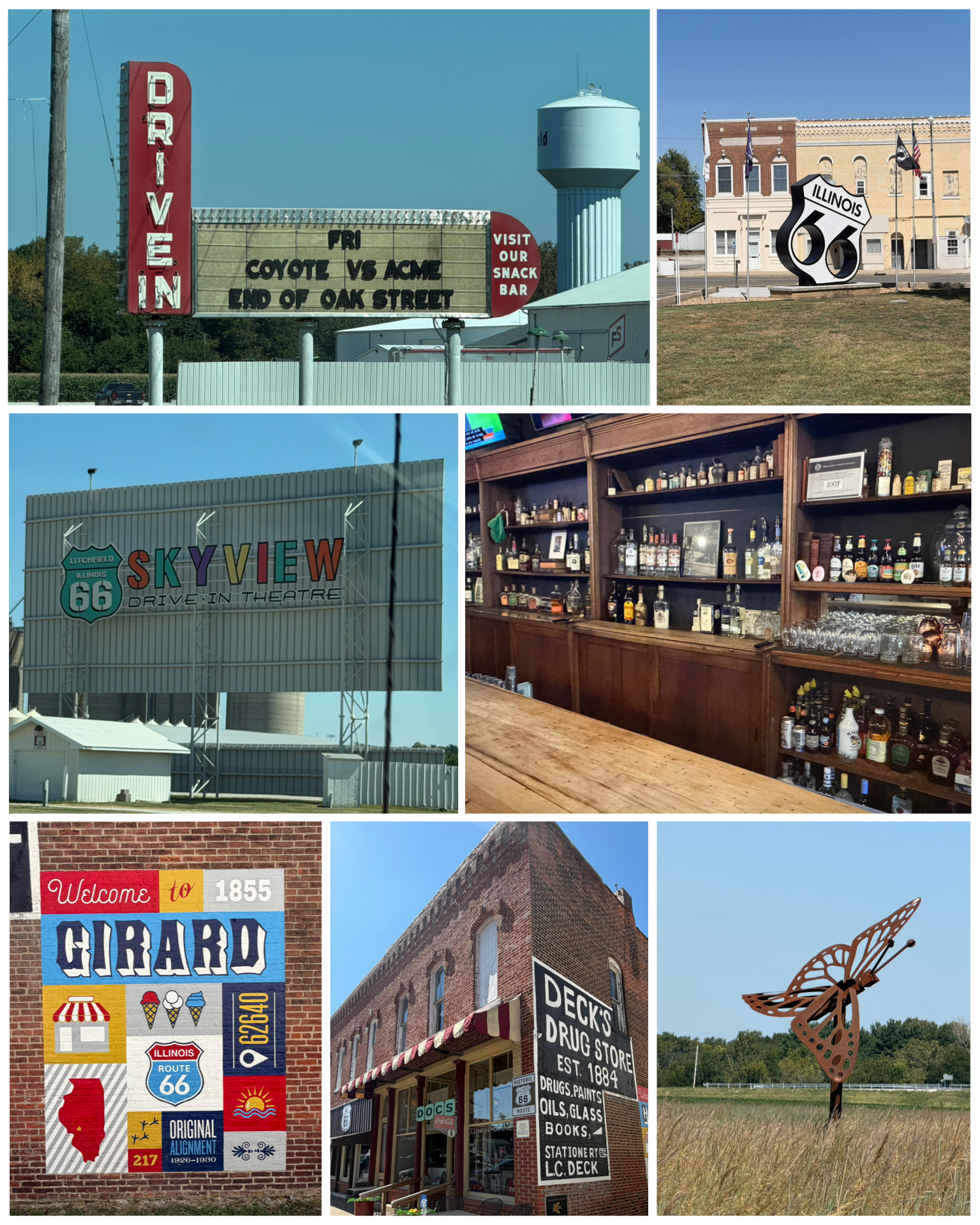 Also in Litchfield is the 66 Skyview Drive-In Theatre (at left, top and center left). Originally just called the Sky View, this Rt 66-facing drive-in screened its first movie on June 15, 1950, and continues to do so today – some 76 years later. Of the dozens of other operating drive-in theaters along the Mother Road, all have since closed at least once except for this one – making it the oldest continually operating drive-in on Rt 66. As an added claim to fame, this theater holds the Guinness World Record for most dogs in attendance at a drive-in movie. On Saturday, October 15, 2022, 199 dogs were officially recorded in attendance (as many as 400 was the unofficial count) for the movie, “A Dog’s Way Home.” I’ll bet that was just some dog-gone fun! Next I visited a place called the Litchfield Rt 66 Prairie (at left, bottom right). A passion project of Henry Ellers, a local naturalist, the 10 acres of over 200 native plant species and this nicely done butterfly art piece opened in 2021. A concrete pathway meandering through the prairie includes several actual slabs of original 1926 Rt 66 roadway. An interesting and reflective stop. Next stop is Girard, IL and a lunch break at “Docs – Just off 66”. This building houses the longest-running business in Girard having opened as a Deck’s Drug Store in 1865. It was the Deck family who ran the business for the next 117 years. A soda fountain was added in 1929, and the business eventually became known as Docs. It would be new owners who added “Just off 66” to the name as it was actually located one block off the Mother Road. Today, it’s a full-service restaurant and bar, but has retained its nostalgic 1929 fountain, along with shelves filled with the Deck family’s collection of patent medicines and other memorabilia. And, they served a really great lunch!
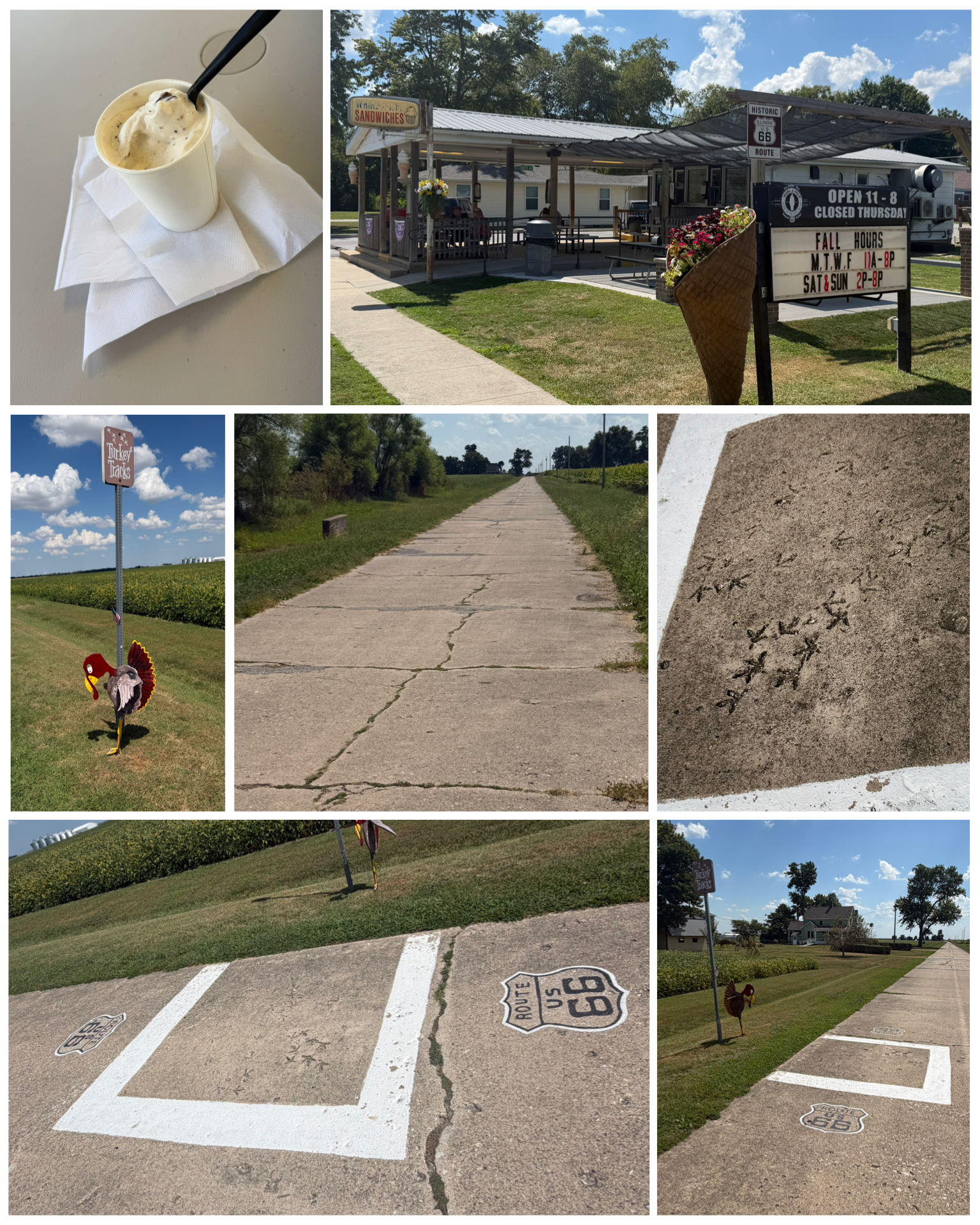 After the very delicious and reasonably healthy salad lunch, I figured I’d stop just down the road at the next Rt 66 attraction and treat myself to a unique ice cream concoction known as a Whirlwind at a place called Whirl-A-Whip. Besides, I had no idea what a Whirlwind was, so I figured it was incumbent upon me to find out for the benefit of my blog readers. So off to Whirl-A-Whip I went. Looking at their menu, they featured a number of Whirlwinds with all sorts of interesting ingredients to include brownies, Oreo cookies, cookie dough, and the like. I think I settled for a Reese’s peanut butter cup variety. I also asked what was special about a Whirlwind. Turns out, it’s the exact same thing as a DQ Blizzard, but just a different name. Oh well, nothing really special here after all. But it was yummy! A few miles down the road in Nilwood, IL and back onto a very old, original, and narrow segment of Rt 66, I find an attraction called Turkey Tracks on Route 66. The story goes that sometime between 1920 and 1922, a tiny rural road was being constructed using poured concrete. A turkey from a nearby farm had gotten loose and wandered off from the farm finding its way and walking through the freshly poured cement, leaving a series of crazy tracks in its wake. Five years later, the former farm road became part of the new Rt 66, only to become bypassed four years later – reverting the road back to its initial rural status. But, that actually helped preserve the road, and thus the turkey tracks that lie therein. So today, a white box and a pair of Rt 66 shields painted around the tracks, along with a sign and a cute wooden cutout of a turkey, mark this historic spot. How fun!
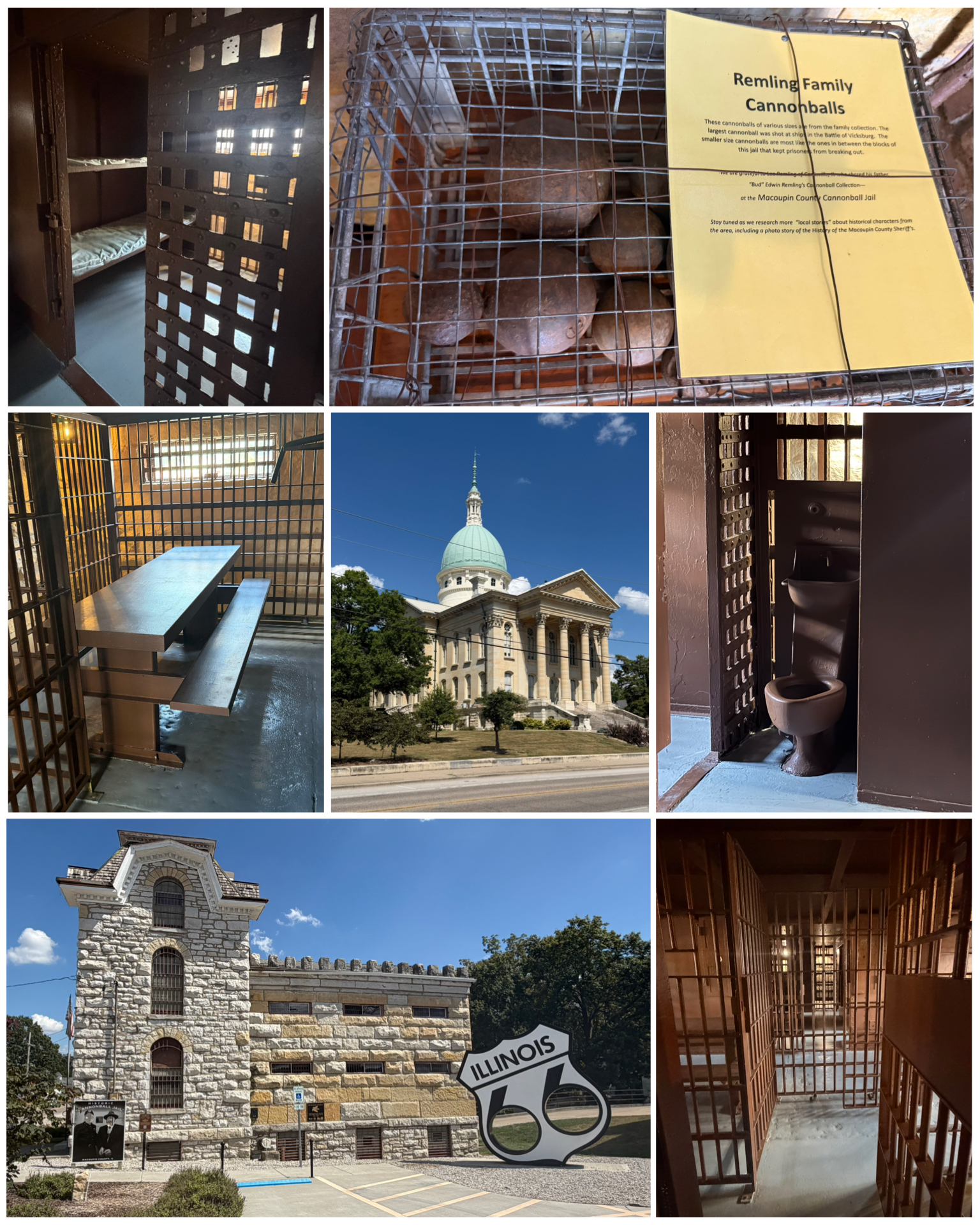 My final batch of places to visit during this day’s travels takes me to downtown Carlinville, IL, where two city-owned Rt 66 attractions sit directly on Rt 66. First up, is what has affectionately been called the Million Dollar Courthouse (at left, center). This Macoupin County building, representing mostly small rural farm communities, was originally planned to be built in 1865 with a $50,000 budget. Construction began but was soon halted with the building not having been completed. Construction resumed in 1870, at which time the budget had grown to a whopping $1.4 million. Lots of controversy and corruption ensued among the county commissioners, but the elaborate courthouse with its ornate 191-foot-high dome was eventually completed. Today it remains one of the few courthouses of its age still operating in its original capacity, rather than having been converted into a museum or demolished. In fact, it is reportedly the first fireproof building built in the U.S., and to this day continues to operate as a working 5-day-per-week courthouse. Truly is a beautiful building! Across the street from the courthouse is the Cannonball Jail (at left, bottom left and others). It was soon after the Civil War when leftover cannonballs were prevalent. Carlinville made use of these leftovers in 1869 by encasing them within the rock and concrete walls of the jail. This was done to thwart any escapes by prisoners if they were to attempt to chisel their way through a wall. No such luck with getting past a heavy cast iron cannonball. This prison was also built in the “Jailer Residence” style – a popular 19th century jail design where this was not only a jail, but also the home of the sheriff, his wife, and their children. This prison actually operated all the way to
 1988, after which it became a Rt 66 tourist attraction. It was closed in 2015 for repairs, then reopened just recently in 2024. It was definitely a place I would not have liked to spend any time in.
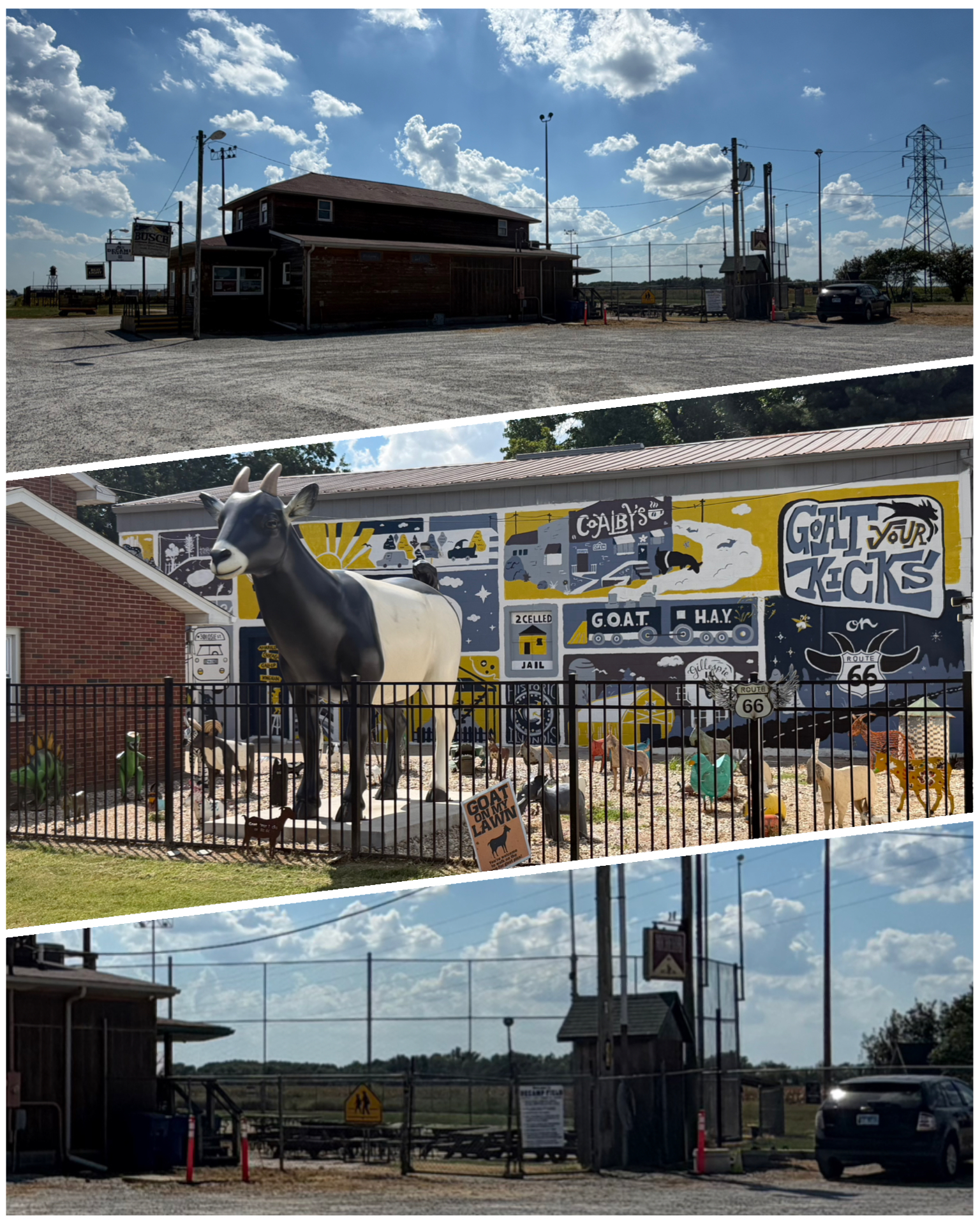
The very last two stops I made on this day’s journey were in Gillespie and Staunton, IL. First in Gillespie we find the Goat of Route 66 (at right, center). It was homeowner Tara Scherner de la Fuente who placed this 10-foot-tall fiberglass statue of a goat in her Rt 66-facing fenced-in yard, along with a plaque that reads “Goat Your Kicks on Route 66”. According to Tara, she simply wanted to bring some of the joy she had found out there to others. What’s particularly interesting is that the picture from the Rt 66 app that I was using to find these gems has a simple picture of a single goat standing in an otherwise empty yard. As you can see from my picture, a lot has happened to this roadside attraction since then. A custom goats-themed mural was added, along with a couple dozen little goat friends and other animals in the yard. It would seem Tara has gone a bit goat crazy with this one! Last up in Staunton is this Rt 66 roadhouse that has been in operation since 1931, and what makes it extra special is that it has its own softball field out back. It too in the early days had a somewhat unsavory reputation for its illegal gambling and alcohol, as well as its brothel. Customers were reportedly held at gunpoint by gangsters in 1934, while the bad guys stole the slot machines, liquor, and everyone’s money. But time healed many of those bad days, and today it is better known for its good food and classic Rt 66 decor. However, according to Google, it is now permanently closed – apparently having done so somewhere within the last 6 months or so. Alas, it appears another Rt 66 venue has been shuttered.
Effingham, IL
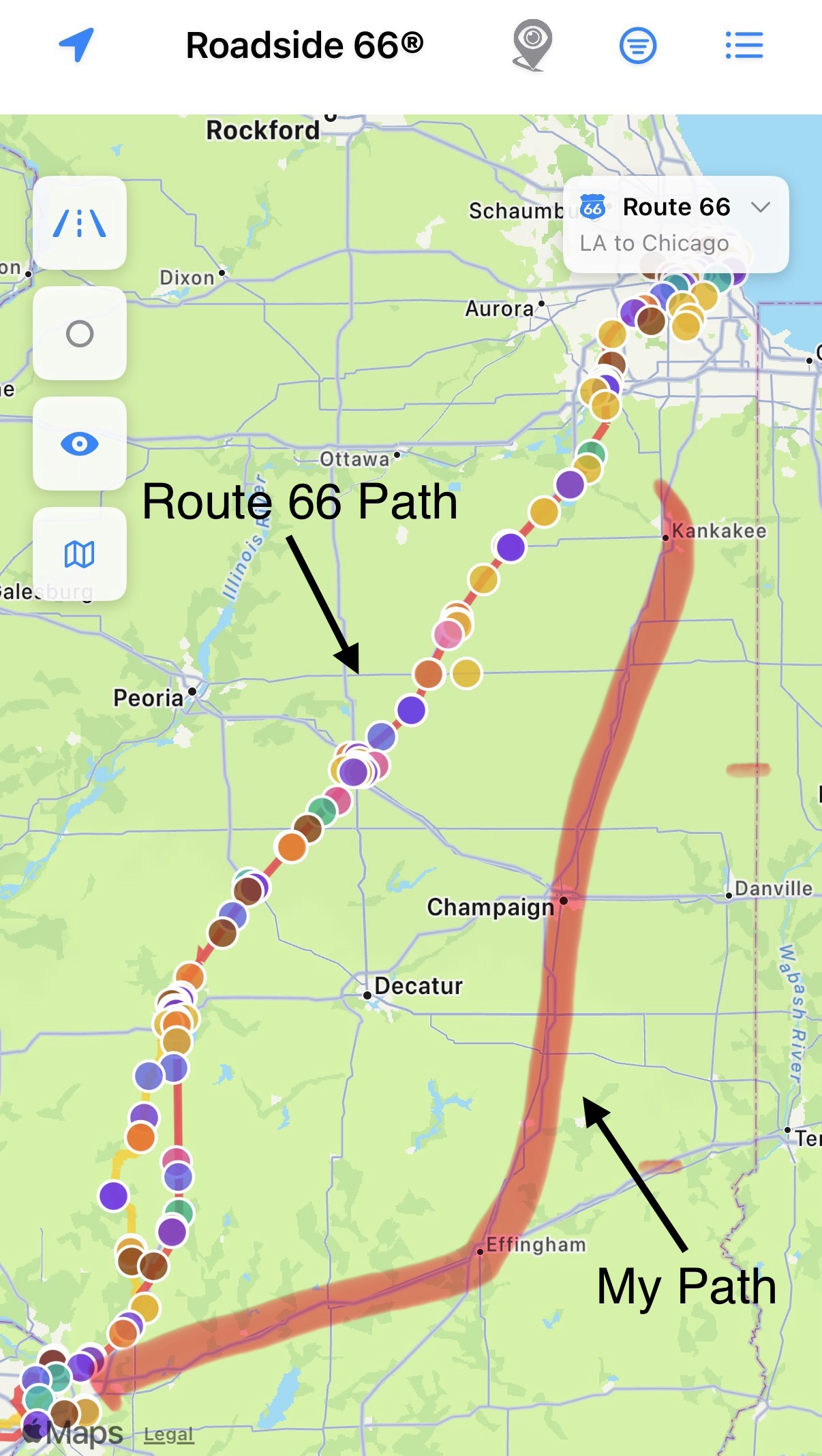 Ok, while I actually hate to admit this, it would seem that my Rt 66 trip routing skills sort of went off the rails a bit from this point onward. When I was planning the route and making campground reservations, it was easy to stay on course as the route traveled across the country east and west. It followed a predictable and consistent path from CA through AZ, NM, TX OK, KS, and even MO. But when it came to IL, that’s when things took a not so predictable route. Apparently when I booked my RV stops, I seemed to have simply followed the natural flow of how the route was progressing from the west. It appeared to me that the route continued from the St. Louis area east to Effingham, then turned north along I-57 and ending in Chicago. Well, turns out that was totally wrong. Instead, Rt 66 turned north from St. Louis towards Springfield then continued north along I-55 to Chicago. Oops! So, as you can see from the map at left, it would seem that going east to Effingham, I ended up putting myself about 75-100 miles off the Rt 66 trail. Even my last stop along the route in Kankakee was roughly 25-35 miles off course to the east. But the Kankakee stop wasn’t so far off course that I couldn’t easily go north to Chicago, then work my way along Rt 66 to the southwest for quite a ways, then simply head back to the northeast to get back to the campground. That was definitely doable. But Effingham was way off course, and would require hours of driving to and back from Rt 66. Mostly, it would be Springfield and Bloomington that would be the farthest towns to get to. Fortunately for me, I’ve actually been to Springfield before and saw a lot of things there in town. Also to my advantage, Bloomington and other Rt 66 stops north and south of that area were not necessarily epic or particularly historic to see – mostly more gas stations and old motels. So, I opted to simply skip the Springfield and Bloomington areas while staying in Effingham, and rather explore the area around where I was. As luck would have it, there was a place that was on my bucket list to see that was not far from Effingham, so that’s where I spent my time. Also, I can take the bit of downtime to catch up with my Blog writing and publishing.
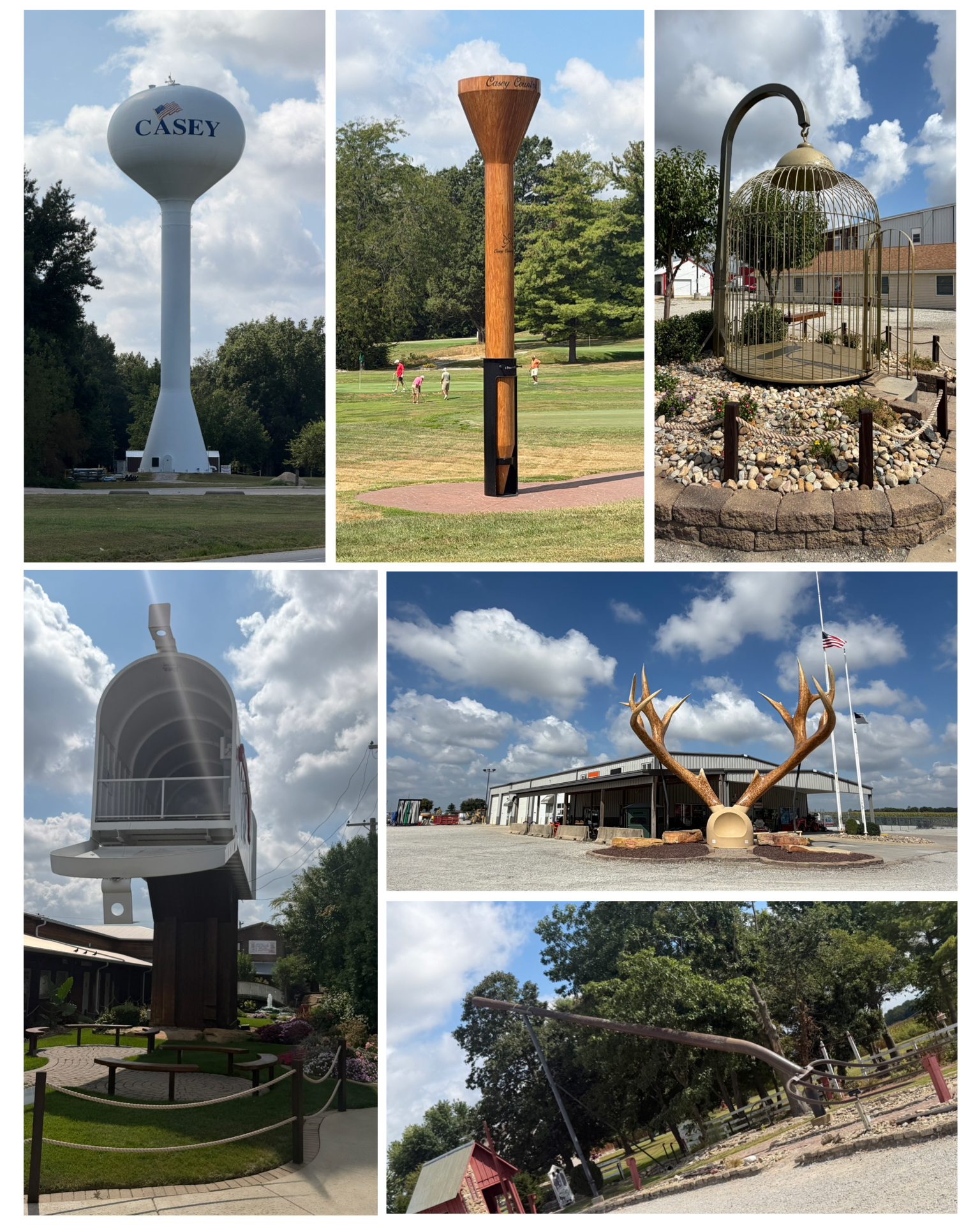 Some time ago, I had learned of a town in Illinois named Casey that was home to a large collection of “world’s largest” things. With a current population of just over 2,000 residents, this town, like many other rural small towns, had suffered economic challenges. To help revitalize the town and to bring in more tourism, local craftsman and businessman Jim Bolin built fourteen things that have set Guinness World Records for their size. Twelve of those items continue to be record holders, while two have since been beaten elsewhere. Well, the tourist attraction worked! Casey has certainly made a name for itself with these world’s largest attractions, successfully turning a small rural town into a major tourist destination. They certainly bring reality to their town motto “Big Things in a Small Town”. They welcome tourists from all over the world. In fact, the day I was there touring around, there were lots and lots of people taking in the sights with me. So much so, it was the largest collection of tourists I had seen this entire trip – far surpassing any crowd I had seen at any Rt 66 location. One of the 12 record holders includes the world’s largest golf tee (at right, top center). At 30.5 feet tall, it was built and Guinness-certified in 2013. While not a record holder, the giant bird cage (at right, top right) makes for an interesting photo op. There’s even a perch-like bench inside that you can sit on for the perfect pic. Another record holder and one of the more popular attractions in town is the world’s largest mailbox. It stands some 15 feet off the ground and features a box having 5,700 cubic feet of mail storage. The base contains a staircase so you can actually get into the box for a great view. Not only that, this is actually a working mailbox. You can post a letter or postcard into the mail receptacle inside the box, and when doing so, the large red flag on the outside goes up. How fun! A couple other giant things to see just outside of downtown include these giant antlers that sit in front of an equipment rental company (at right, center right), and the world’s largest pitchfork (at right, bottom right) a 2015 entry at 60 feet long, and weighing in at over a ton that sits outside of Richards Farm Restaurant.
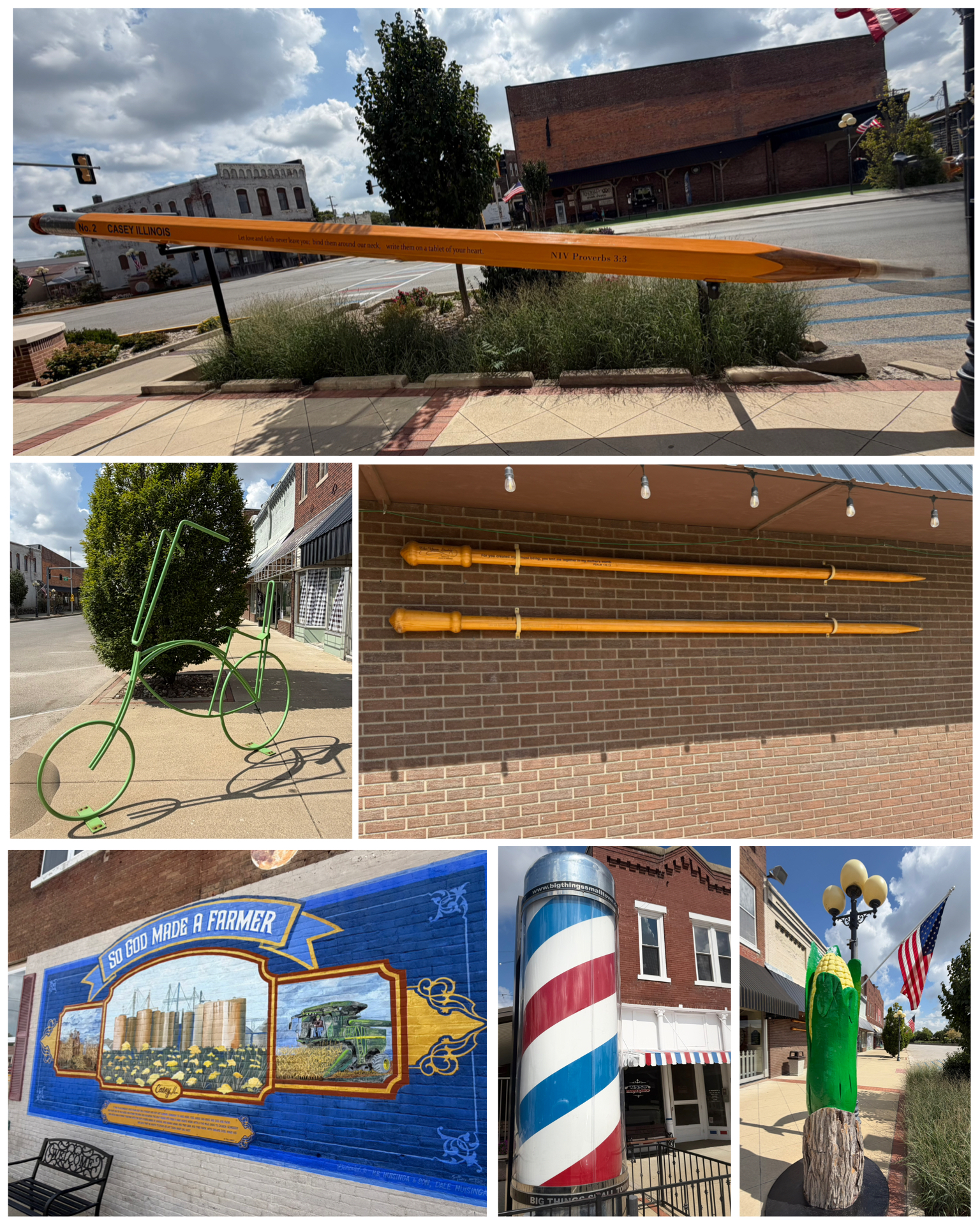 Next on the list is this giant wooden pencil (at left, top) that measures a whopping 32.5 feet long. While not the world’s largest (Malaysia has a 65-foot pencil, and a museum in St. Louis has one at 76 feet), it surely was sizable. Giant knitting needles, a giant-framed bike, and a big ear of corn add even more oversized attractions to downtown. The next Guinness record holder goes to the world’s largest barber pole (at left, bottom center). Guinness certified in 2019, this 15-foot pole is just outside of Tina’s Barber Shop. Certainly can’t miss this place! The town also had several really nicely done murals like this one paying homage to the local farmers.
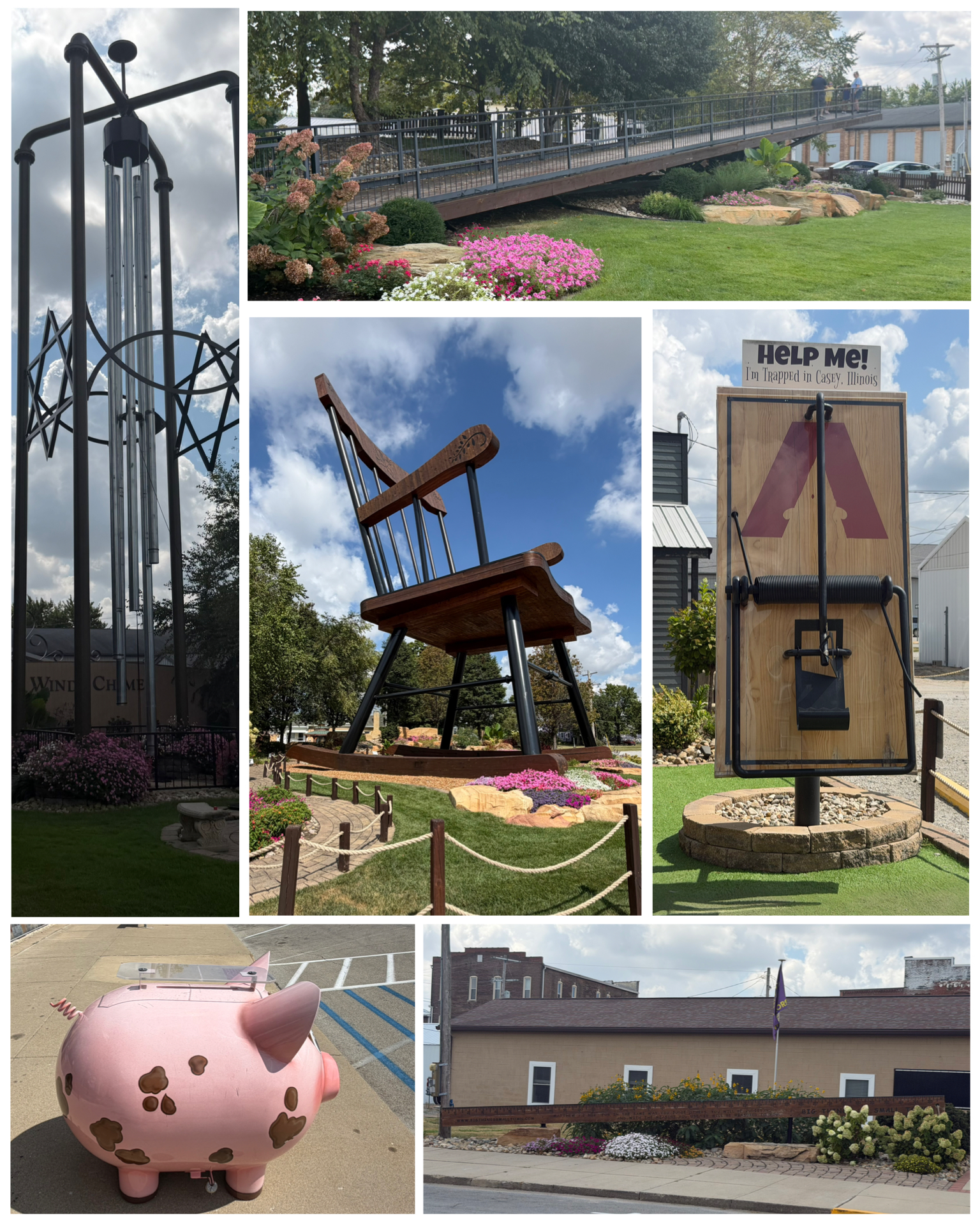 Several other record holders were left to see in downtown. First up is the world’s largest wind chimes (at right, top left). Standing 55 feet tall with metal tubes suspended 49 feet from the ground, this total structure weighs in at almost 17k pounds. Designer and builder Jim Bolin was inspired to create this in 2011 from his childhood memories of listening to wind chimes at his grandma’s home. A large rope hangs from the chimes that visitors can pull to listen to these world record chimes. The largest rocking chair (at right, center) was next on my list to visit. This behemoth stands 56.5 feet tall and weighs in at a whopping 46k pounds. It was unveiled and became the record holder in 2015, beating out the previous 7-year record holding 42-foot-tall rocking chair located in Fanning, MO. In order to get the Guinness record, the chair had to actually rock, so several large, strong men heaved and hauled, getting the chair to rock back and forth in front of the Guinness judges. Alas that day a new record was achieved. Another world’s largest was this teeter totter (at right, top right) built in 2018 and Guinness certified in 2019. The teeter totter is 82 feet long, and is actually functional – being available for seesaw rides on Saturdays during the tourism season. All other times, you are still able to walk on it, but one end is locked down preventing it from inadvertently teetering or tottering. While not themselves record holders, a giant mouse trap, piggy bank, and yardstick add additional giant fun to the town of Casey. It was a really fun day walking through this little town having so many big things!
Kankakee, IL
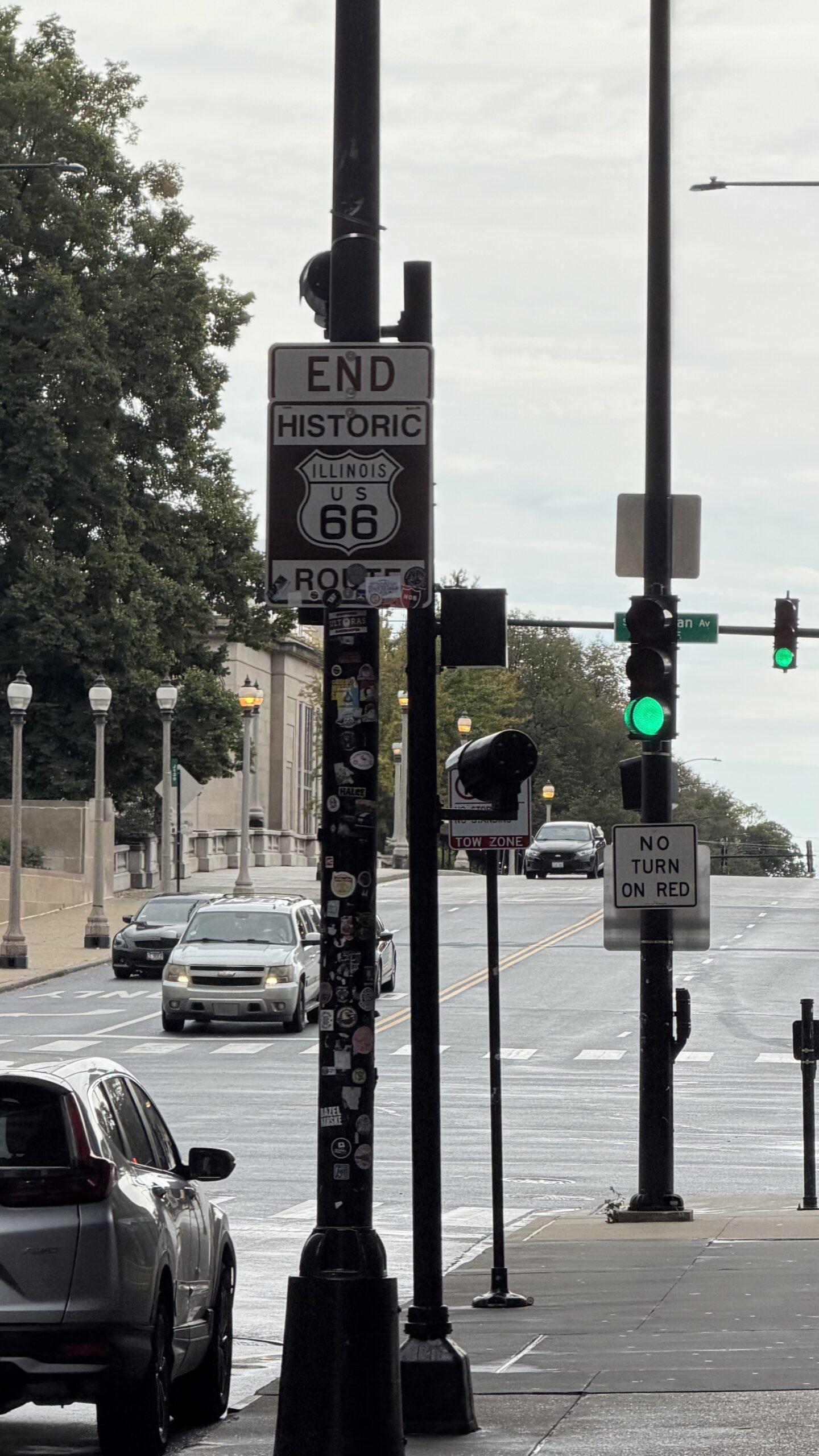 This would be my 16th and final stop – wrapping up this year’s Rt 66 adventure. My goal was to get sort of close to the Chicago endpoint, without actually being anywhere near Chicago. Despite the slight misalignment, I was sufficiently near the endpoint from here in Kankakee. So, the goal was to get into downtown Chicago, take some quick pics of the endpoint sign, then get the hell out of there. While there were a handful of other signs and Rt 66 attractions there in downtown, it was just too urban with limited parking in and around the areas of interest. Just to get the pics and selfies from the endpoint sign that I did, I had to circle the area a few times to figure out where I could pull off, then I temporarily double parked in a bus lane, jumped out, made a mad dash to the sign, took some pictures and a selfie or two, then ran back to the truck and pulled out of there before traffic backed up. It was a harrowing experience and was a fresh reminder of why I dislike big cities! But, I got the all-too-critical picture that I needed, so all worked out well. From here, I would head out of downtown Chicago to the southwest to visit other, not so hectic towns along the Rt 66 corridor.
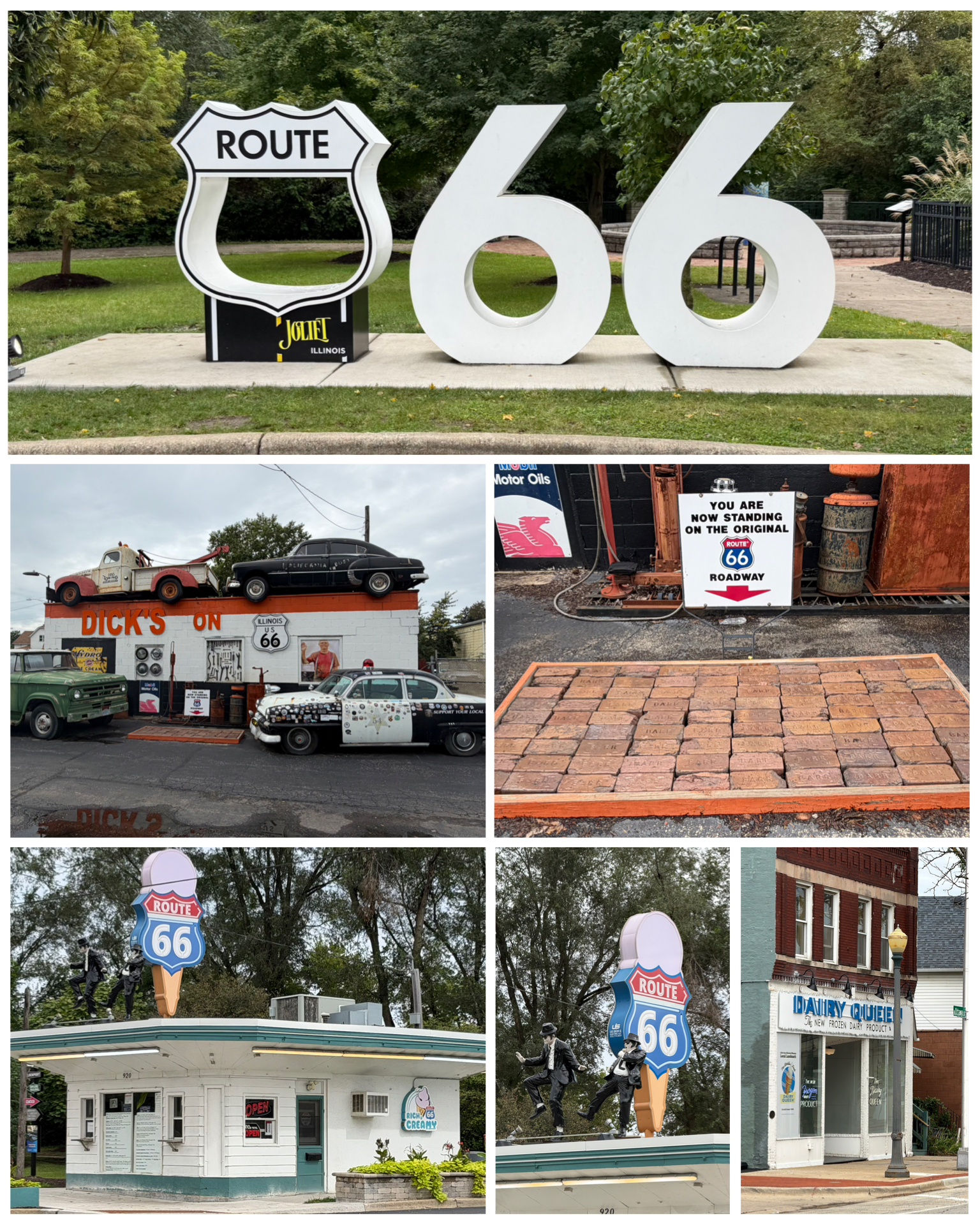 First up was a stop in Joliet – a really cool town about 30 miles from downtown Chicago, that became known for being the first major city outside of Chicago on Rt 66, and had lots of interesting things to see. Here I would find what seems like a historic Rt 66 photo op (at right, center left) with its roof-mounted antique tow truck and other vintage vehicles scattered about, but is actually a real, operating towing company named Dick’s Towing Service. Besides the cool-looking facade, what makes this stop especially interesting is the rectangular section of old-time original brick portion of Rt 66 (at right, center right). The wooden-framed segment sits in front of the tow company and welcomes visitors to take a stand on the 100-year-old piece of history.
What was once a mobile home sales office from the 1960s, was converted to the Rich & Creamy ice cream stand in the 1970s (at right, bottom left and center). The roof-dancing pair of Jake and Elwood, aka the Blues Brothers, were added some time later. Today, this Rt 66 venue continues to serve some of the best ice cream along the historic route. Joliet is also home to the very first Dairy Queen location in the country (at right, bottom right). This Rt 66-facing venue occupies a building constructed in 1895. On Jun 22, 1940, it became home to the very first business to carry the Dairy Queen name. It is no longer a DQ, and spent many years as a community church, then an insurance company, and now appears to be vacant. Hopefully the city of Joliet will continue to maintain it as a historic building.
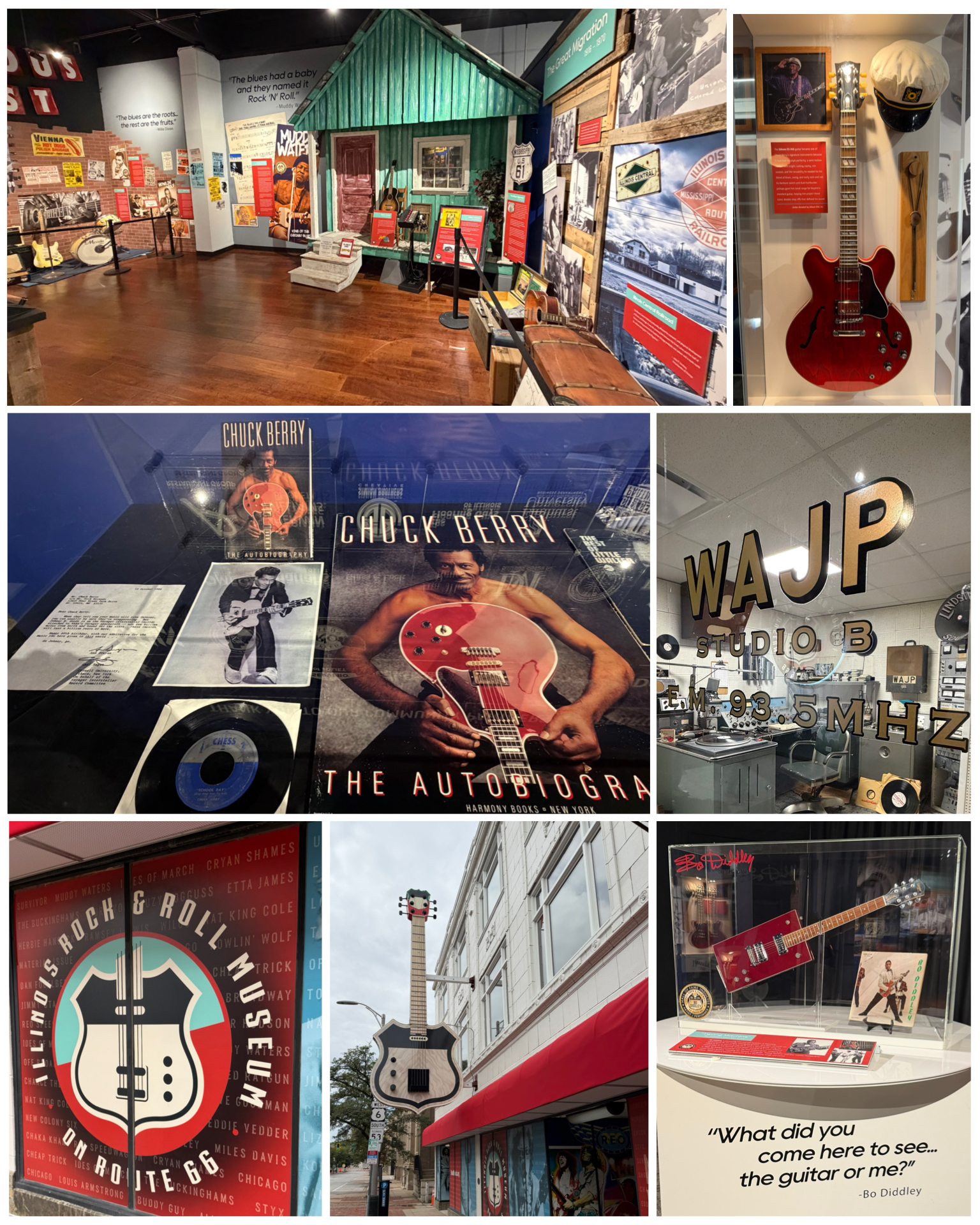 The Illinois Rock and Roll Museum on Rt 66 was my next stop. Occupying a three-story building, the museum features artifacts and memorabilia representing much of the music history from Illinois. The history begins from the outside with a 24-foot-tall, 10-foot-wide guitar known as “Gigantar”, that features a body in the shape of the Rt 66 shield. I was actually fortunate to have seen Gigantar as it had just been placed back on the building a few days prior after having been absent for some time while the building was being restored from damage due to an F1 tornado (HERE). But the building repairs were completed, the guitar replaced, and the museum in full operation. Well, mostly full operation as the third floor was still a work in progress setting up a brand new exhibit. I was able to view that floor, but since it has not yet been officially opened, I was prohibited from taking any pictures there. But, it was a really awesome museum with lots of history and items from some very popular musicians like this square body guitar from Bo Diddley (at left, bottom right), to the Chuck Berry favorite Gibson ES-345 (at left, top right). There was even a studio room (at left, center right) featuring all the original equipment from radio station WAJP FM – a Joliet radio station that began broadcasting in April 1960. Overall, a really cool museum that did a great job representing the Illinois music scene.
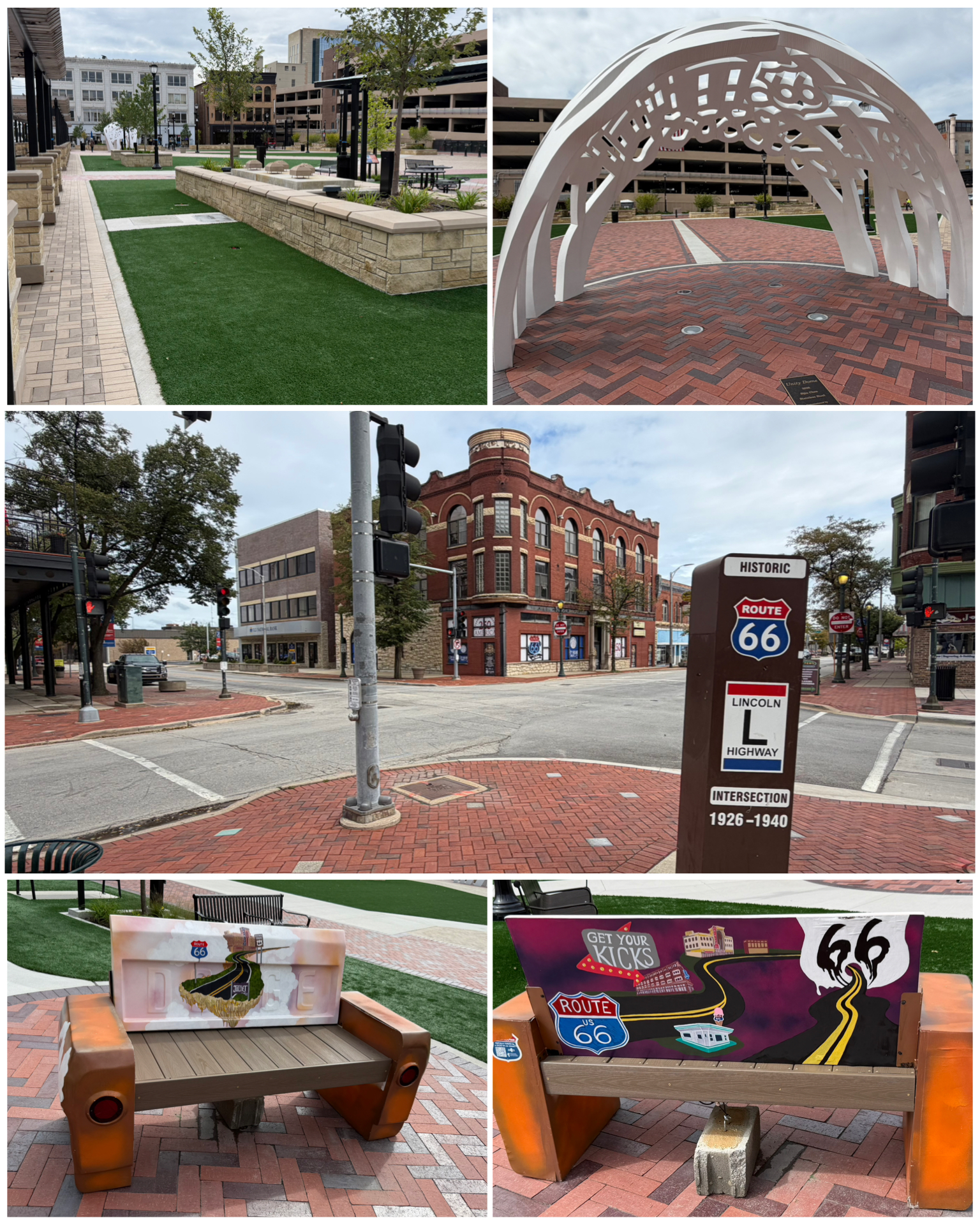 Back in the 1910s and 1920s, it was the Lincoln Highway that would have been the most popular and well-known road in America. Marked by a series of red, white, and blue monuments featuring a big letter “L”, it was the first transcontinental roadway in the United States and one of the first built expressly to accommodate automobiles. It ran from Times Square in New York City west to Lincoln Park in San Francisco. Of course, Rt 66 would later be developed, and become the Mother Road – America’s favorite. Up until 1940, here in Joliet those two famous roads would meet at this intersection (at right, center). This seven-foot-tall monument dedicated in 2016 marks the spot and features signage representing each of those famous highways. As I was wrapping up taking pictures of the intersection, a nice woman came up to me inquiring if I was a tourist. I explained to her that I was, and was doing the complete Rt 66 trip. She mentioned that I needed to include a brand new park that was just built and opened down the street. I thanked her and sure enough, I stumbled upon Joliet City Square – a vibrant, welcoming destination for connection, culture, and community designed as Joliet’s central gathering place. It features several Rt 66 themed elements and has a mix of weekly activities, recurring monthly events, and signature celebrations. Its centerpiece is the Unity Dome (at right, top right), a public art sculpture by internationally
 recognized artist Sijia Chen. You can see the Rt 66 shield prominently featured in the dome’s structure. A really nice park that will represent Joliet and Rt 66 well for years to come.
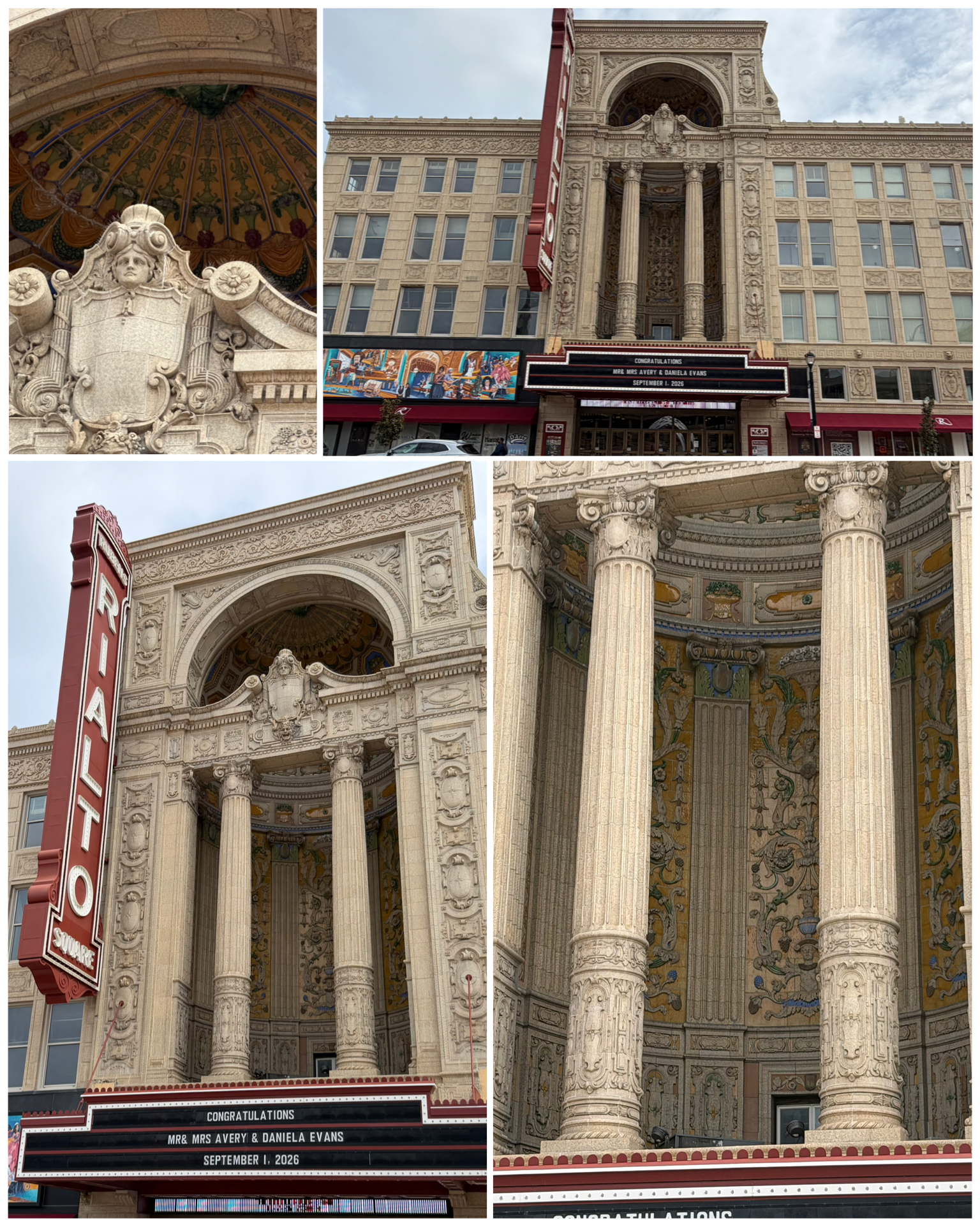
Across the street from the City Square was the historic Rialto Square Theatre. Coined as the Jewel of Joliet, this 1926-built theater was described as one of the ten most beautiful theaters in the country. The million-dollar Rialto reportedly could seat roughly 10 percent of the town’s then population of around 40,000 residents. Originally designed and operated as a vaudeville movie palace, it now houses mainly musicals, plays, concerts, and stand-up comedy. With its marble columns, vaulted celestial domes featuring intricate sculptures, giant chandeliers, and its signature 70-foot-high neon sign, this place is as opulent as any place could be. Since one of the theatre’s original purposes was to show silent films, which typically required musical accompaniment and sound effects, a fancy organ was included in the building’s design, with the pipework installed to either side of the stage. The organ’s console is mounted on a platform that can be raised to stage level or lowered into the orchestra pit. Very cool!
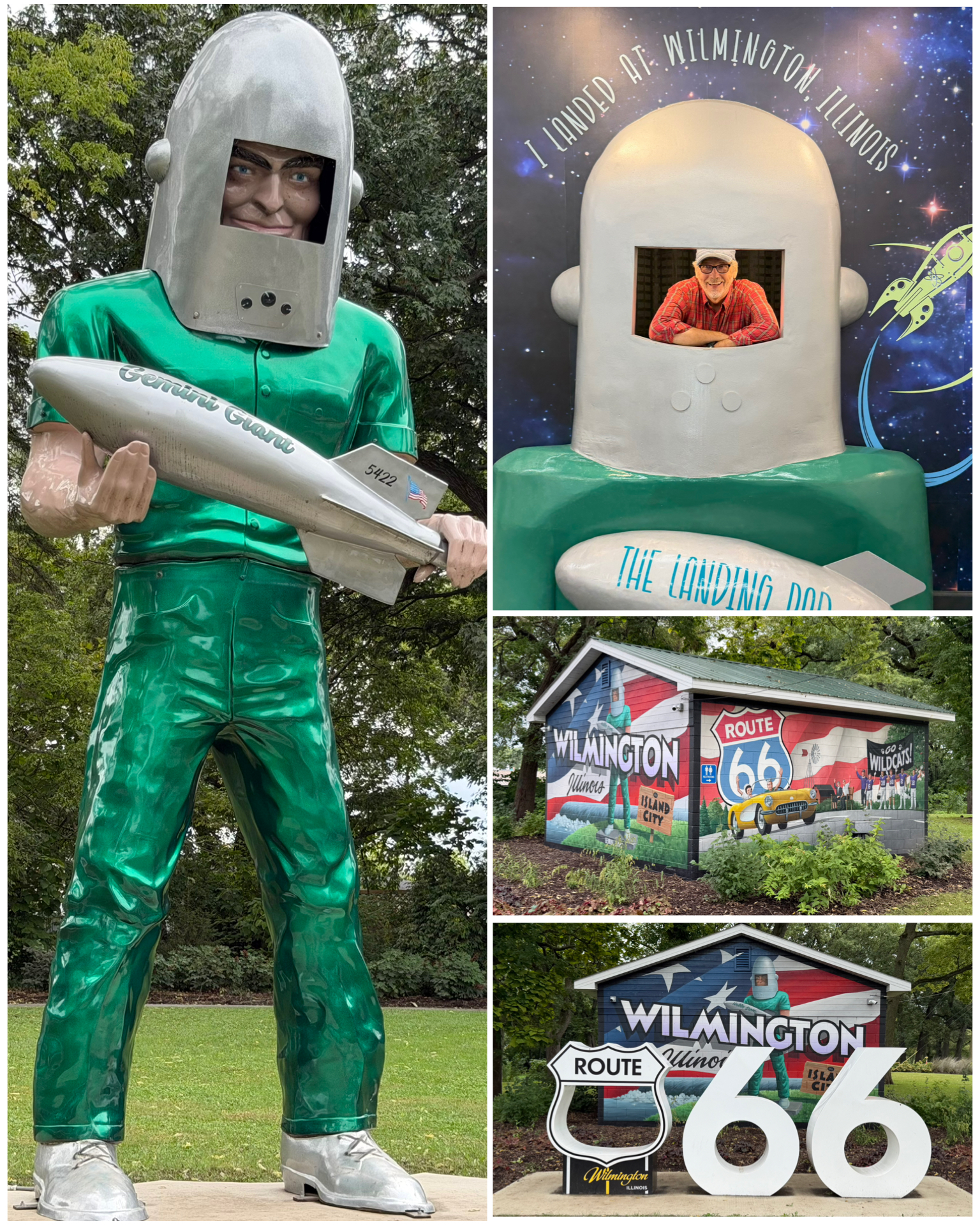 Next I traveled to Wilmington, IL to check out this Rt 66 icon. This is the Gemini Giant – so named by fifth-grader Cathy Thomas who provided the winning entry via a naming contest among school kids in 1965. Apparently, the NASA Gemini program was in full swing at the time, so it made sense. The unique customized 23-foot Muffler Man turned astronaut had just been purchased for $3,500 by John and Bernice Korelc to stand tall outside their Launching Pad drive-in restaurant on Rt 66. It would be the International Fiberglass company, who popularized the original Muffler Man, that built this custom astronaut version. Two other astronauts from the same molds were reportedly made, but the Gemini Giant is the only known survivor. The Korelcs retired in 1986, and the Launching Pad continued under various owners for several decades thereafter. In 2023, the drive-in came up for sale once again, and in 2024, the Gemini Giant itself came up on the auction block. Its then owner supposedly threatened to destroy the Giant if the bidding did not go high enough. In the end, the Joliet Area Historical Museum offered up a whopping $275,000 bid – which I would presume would have met the owners’ high bid expectations. The museum won the bid, restored, then relocated the Gemini Giant to its current home along Rt 66 in a Wilmington city park. Such a historic Rt 66 icon, I would imagine at the price they paid for him, we can be relatively assured that he will have a long and high-quality life for lots of future generations.
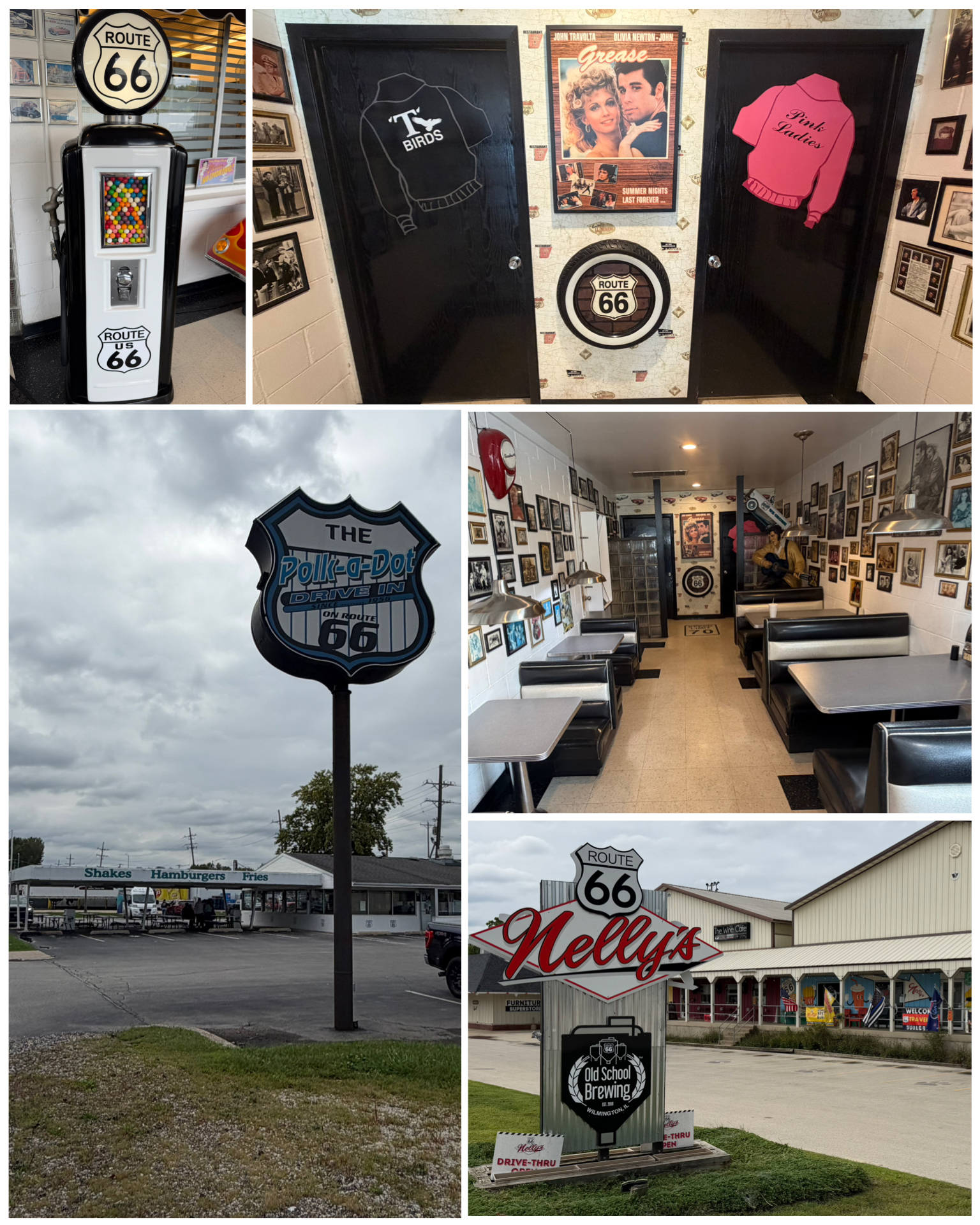 Well, it was past noon by now and I was getting hungry. Just across the road a bit from Gemini Giant was a Rt 66 themed food place called Nelly’s, that happened to share a space with Old School Brewing. Certainly sounds like a perfect lunch stop to me! I actually could not find any historical information about Nelly’s, so it actually may be a newer establishment that simply adopted and embraced its Rt 66-based location. Their menu consisted of your typical sandwich/burger offerings, but one menu item called “Italian Beef” caught my eye. I inquired as to what Italian Beef was, but the girl behind the counter was not exactly too sure. So, I took a chance and went ahead and ordered it. It arrived a short time later and was a heap of thinly sliced beef and mozzarella cheese in a sub roll, with a side of some sort of Au Jus. Hmmm – looks exactly like a French Dip to me! Sure enough, tasted like one too. So, when the counter-girl came by to check on me, I gave her a quick lesson on the French Dip sandwich so that any future customers who ask her about the Italian Beef can be properly schooled. A good lunch overall! My absolute last and final stop along this epic 4-month Rt 66 adventure takes me just down the road a bit to Braidwood, IL. Here I would find a classic Rt 66 eatery and ice cream shop called the Polk-a-Dot Drive-In. It started life in 1956 as a converted school bus that was painted with polka dots and turned into a food truck that would sit open for business along Rt 66. When owner Chester Fife saved enough cash, he built a full-fledged restaurant on the site in 1962, and called it the Polk-a-Dot Drive-In. Business was good for a while, but like other Rt 66 venues, it declined as traffic moved elsewhere. It was under new ownership, and in the mid 1990s, they decided to take a chance on the seeming revitalization of the Grand Mother Road. They added more decor and Rt 66 artifacts to give it a more retro diner feel, along with a host of photo-op figures including Marilyn Monroe, James Dean, the Blues Brothers, and even Elvis. I treated myself to an ice cream cone as a final sign-off to this amazing trip.
Final Thoughts
Wow … just wow! No words can adequately summarize the sheer joy this trip has brought me. If this, in fact, does turn out to be my final RV adventure, I can surely say that I will be going out with a bang! Traveling the length of Rt 66 is truly the epitome of the American road trip. And for me, doing it on its centennial birthday was just icing on the cake. I think I’ve pretty much checked off the bulk of my bucket list items, and can now settle down a bit and focus on spending a bit more time with family. I’m sure I’ll continue to travel as there’s still more to see and explore, but I think I’ll adopt a different approach to doing so in the future. Likely involving driving a much smaller and more efficient vehicle, and perhaps finding other sleeping arrangements as I go. But for now, I’ll be focusing on converting my home base RV lot into a permanent homestead. So stay tuned as I’ll bring you along for that ride. Till then, be well and safe travels.
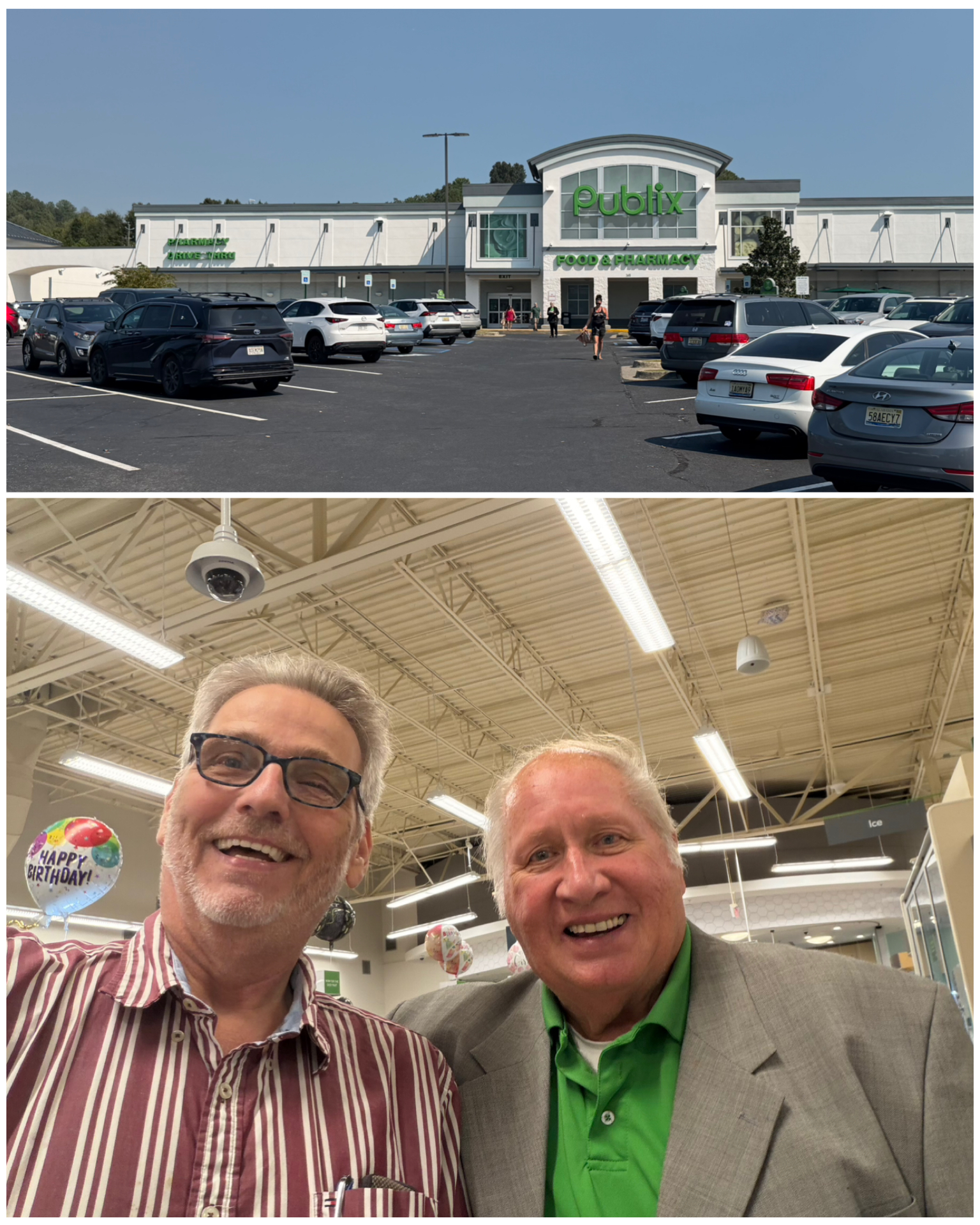 Epilogue: A funny thing happened as I was working my way back home from this year’s trip. I was traveling through Alabama and needed to make a grocery run. I was thrilled to see that I was far enough south that my favorite grocer, Publix, was nearby. As I was walking the aisles, this gentleman pictured here approached me and identified himself as the founder of Publix, and thanked me for shopping with them. I told him I loved Publix, and of course asked for a selfie with him so I could feature him in my blog. I later wanted to get more information about him and remembered his name tag said George. A quick Google search uncovered the founder of Publix to be George W. Jenkins. Cool! But a bit more reading also noted that George Jenkins passed away in 1996 at the age of 88. Then I thought maybe I misheard him and he might have said that he was the son of the founder of Publix. But a review of George Jenkins’s obituary showed he had five children, two of whom were sons, but neither of whom were named George. I even checked the corporate list of executives, and there’s no one named George. Now I’m wondering just who the hell this George guy was? He certainly was pleasant, and was going around to all the shoppers and shaking their hands thanking them for their patronage. Maybe he’s a harmless local homeless person pretending to be the founder, or there’s some other explanation. But for now, all I’ve got is a selfie with some guy named George whose true identity remains a mystery to me. Gotta love it!
UPDATE: Curiosity got the best of me, so I decided to call that Alabama Publix where I had been to see if I can figure out who this guy was. Turns out, the day I happened to be there was some sort of Publix anniversary. To celebrate, one of the store’s employees put on a suit jacket and a “George” name tag pretending to be the founder George Jenkins. He then wandered around the store greeting and thanking visitors, identifying himself as the founder. So it was all apparently some sort of store fun to celebrate the anniversary. Well, they certainly got me good!
I only show a sampling of my adventure pictures here in the blog, and do so mostly in collage format for brevity and ease of reading. If you want to view an album containing individual full fidelity and hi-res images of all my travel pictures related to this specific blog, click the image below. Enjoy!
Perfect Route 66 final blog!! I loved the Campbell’s Service Museum. Dave and I were talking the othet day about how different service stations (aka gas stations) were when we were young. I remember the attendant jogging out, smartly dressed in his uniform, to fill the car up, checking the oil and other fluids, tire pressure and washing your windshield while the pump ran. And at some we even got S&H Green stamps (remember those)!!! The gold old days. I miss them.
Loved the ending with the mystery “Publix founder”. Too funny.
You’ve certainly had some great adventures. I look forward to seeing your new park model. Welcome home!!
I’m very behind on reading your blogs, but had to read this one. I have a hard time believing you are giving up the RV life, but maybe it’s just because I’m so far behind reading. Love the Publix in AL story – that’s a hoot!
More replies as I catch up. I hope you will continue your blog with your FL home adventures!!
Have a wonderful winter getting things setup for a ‘permanent’ place to live! 🙂
Your entire Rt 66 trip bog has brought back many memories for me. You are correct in saying that it is the ultimate road trip. Everyone who can should do it, even if it takes them less than 4 months. I did it in six weeks and anything less than that would be a real compromise. I also did a long stretch of the Lincoln Highway at some time in my cross country road trips. AS for this blog I do remember seeing the Gemini Giant. I can not believe that it sold for $275K, and how did a Historical Museum come up with that much money. Amazing. The Publix story was priceless and your follow up was impressive. You have some very good research skills.
As Debbie said, Welcome Home.