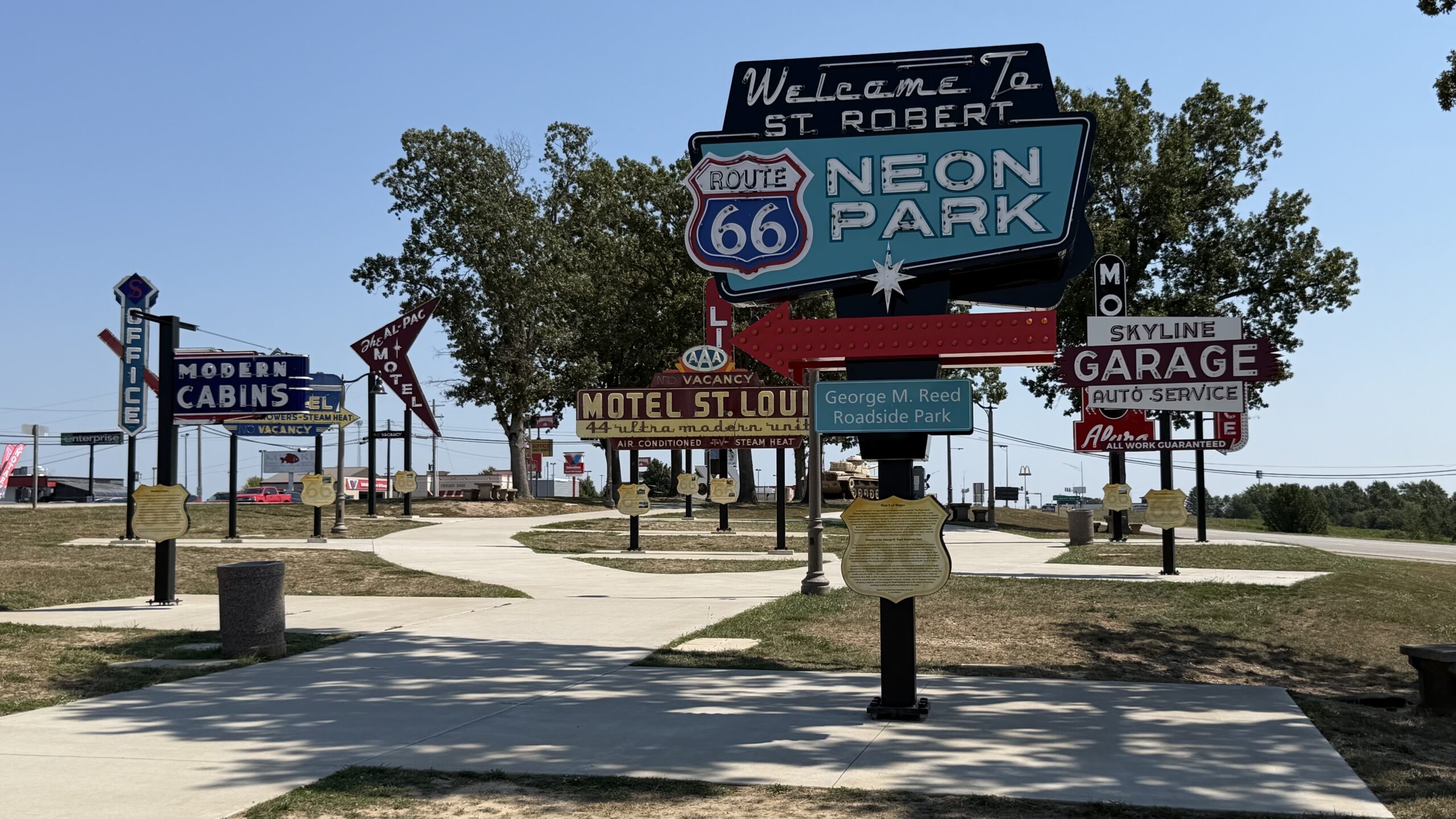
One of the things I found interesting during my Rt 66 tour was the neon sign parks featured in several of the towns I visited. It’s interesting to see the historical value and reverence given to these signs – so much so that they have their own dedicated parks in which to shine for generations to come. It sure is a great way to preserve history. So much more to see as we continue our journey eastward along Rt 66, so let’s get to it.
Joplin, MO
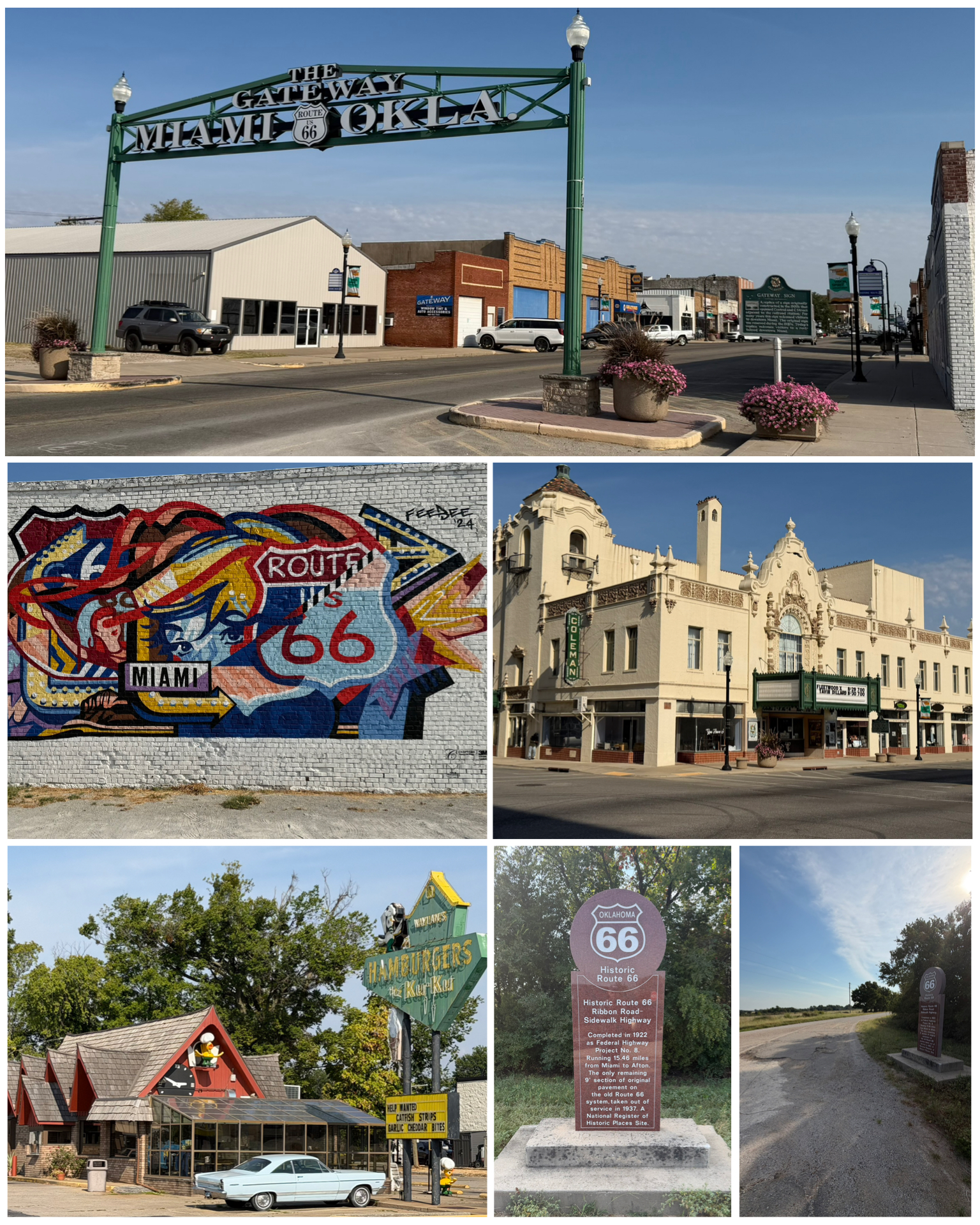 My next stop as I continue my trek along Rt 66 takes me to Joplin, MO. And once again, having a significantly shortened stay of only 2 days here, I had to jump right in and get started to see as much as I could. From here, I will be exploring portions of OK, KS, and MO, heading both east and west from Joplin along Rt 66. First up I head back towards the west to Miami – and that’s not the one in Florida but rather in Oklahoma. Located in the far upper right-hand corner of the state is this good-size town of just over 12,000 residents. One of its claims to fame is the Ribbon Road (at left, bottom center and right) – at only 9′ wide it’s the narrowest surviving section of the old Rt 66. This section of road, now on the National Register of Historic Places, is just over 15 miles long and was built in 1922, and removed from service in 1937. The story goes that the local community responsible for paving its section of Rt 66 only had enough money to complete about half the required length. So instead, they opted to pave the entire length at only half the normal width. Certainly a creative solution! Despite it being a bit crumbly and beat up, you can still traverse this section of roadway. You just need to be watchful of any oncoming traffic! Also in Miami is this gem – the Coleman Theater (at left, center right). Built in 1929, this beautiful vaudeville / movie theater palace was a gift from town millionaire George L. Coleman, who spared no expense on its design or construction. Despite being almost 100 years old and having had threats of being torn down over the years, community preservationists have protected it to ensure its survival for generations to come. Having never actually closed since it was built, it even has its original Louis XV chandelier and a Wurlitzer pipe organ – the latter of which is reportedly still used when showing silent movies. Spanning across South Main St (aka Rt 66) is a gateway sign that is a replica of the sign originally constructed in the early 1900s and then removed in the 1930s. It always offered a welcome to the town of Miami, and this new sign does the same to the now revitalized downtown. Pretty cool! What was once among over 200 chain burger joints across the Midwest bearing the name Ku-Ku, this one in Miami is the last and only remaining survivor. Besides its iconic neon sign, it was the chef-hat-wearing Ku-Ku bird emerging from the cuckoo clock in the building’s gable that gave this place its signature look. Definitely unique!
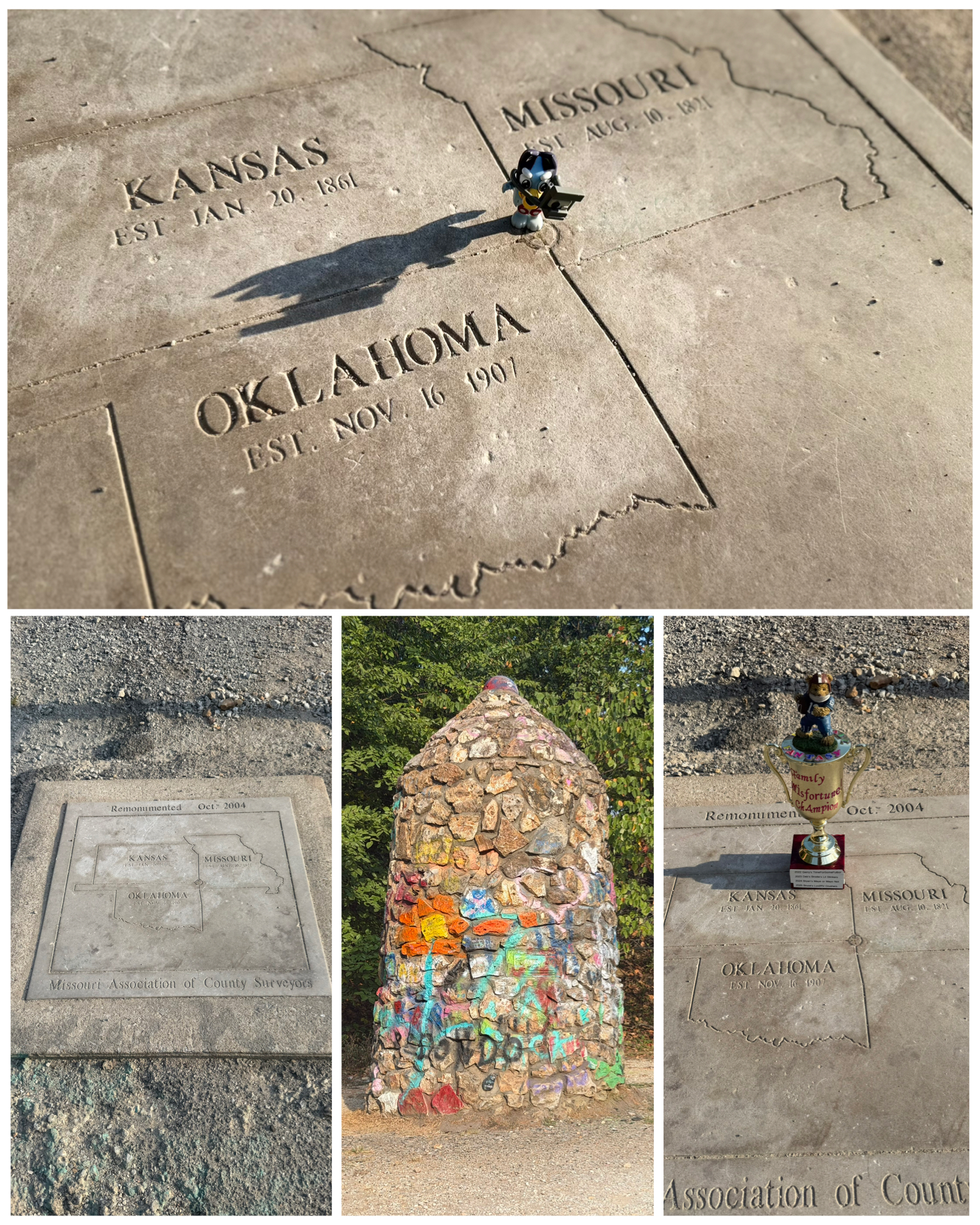 Next I visit a unique place where you can stand in three states at the same time. Here, I let my special Rt 66 Bluey character and the Fantasy Football trophy take center stage and enjoy the limelight. Technically located in Quapaw, OK, the tri-state boundary was originally surveyed by an 800-member expedition in 1857 – taking something like six months and walking some 40 miles across difficult terrain. A stone cairn was built on the spot (at right, center bottom) by the National Youth Administration in 1938, but later determined to be about 50 feet west of the actual spot. In 2004, the Missouri Association of County Surveyors created the stand-here plaque on the actual and correct spot. Interesting bit of trivia is that Missouri actually has 10 “tri-state” corners around its borders, but only two of them are on dry land – the other 8 lie under the waters of the Mississippi and Missouri rivers.
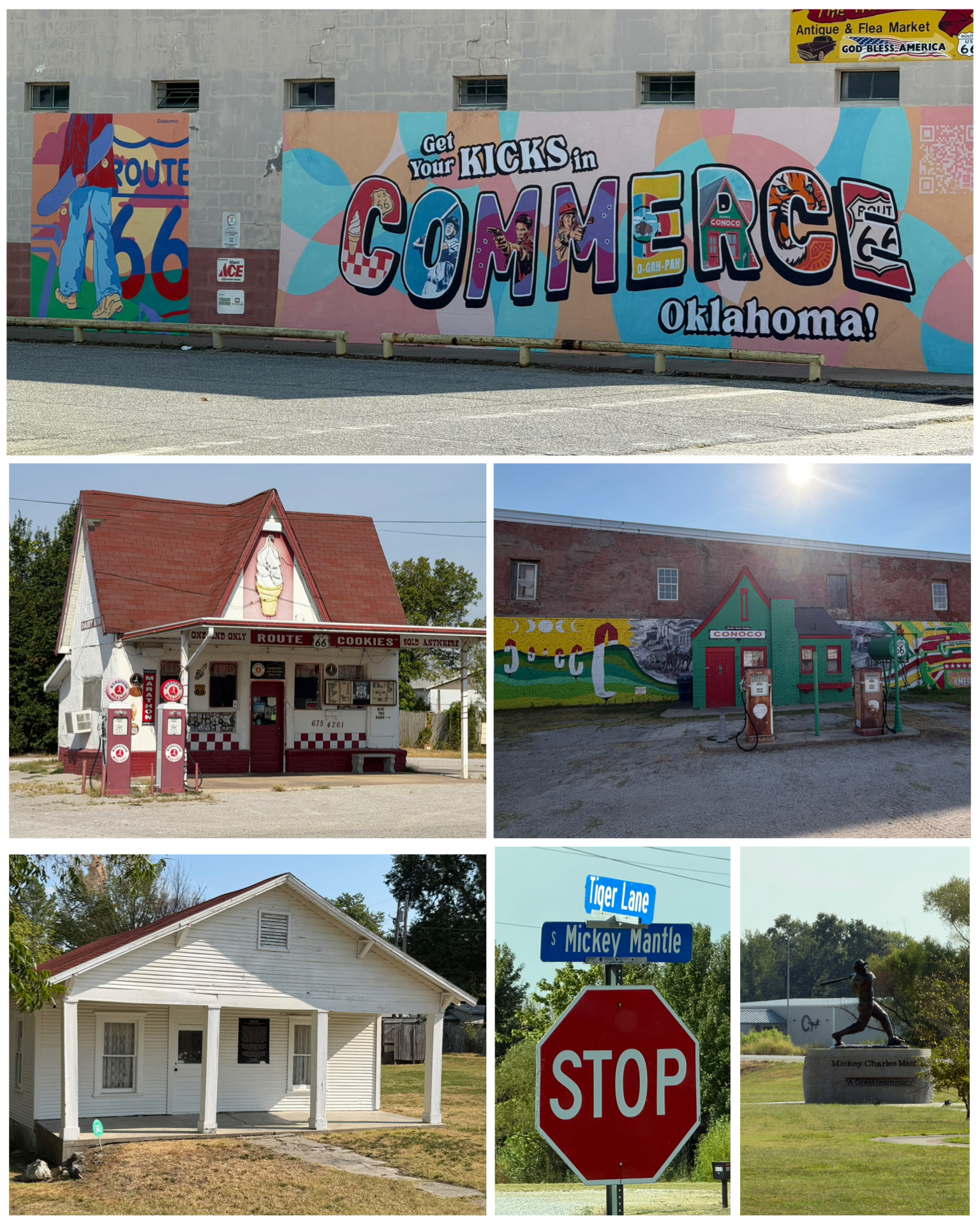 Commerce, OK was my next stop – home to a couple of interesting Rt 66 venues, and childhood home to a famous baseball player. A Marathon gas station right along Rt 66 opened in 1927. In order to drum up some more business, in 1951 the owner’s wife began selling soft-serve ice cream as a side hustle during the summer. When the owner passed in 1957, the wife turned the place into a full-time ice cream shop renaming it Dairy King (at left, center left). She eventually added burgers and corndogs to the menu, and the place became a popular Rt 66 hangout. The business was sold in 1980 and the new owners added neon to the building, a couple of old gas pumps, and introduced a Rt 66 shield cookie – which eventually became trademarked and not sold anywhere else. They remain owner/operators to this day, and still sell the famous cookies. Across the street from Dairy King is the Hole in the Wall Filling Station (at left, center right). Built around 1930, the story goes that the lot was not big enough for both the gas pumps and gas station office/store, so they only built half of the building and put it up against the tall brick wall of the adjacent building. Sort of makes it look like the other half of the gas station is on the other side of the brick wall, but actually is not. Some even say that this place never opened as a gas station and was built only to look like one. It wasn’t until the early 2000s that new owners gave it a red and green Philips 66 paint job and turned it into a small gift shop that it would then become a Rt 66 attraction. So who knows what it was like in the early days. Also in Commerce it turns out to be the childhood home to famed baseball legend Mickey Mantle. A nine-foot tall bronze statue sits just outside the center field fence of the Commerce High School baseball field honoring the boy who would be known locally as the Commerce Comet. His family moved to Commerce when Mickey was 4 years old, and he attended and played ball for Commerce High School. A few blocks away on Quincy St sits his actual childhood home (at left, bottom left). It’s in a bit of rough shape despite having just gone through some partial restoration in 2023. There are thoughts that it might become a museum or perhaps an AirBnB, though neither of those ideas seems to be moving forward at this time.
Next, I would venture across the state line into Kansas. With only about 13 miles of actual Rt 66 traversing the state, Kansas has by far the shortest stretch of the Mother Road among the eight states through which it passes. But despite its short length, its rich offerings include the Marsh Arch “Rainbow Bridge,” the restored Texaco service station and Gearhead Curios shop in Galena, the Cars on the Route diner, and the Baxter Springs Heritage Center & Museum. So, off I go to explore this 13-mile stretch of historic roadway.
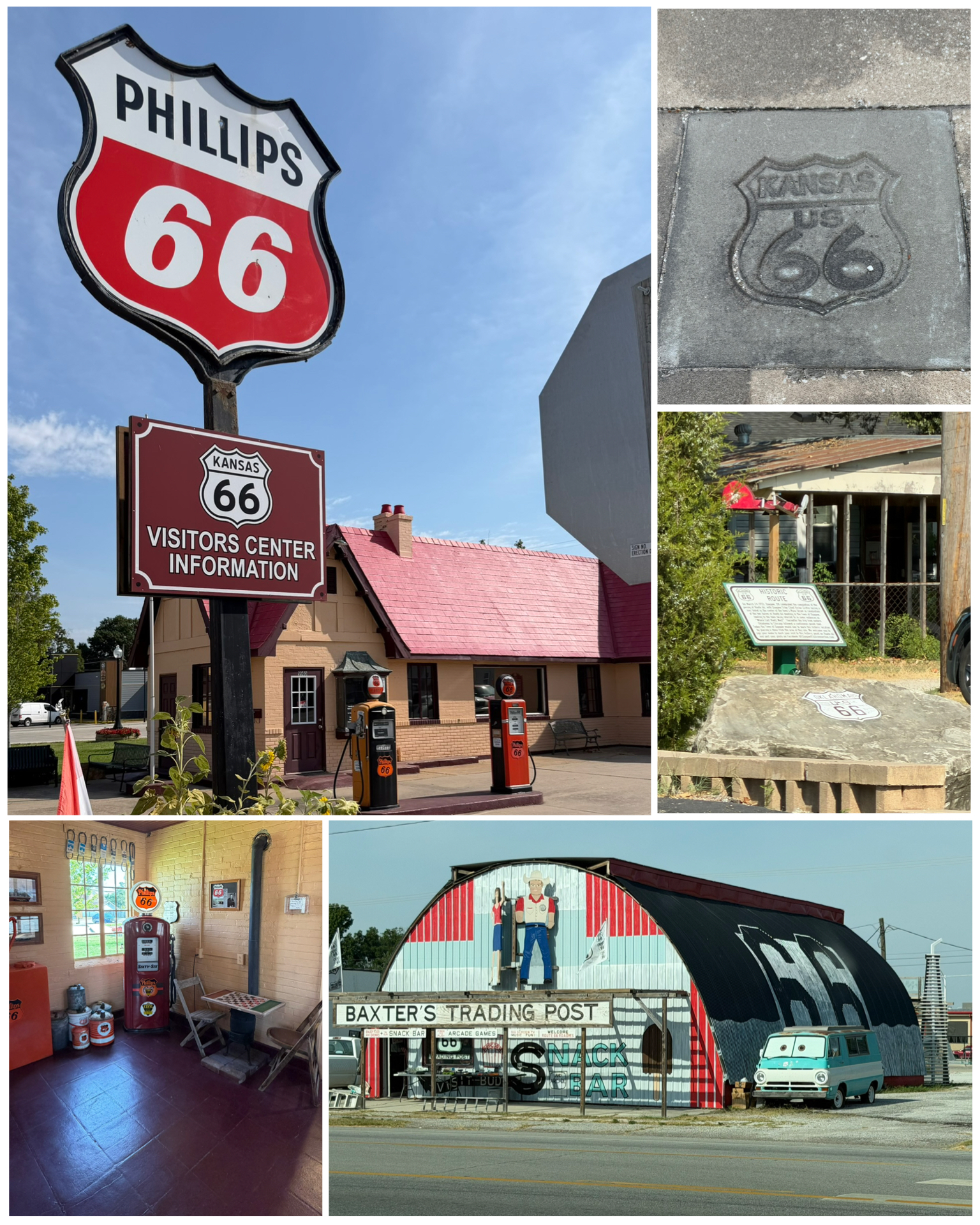 But just before crossing the border, I stopped to check out this famous rock in Quapaw, Ok (at right, center right). Quapaw calls itself “where east meets west” and it would be this section of Rt 66 that in 1933 the Chief of the Quapaw Tribe laid a zinc tablet to commemorate the final section of paved Rt 66 between Chicago and Oklahoma. Well apparently zinc is not a very hardy metal, and it was not long before the road inlay was obliterated. It was decades later in 2017 that instead they placed this giant rock near where the inlay once stood, and welcomed tourists to come and sign their name upon it. Supposedly the rock is filled with names at the end of each tourist season, so they then scrub it clean to make it ready for the next year’s batch of tourists. The first town that you reach when crossing into Kansas from the south is Baxter Springs – the first of only three towns that exist along this 13-mile stretch of Kansas Rt 66. The first attraction you reach is the Trading Post (at right, bottom right). This popular photo op place has a number of two-dimensional Rt 66 icons including the Pops soda bottle, and several Muffler Men and Uniroyal Gals ready for photos. The next stop was a visit to the former 1930 Cotswold cottage-style Independent Oil and Gas Service Station – now the 2020 restored Baxter Springs Rt 66 Visitors Center. It featured a nice little museum with time period artifacts, along with a very well versed, and somewhat over-talkative visitor center representative who easily talked my ear off for upwards of 30 minutes. I guess they don’t get too many visitors around here so they make up for it in other ways. But she was actually very nice and very knowledgeable about the area and its Rt 66 history, and managed to work in many aspects of that history in between lots of anecdotes about her personal life. A fun and interesting stop nonetheless.
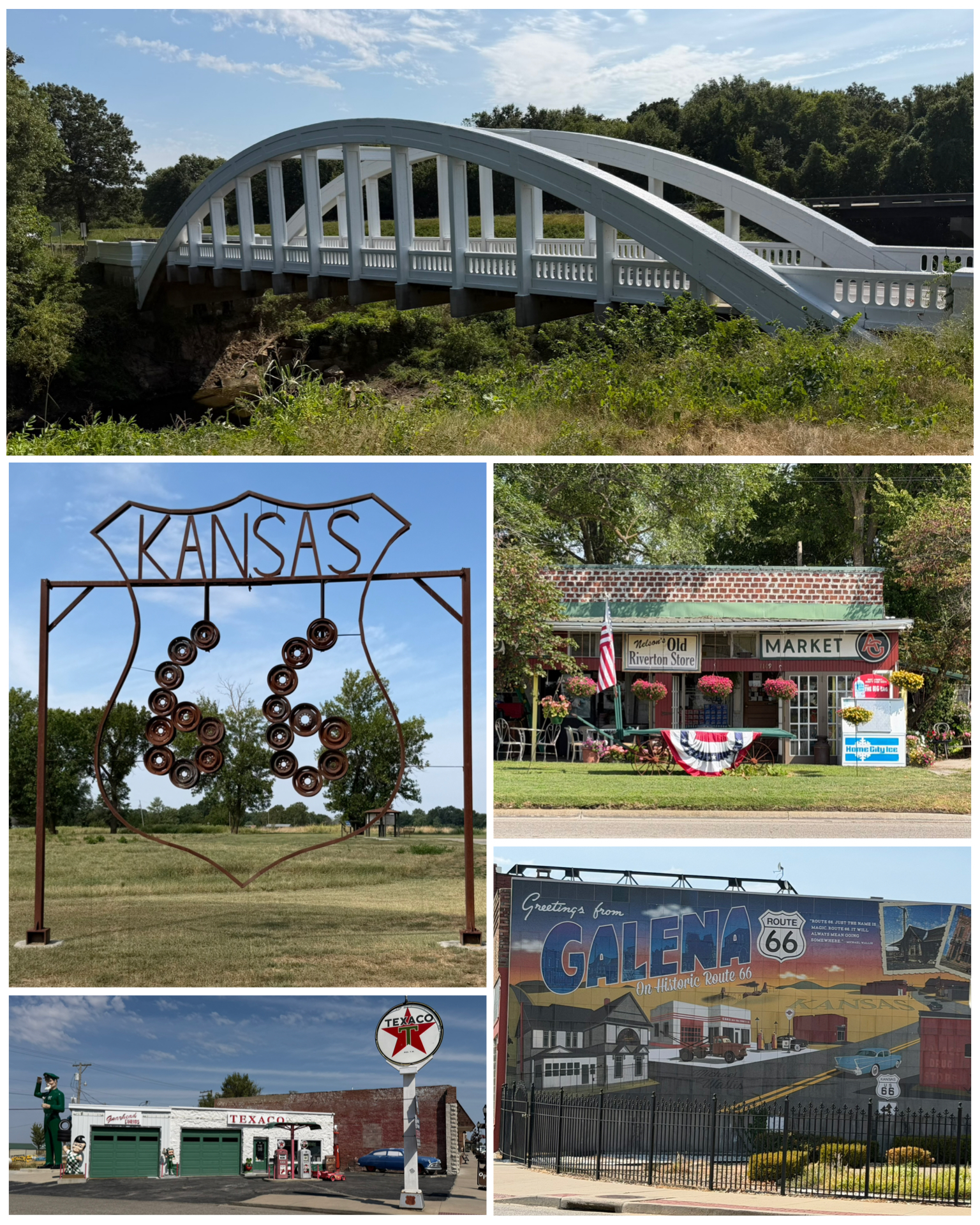 Further into Kansas we come to Riverton and what is perhaps the single most iconic feature of Kansas Rt 66 – Rainbow Bridge. Spanning Brush Creek, this 130-foot-long concrete arch bridge, designed by James Barney Marsh, is the only bridge of this design along the entire length of Rt 66. It was opened to traffic in December of 1923, and operated well into the 1990s. It was at that time when it was threatened with demolition, but saved by preservationists who convinced the state to build a new bridge further downstream – leaving this bridge as a historical landmark. Lacking any rainbow colors, the bridge actually gets its name from the pair of graceful concrete arches that span along either side of its narrow roadway. Today the bridge remains fully restored and serves as a one-way travel drive-thru photo op for Rt 66 tourists. Next is this nicely done Rt 66 shield sign made from wheel rims (at left, center left). Completed in 2018, it was the idea and ultimate creation by a group of high school students from Riverton – the second of only three Rt 66 towns that pass through Kansas. This 20-foot-tall sign features two sixes made from welded-together wheel rims donated by the Kansas Department of Transportation. Nicely done! Just down the road along Rt 66 is the Old Riverton Store (at left, center right) which bills itself as the oldest continuously operating store on Rt 66. It was built and opened in 1925 – a full year before Rt 66 was even born. It has remained in business since, still having its interior tin ceiling, and still selling sandwiches, coffee, snacks, and souvenirs to this day. They actually celebrated their centennial anniversary last year. Wow! Next, we come to the third and final of the three Kansas Rt 66 towns – Galena. Here we find this beautiful welcoming town mural (at left, bottom right) showcasing their Rt 66 heritage. Once into town, we arrive at this one-of-a-kind Texaco Giant. Standing 22 feet tall, it was custom made and unveiled in September 2024 to showcase this restored 1939 Texaco filling station that now operates as a Rt 66 souvenir shop named Gearhead Curios. He is molded from the shoulders down after the Amarillo-based 2nd Amendment cowboy, while his head is fashioned from the Paul Bunyan Muffler Man. A goatee and painted sideburns were added to resemble Curios owner Aaron Perry. Definitely a unique version of a Muffler Man!
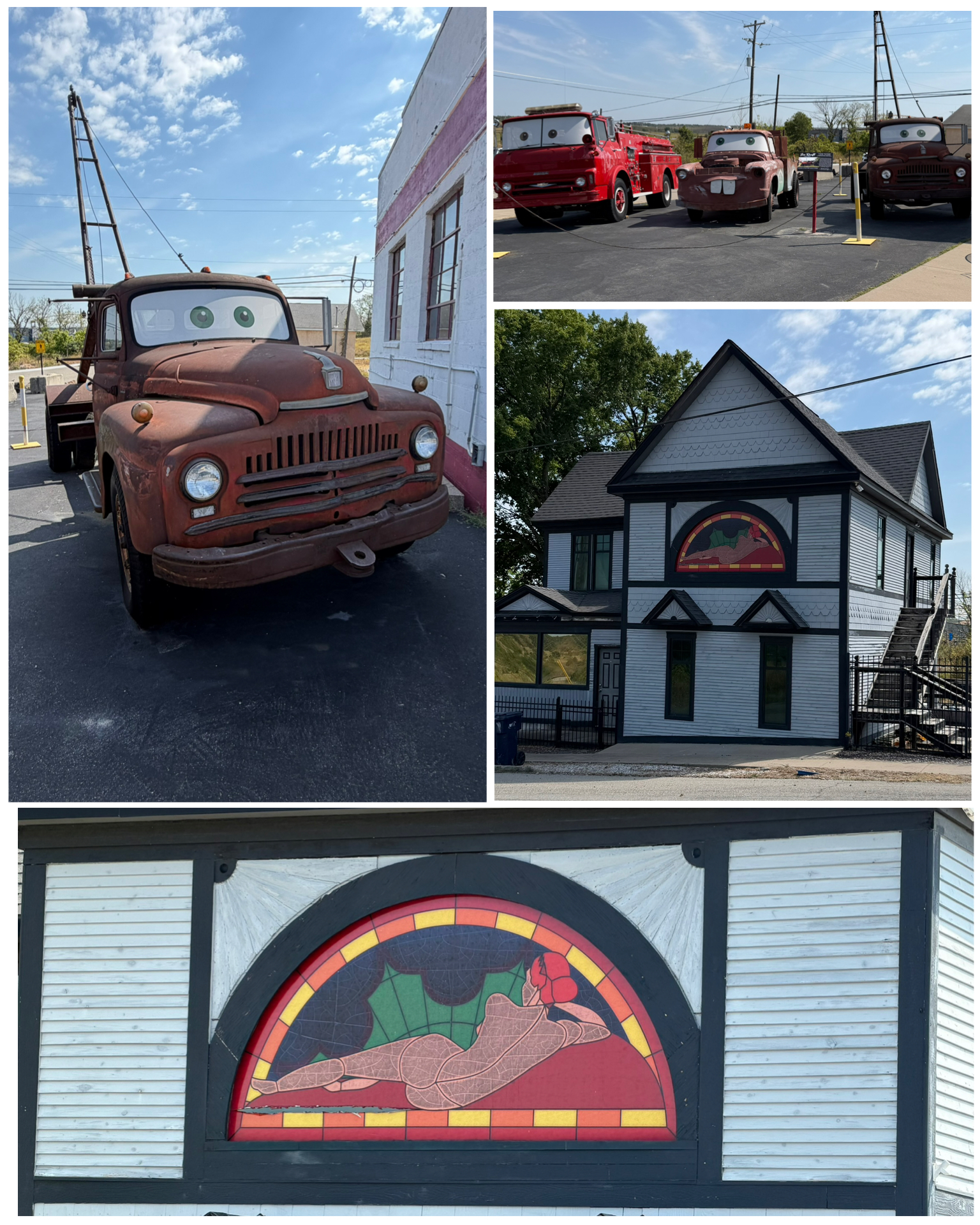 Next in Galena we come to what is believed to be the birthplace of the 2006 movie Cars. It was here outside a 1934 Kan-O-Tex service station that a group of Pixar designers on a 2001 Rt 66 research trip took notice of an old 1951 International L-170 truck that would later inspire the film’s most popular character Tow Mater. The rest, as they say, is history. Of particular interest across the street from the Cars truck was the house affectionately known as the Staffleback Bordello. It was constructed in 1890 by the Galena Mining Co as a brothel for its employees to use (what a nice company benefit). It was believed to have been the home of Ms Staffleback – an infamous 1890s madam who was convicted of murdering one of her clients and dumping their body in the local mines. This beautiful Victorian home was restored in 2010 and opened for tours as the Galena’s Murder Bordello – complete with its archway stained glass of a rear-facing nude woman. There is plenty of local controversy as to whether this is the actual house where Ms. Staffleback once lived, let alone that this was the location of the murder for which she was convicted. Certainly, some residents would rather not bring this piece of history to the forefront of tourists. But I suppose either way, it does bring tourist $s to this little town so I guess there is that benefit!
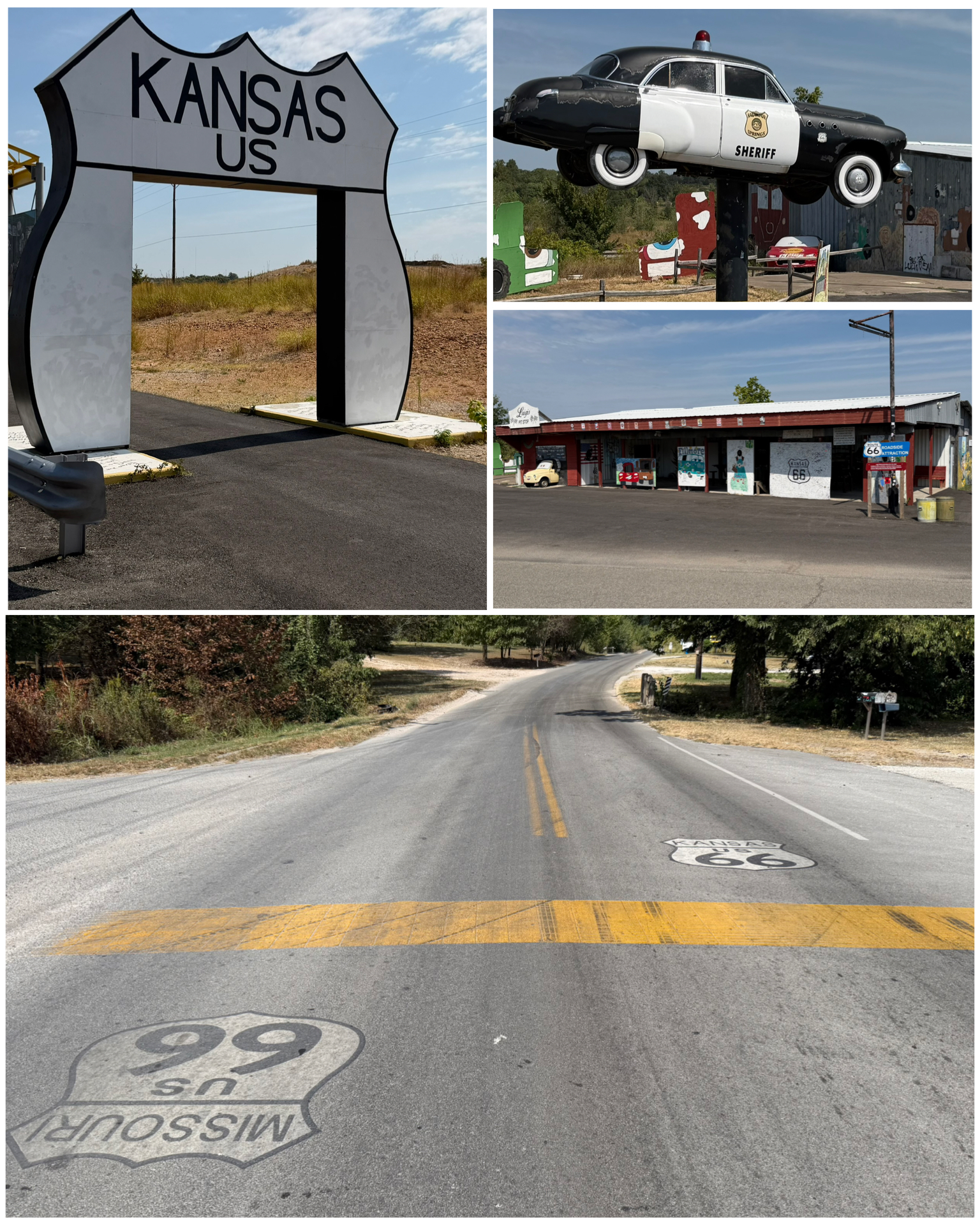 Next we come to the final collection of Rt 66 sites in Galena, and in fact in all of Kansas. First up, was Luigi’s Pit Stop (at left, top and center right) – a tribute location to the Pixar movie Cars. It includes a 1949 Mercury police cruiser sitting up on a pole – representing Sheriff from the film. There’s also Luigi – an Italian Fiat 500 that’s sticking out from a tire shop. Across the street is the last of four drive-thru Rt 66 shields that exist in AZ, NM and here in KS, where once again, I opted to take a picture of the shield alone sans the truck. Completed in 2024, this 16-foot-tall metal shield commemorates your entrance to, or exit from the 13-mile stretch of the Kansas Mother Road. The final attraction to check out here in Kansas is actually the dividing line that separates the Kansas side of Rt 66 from the Missouri side. As with much of Rt 66, this 2-lane original segment between Joplin, MO and Galena KS was rerouted with a 4-lane version bypass. The purists preferred the original 2-lane route so they laid several rows of yellow-painted bricks along the dividing line between the two states to provide a photo op to entice would-be tourists to follow the original Rt 66. Certainly worked for me!
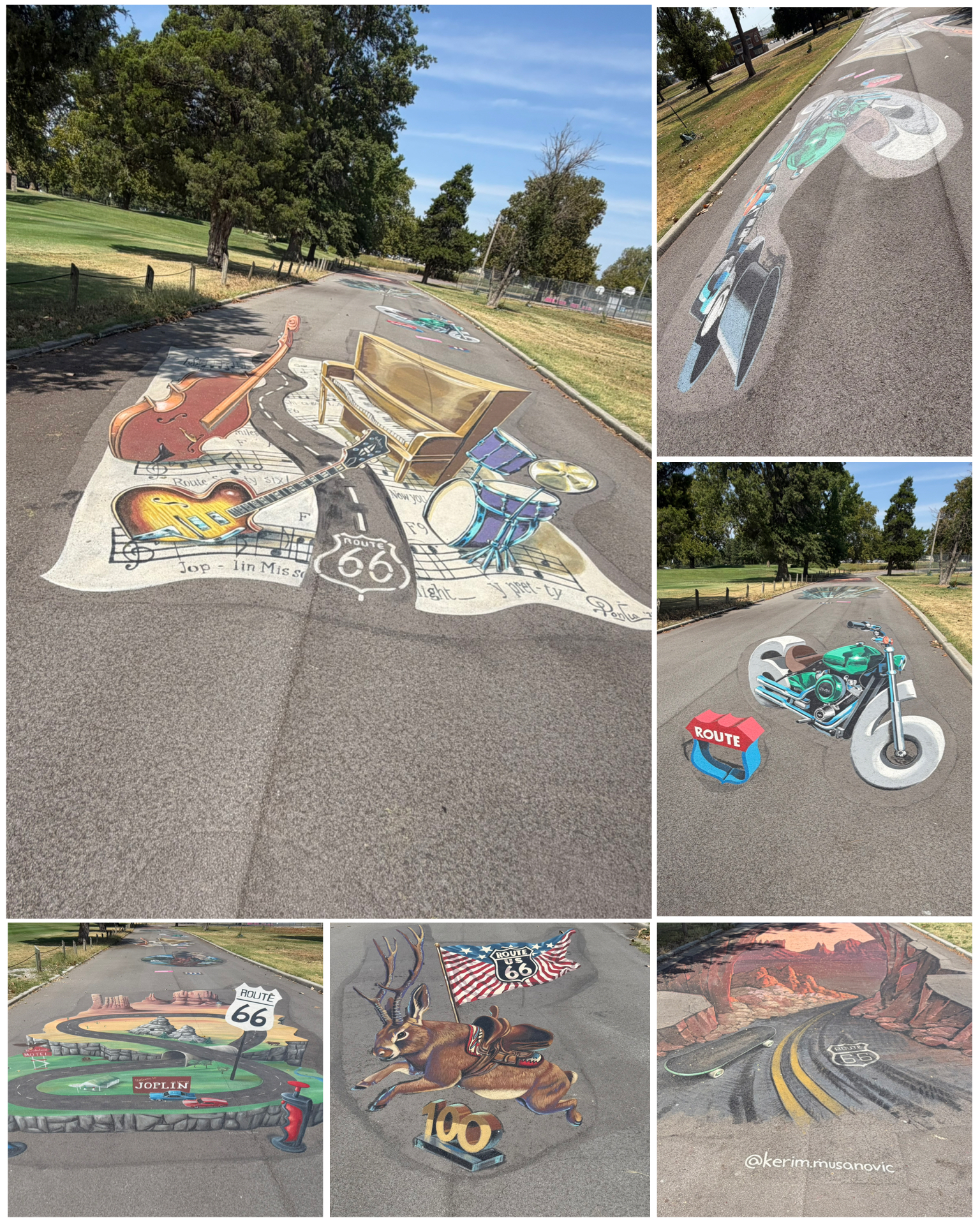 Next I extended my exploration into the state of Missouri – starting in the town of Joplin. First stop was this really awesome Joplin event called the World Street Painting Around the World. It included three locations that featured 29 three-dimensional artworks made by artists the world over. Done during the Route 66 Centennial, this created the world’s largest open-air 3D street painting gallery. Each street scene had a specific place designated where to stand so that you get the true 3D effect. It was truly amazing and it’s doubtful that these pictures will do it justice!
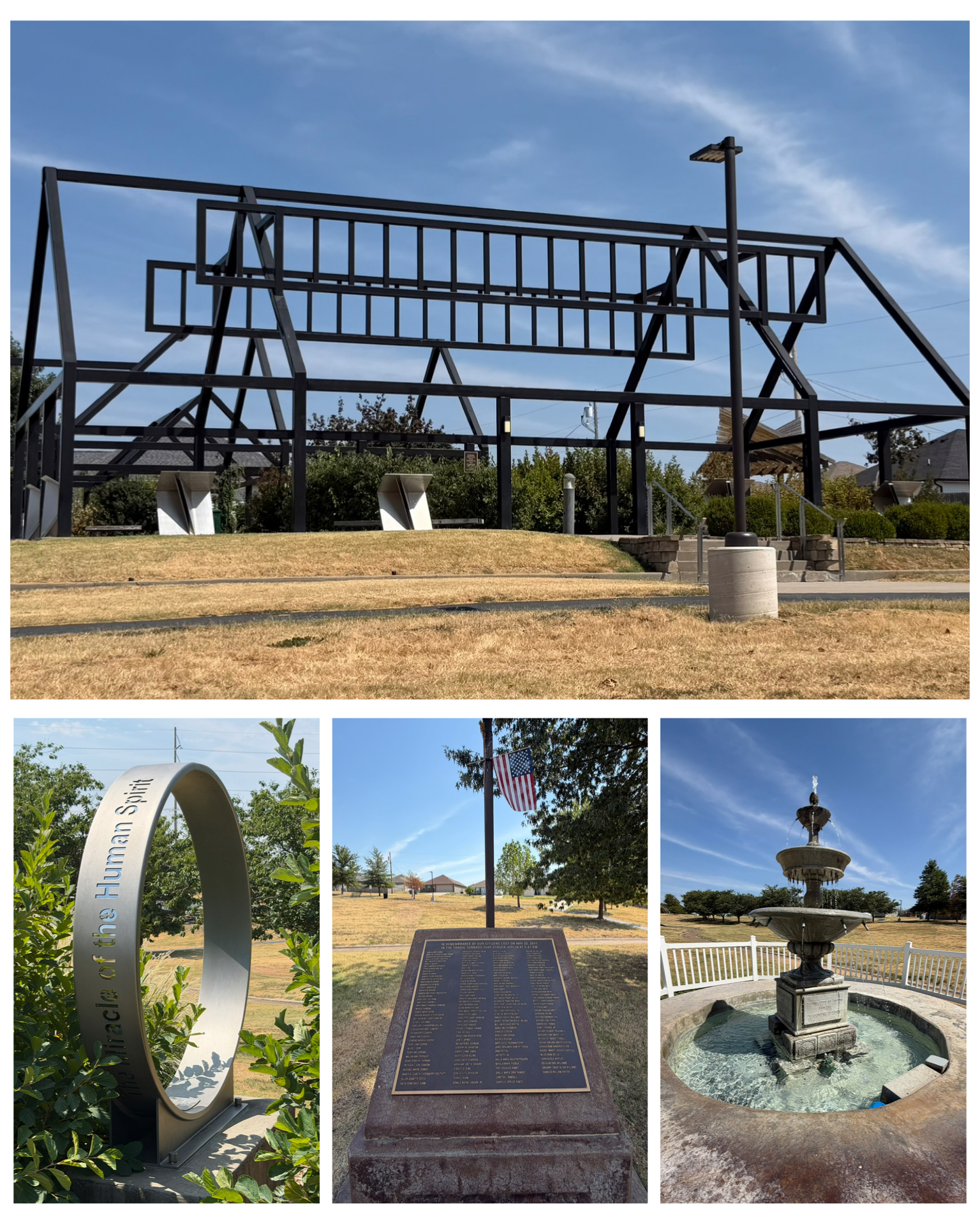 Many of you might recognize the town name of Joplin from the horrific tornado that tore through and caused catastrophic damage to this poor town back in the early evening hours of May 22, 2011. The EF-5-rated tornado was the deadliest US tornado in over 60 years, taking the lives of 158 individuals, and injuring over 1,000 more. It damaged nearly 8,000 buildings and destroyed over 4,000 homes for a total net loss of $2.8 billion – making it the costliest single tornado in U.S. history. Though certainly not Rt 66 related, I did take the time to visit Cunningham Park and its Miracle of Human Spirit exhibits. From the bronze plaque that memorializes the names of each life lost, to the Butterfly Garden, and the Ring that honors the volunteers who selflessly contributed to the town’s recovery, to the skeletal wireframe house representative of the aftermath – together they serve as a powerful testament to the city’s resilience and as a moving memorial to the community. It was a beautifully done memorial park!
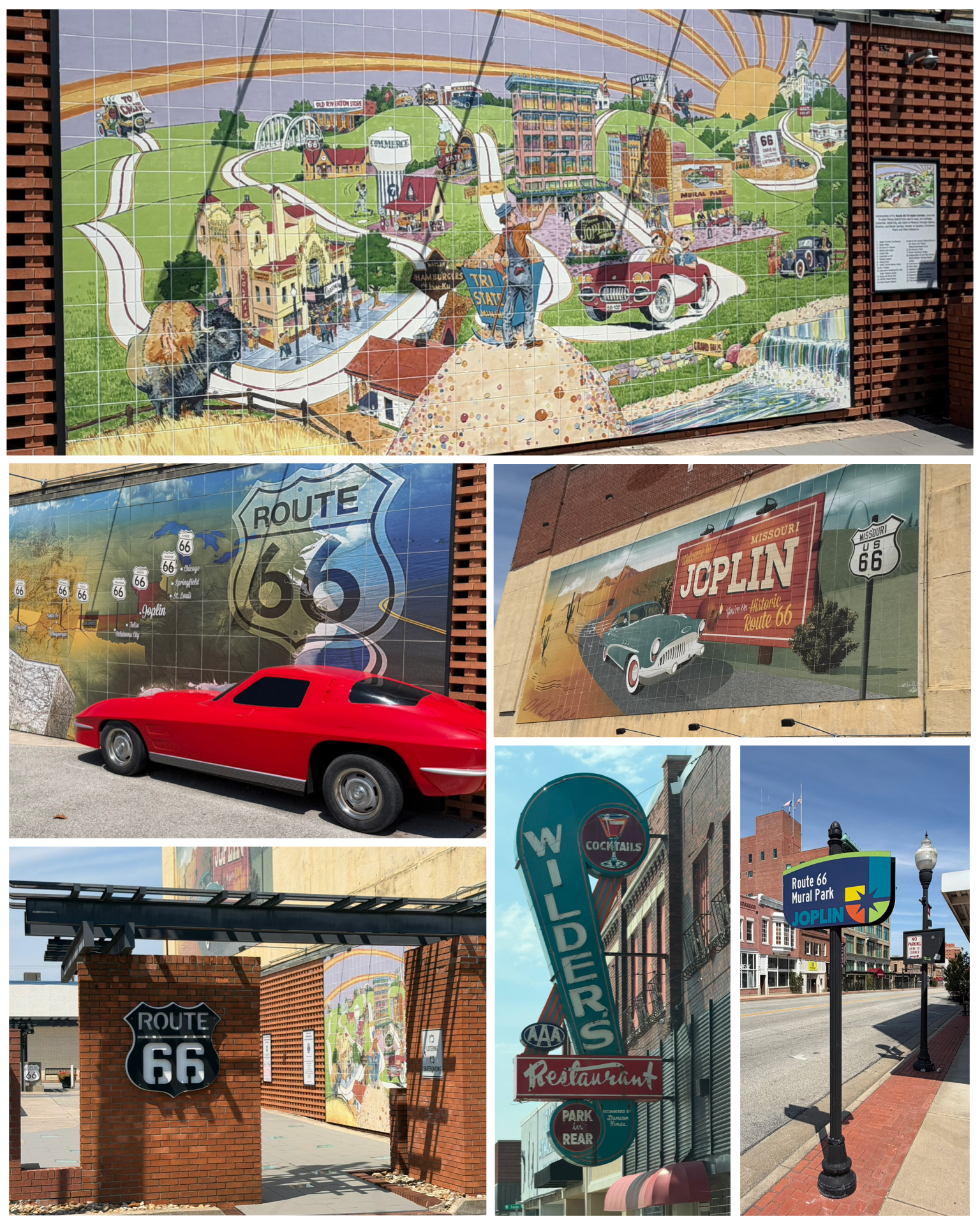 Back to downtown Joplin to check out a couple of Rt 66 sites. First up a couple blocks off of Rt 66 was the Wilder’s Steakhouse (at right, bottom center). Besides being a popular eating stop since 1929, it has an interesting history. In the late 1950s besides serving outstanding meals, owner Verne Wilder ran an illegal casino above the restaurant. Local police looked the other way, but the nearby Kansas City mob was none too happy. They tried to put a stop to it by placing several sticks of dynamite on the roof above Verne’s office in an attempt to kill him. It blew a large hole in the roof, but left Verne unharmed. I’m not sure what became of the casino after that, but the restaurant still serves wonderful meals to this day. Next up I visited the Joplin Rt 66 Mural Park. Here were several murals showcasing Rt 66 as it traverses through nearby KS through Joplin and on to Carthage. There was even a mural that featured a half of a replica 1963 Corvette sticking out of the wall to add dimension for photos. Also, the murals were not painted – but rather have their colorful elements baked into tile and mortared onto the wall. With that, this mural park should remain colorful for a very long time. Nicely done Joplin!
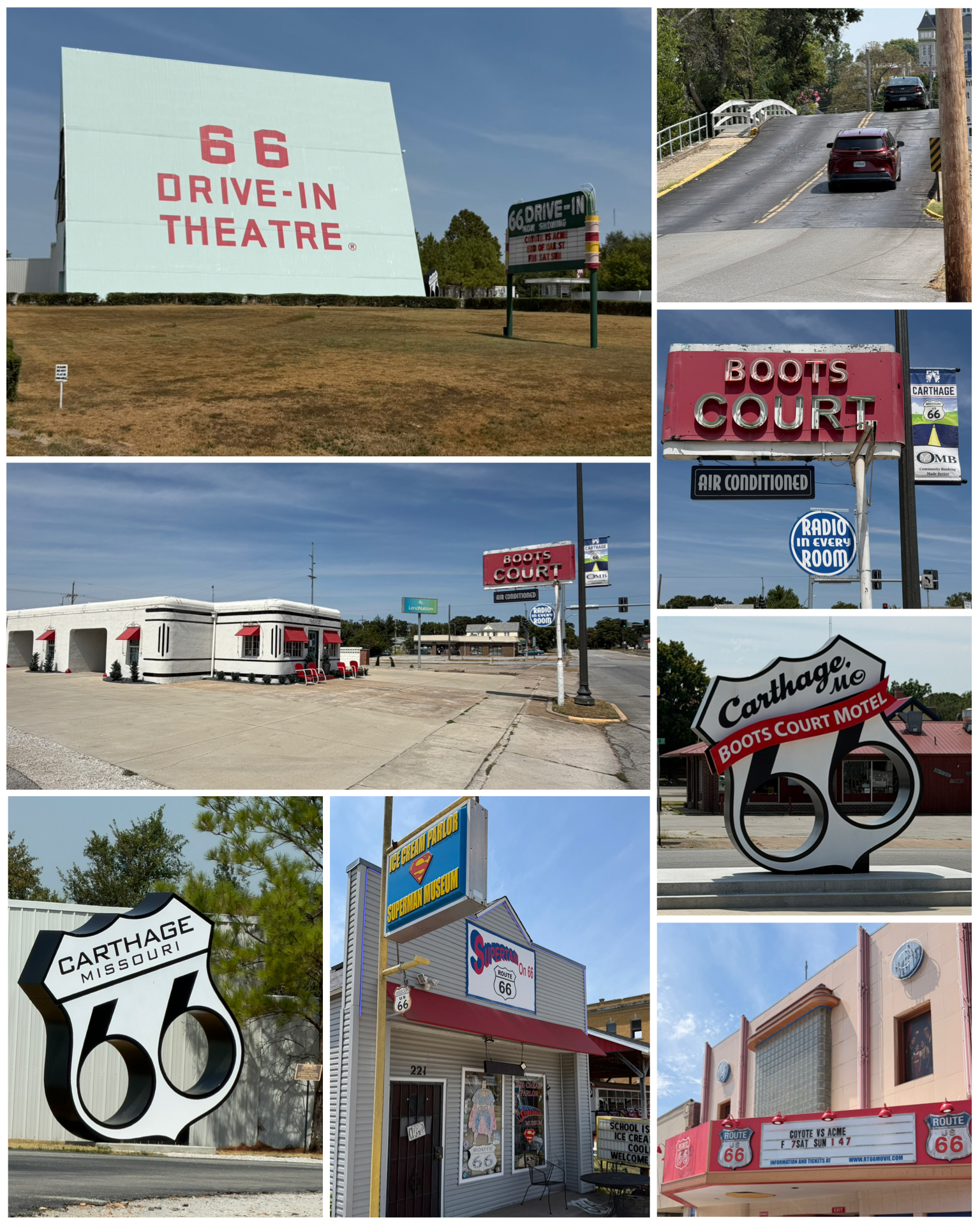 I continued heading east from Joplin for my next stop in Webb City. Here I would find the Route 66 Theater (at left, bottom right). This theater blends the Art Deco themes of the 1930s movie palace, with a modern-day movie venue with Dolby Digital surround sound and digital projection. And for $399, you can rent out the entire place for kid parties of 25 with the showing of any movie they want, and an all-you-can-consume popcorn and soda bar. Bring your own cake! I was actually looking forward to my next stop down the road in Carterville, as it was just about ice cream snack time and next up was the SuperTAM on 66 Ice Cream Parlor and Superman Museum (at left, center bottom). Besides ice cream, the place features the 2,600-item private Superman collection of Larry Tamminen who opened the venue along Rt 66 in 2006. He originally called it Superman on 66, but Time-Warner lawyers got after him, so he used the first three letters of his last name and changed it to SuperTAM. According to Google, it was supposed to be open, but alas for whatever reason, it was not. So not only did I not get to see the Superman collection, I also didn’t get any ice cream. How disappointing! Continuing east, my next town to visit is Carthage where the first point of interest is the 66 Drive-in Theater. This theater showed its first movie on September 22, 1949, and continued operating until Rt 66 was decommissioned in 1985. It spent the next decade or so as a local junkyard, but thankfully was restored and reopened in 1998. To this day, it continues to showcase two first-run movies each weekend during warm weather months. Its other claim to fame is that it was the inspiration for the Radiator Springs Drive-in Theater featured in the Pixar movie Cars. The next Rt 66 oddity in Carthage is what is affectionately called the Whee Bridge (at left, top right). It was 1920 Oak St (later to become Rt 66) that had to cross Union Pacific railroad tracks with enough height clearance for the engines and their cargo to safely traverse below. They only had 56 feet of length to work with, so they built a timber bridge in the shape of a hump. In the early days when cars rarely travelled over 25 MPH, it wasn’t much of an issue. But as engines got bigger and speeds increased, it wasn’t long before cars would cross at a higher rate of speed causing them to briefly become airborne – hence the Whee in Whee Bridge. Despite it looking like a lot of fun, I opted not to take my big-boy F450 dually truck on an airborne adventure. Probably a good decision! Last up in Carthage I visited Boots Court (at left center left and top center right). It was Arthur and Ilda Boots who opened Boots Court on Route 66 in 1939. For its time, it was a sleek and modern motel, neon-wrapped, and advertised having a “radio in every room”. They charged a whopping $2.50 a night back then, and reportedly had Clark Gable stay there twice, and Mickey Mantle and other celebrities staying at least once. Like many other Rt 66 venues, it fell into serious disrepair after several decades of neglect, and was nearly demolished in 2003. But once again preservationists came to the rescue and fully restored and reopened all 13 rooms in 2023. The adjacent gas station was converted to a Visitor Center and gift shop. Nicely done!
Lebanon, MO
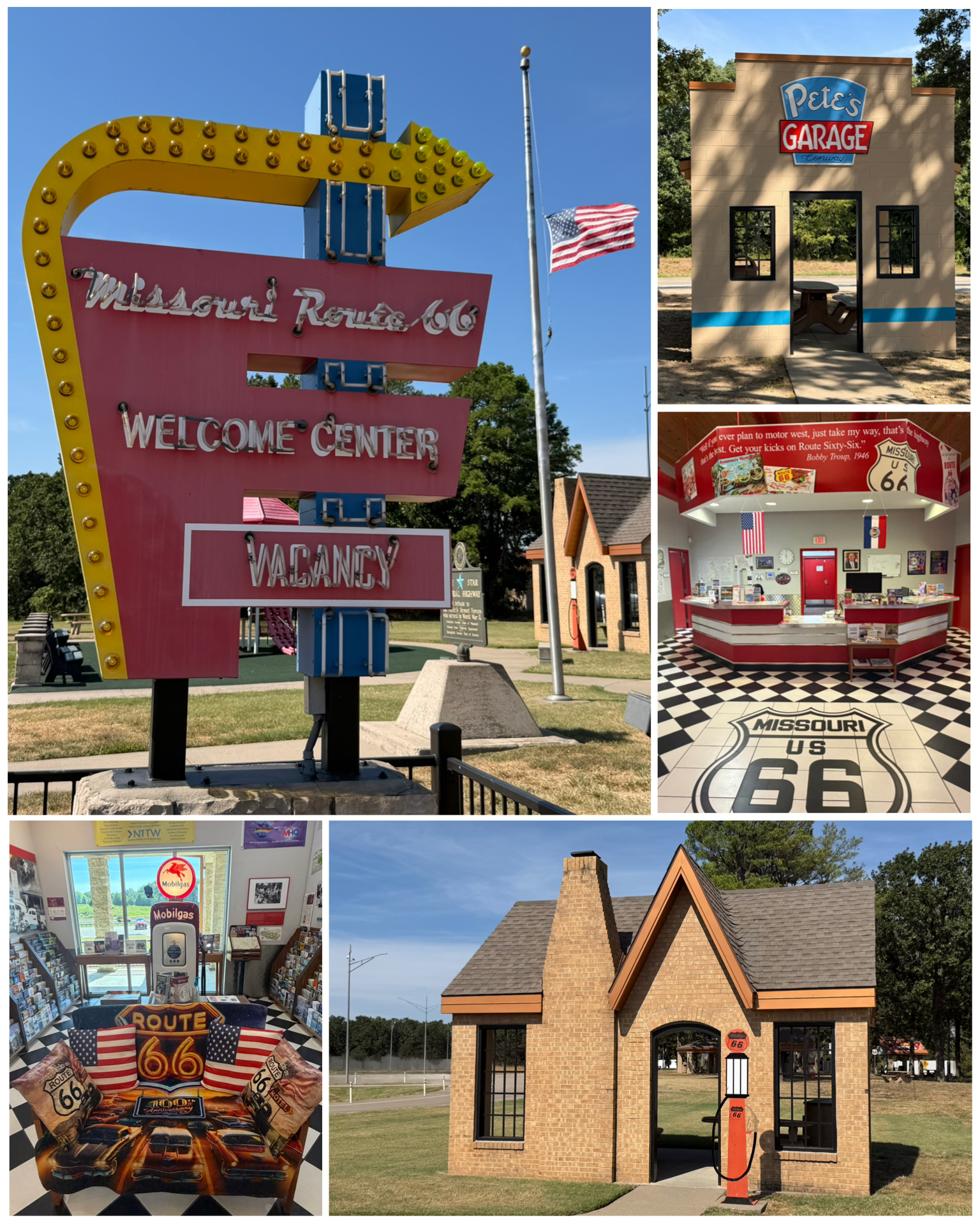 My next overnight stop takes me deeper into Missouri where I will finally catch back up to my original schedule – albeit arriving 3 days late for a shortened 4-night stay. At least I’ve now got a bit more time to spend on the Mother Road to explore what there is to see. I pointed the truck back to the west where I would first visit the I-44 rest stop and visitor center near Conway. It’s not your average boring nothing to see there kind of rest stop, but rather one that has fully embraced the Rt 66 theme. A large neon-style sign, a replica of the Munger Moss Motel sign in Lebanon, welcomes you to the stop. Outside are several Rt 66 picnic areas that not only provide shade, but also offer a private 66-themed mini building in which to sit. Inside the visitor center we find the visitor portion looking like a 50s diner, while the brochure area has an old gas pump and other Rt 66 decor. Very nicely done for an interstate rest stop, but it does seem a bit odd given it was this very interstate that sort of killed the old Rt 66 to begin with.
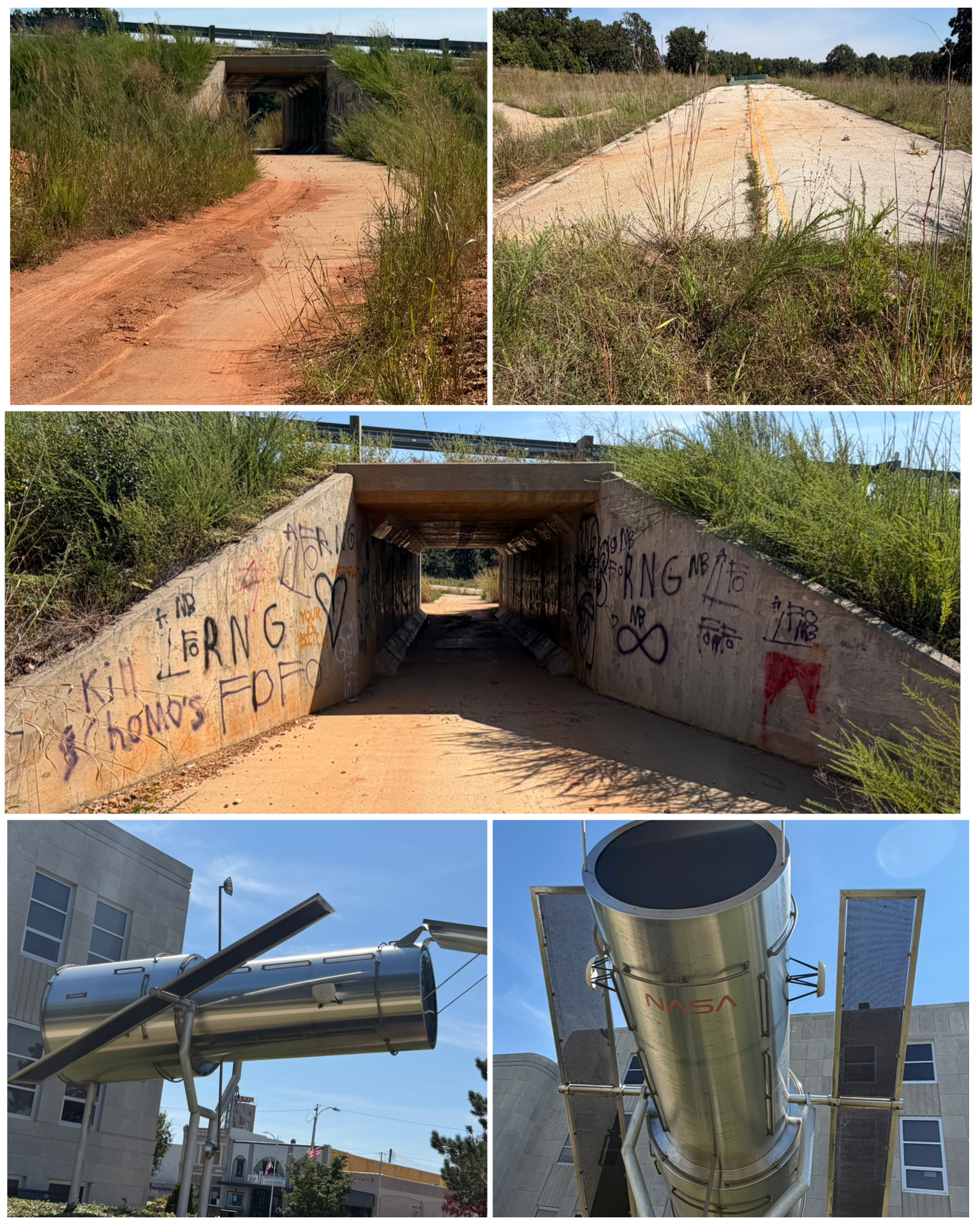 While a lot of the original abandoned sections of Rt 66 are either long gone or severely degraded, this little slice of roadway, complete with its center stripe, has managed to stay pretty fresh, and has since been designated as a city park. The 150-foot stretch of old Rt 66 sits amid a highway interchange making it a bit isolated. So, the town created a special parking area and even built a walkway tunnel underpass that safely leads visitors to the ancient roadway. I’m guessing that this is still a work in progress as the parking area was all dirt, as was the pathway leading from and to the tunnel. There has apparently been some discussion about adding an amphitheater stage to turn the area into an outdoor venue. Time will tell how much more will be done to this area, but I’m hopeful that at least the historic roadway will remain the focus point. Down the road in downtown Marshfield is this cool Roadside attraction. Fashioned after the Hubble Space Telescope, this quarter-scale replica sits on the front lawn of the county courthouse in honor of Edwin Powell Hubble – the telescope’s namesake who himself spent the first ten years of his life here in Marshfield. It was very cool!
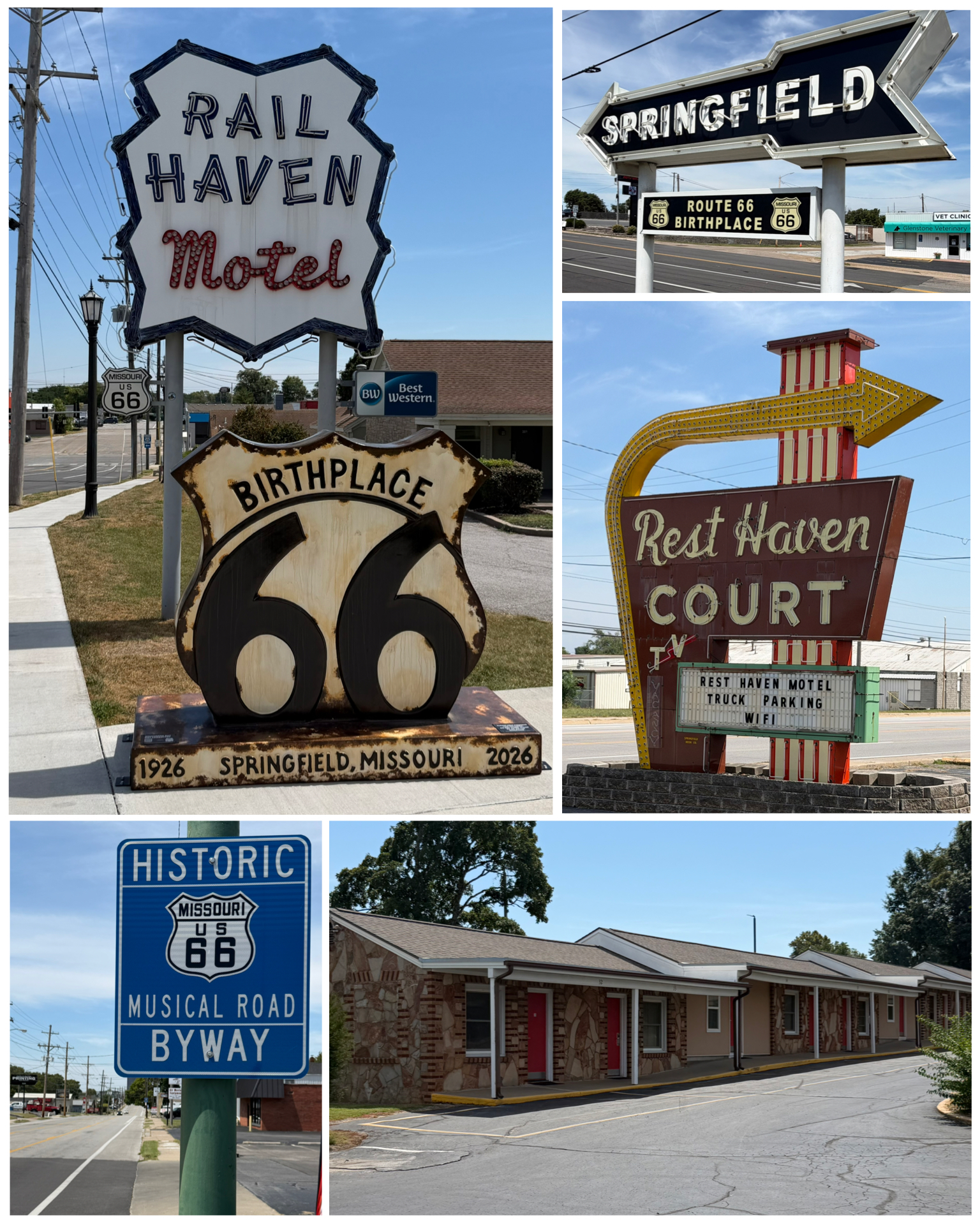 Next I continued my western trek and ventured into downtown Springfield, MO – the town that bills itself as the Birthplace of Route 66. Here I find the Rest Haven Court – a Rt 66 resting place known for its still-lit vintage neon sign which later became the inspiration for the better-known sign outside of the Munger Moss. Like a lot of Rt 66 venues, this place started out life as a gas station, then added some cottages for overnight guests, continued expanding, then by the mid 1950s the gas station was gone and it evolved into a full-fledged motel. Seventy years later, it’s still in operation offering a place to catch a snooze for the night. Next along the route is the Rail Haven Motel (at right, top left and bottom right) which has remained virtually unchanged since it was built in the late 1950s, and continues to deliver on its reputation as being one of the best-maintained old motels on 66. If you want a real treat, you can stay in room 409 – the Elvis Suite. It features a bed with pink Cadillac tail fins and commemorates Elvis Presley’s reported stay in that room in 1956. Springfield is also home to one of only a handful of musical roads (at right, bottom left). This musical road segment was created earlier this year to honor the Route 66 centennial and America’s 250th celebration. It plays “America the Beautiful” when passing over the strategically placed rumble strips at the designated 30 MPH. Very cool!
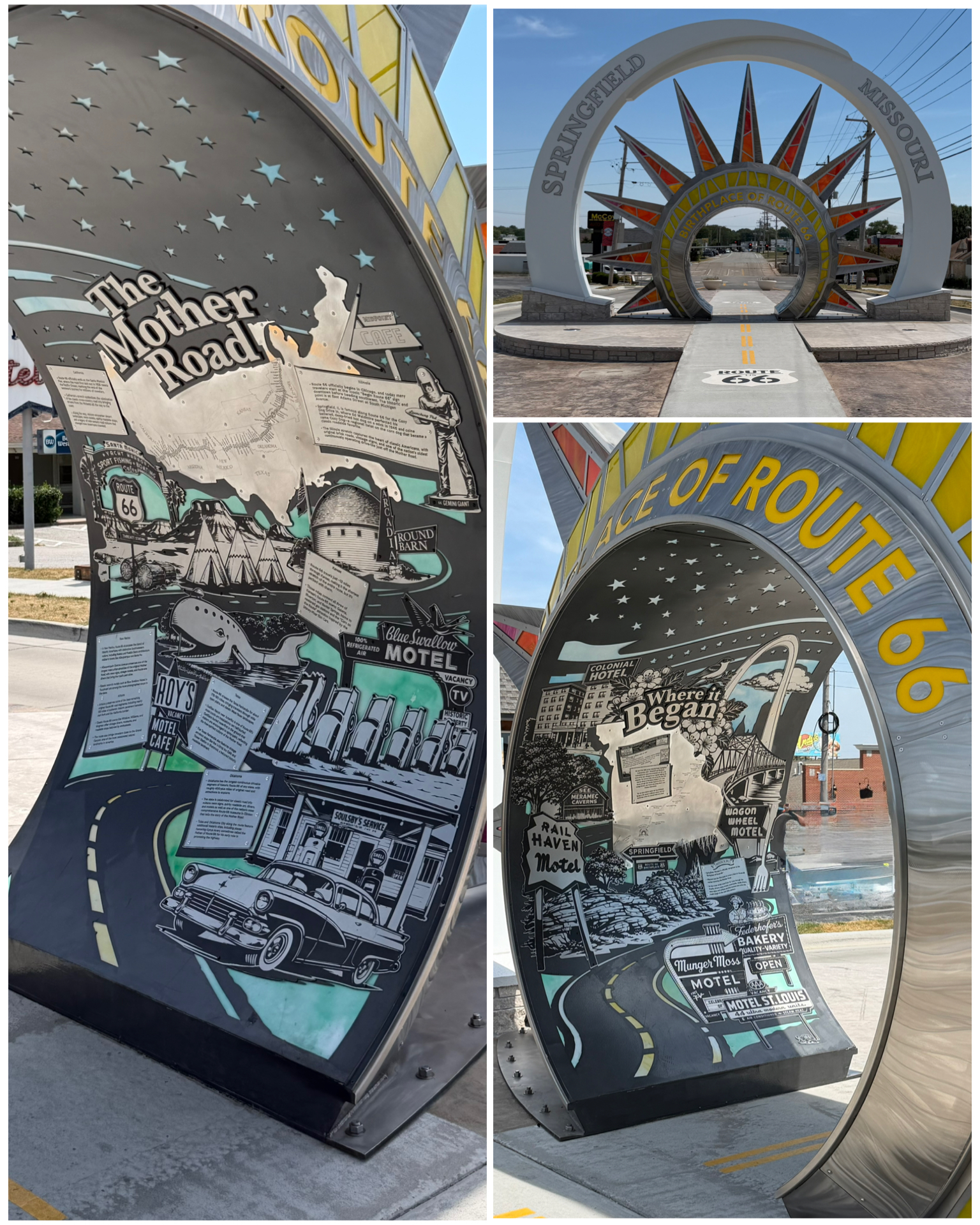 Another new addition to Springfield for the centennial celebration was this art piece known as the “Queen’s Gate 66” – a landmark that honors Springfield’s place in the history of Rt 66. It was here in Springfield where the numbering of the road as 66 was first proposed and subsequently named in 1926. The gateway, built literally in the middle of Route 66, sports the Queen theme inspired by the city’s identity as the Queen City of the Ozarks. It’s beautifully done and is engraved with images of iconic Route 66 attractions on the inside. Resembling a portal of sorts, its large crown-like structure stands almost 30 feet tall creating a striking symbol of welcome to Rt 66 visitors.
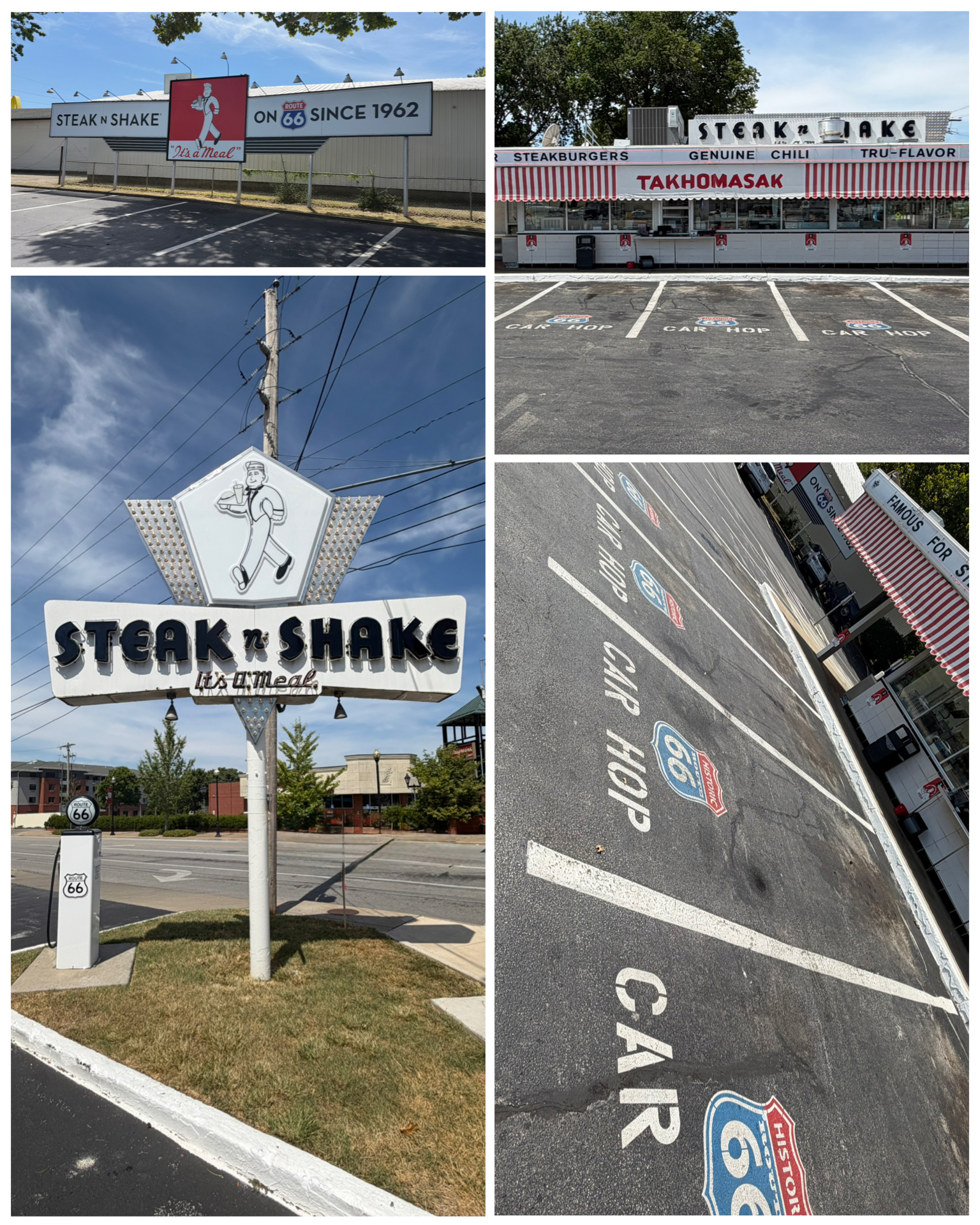 Downtown Springfield is also home to one of the few Steak n’ Shake burger joints that still looks the same as it did on the day that it opened – which in this case was 1962. It still has its stainless steel nine-stool serving counter, elaborate neon signage on the roof and on its parking lot sign, as well as all original neon-wrapped roofline slogans. It even has Rt 66 shield-tagged parking spots used for car-hop-style curb-side delivery. A really cool place that has certainly survived the test of time to remain in peak condition, both visually and operationally.
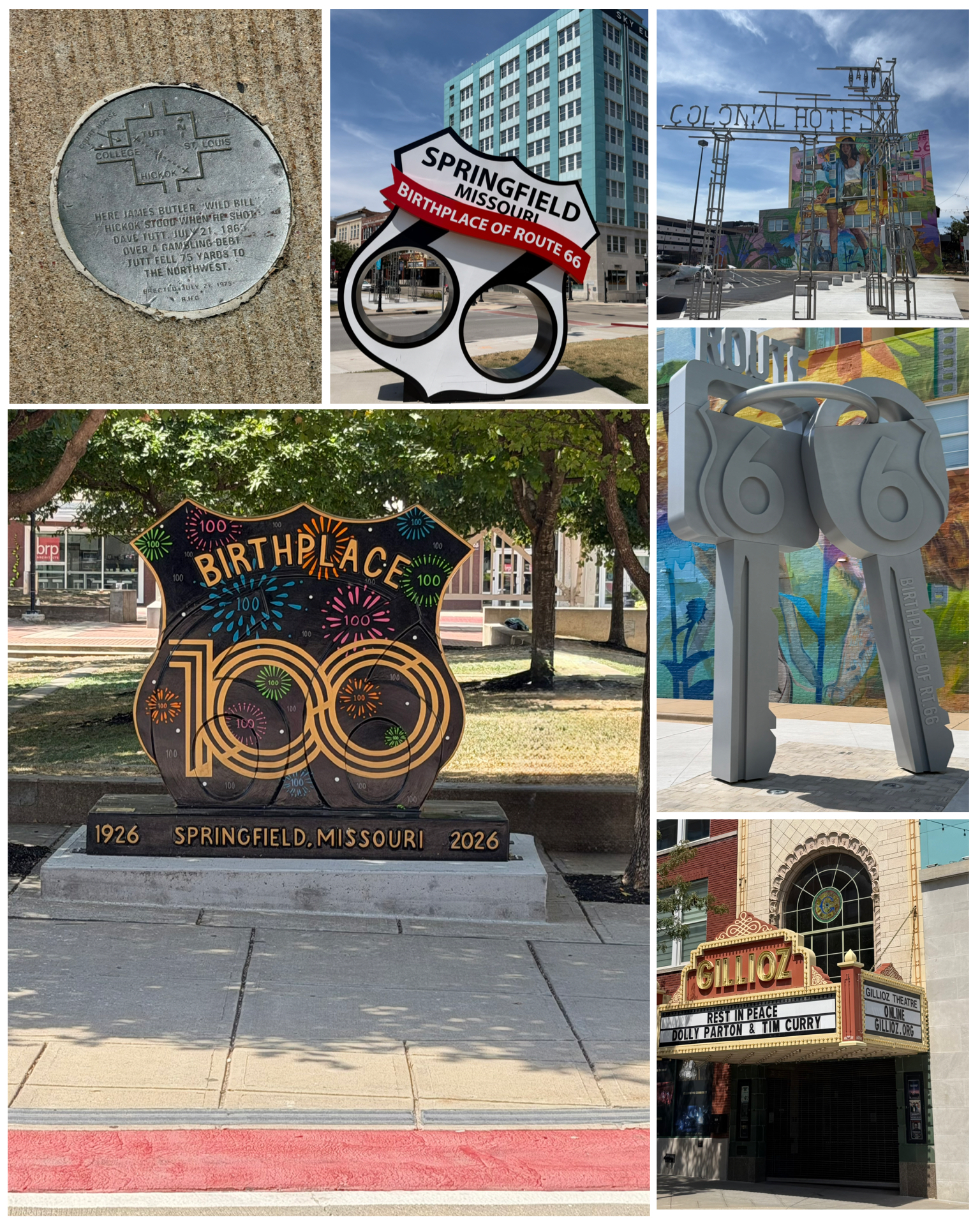 Lots more places to visit further into downtown Springfield. Several road shields adorn downtown paying homage to their unique history as the birthplace of 66. The story goes that on April 30, 1926, John Woodruff of Springfield, MO and Cyrus Avery of Tulsa, OK, sent a telegram from Springfield’s Colonial Hotel to Washington, DC, asking that the proposed Route 62 (originally thought to be Route 60) be changed to Route 66. It was believed 66 had a better ring to it, and the 2 in 62 suggested perhaps a 2nd rate road. The change was accepted, and the rest is history. The Colonial Hotel was ultimately torn down in 1997 in exchange for a parking lot, but the historic spot still remains known as the Birthplace of Route 66. The parking lot was renamed “Birthplace Plaza”, where a skeletal outline of the hotel was added (at left, top right), along with a giant set of Rt 66 keys that doubles as an information kiosk. Across the street is the Gillioz Theatre – a 20-foot-wide movie palace built in the 1920s. Despite its narrow stature, its inside is reportedly extremely opulent in Spanish Colonial Revival design, having plaster griffins, winged cherubs, and Roman pillars. It actually opened one month
 before Rt 66 became official in 1926. Ronald Reagan attended the world premiere of his film “She’s Working Her Way Through College” here at the Gillioz, in addition to having Elvis Presley pass an afternoon here, catching a couple of movies. The theater also has a haunting element ever since the projectionist died on the job on New Year’s Eve 1962. Now that’s spooky! Last up, was this plaque that marks the spot in Park Central Square where on July 21, 1865, Wild Bill Hickok shot and killed Davis Tutt over a gambling debt. It was supposedly a notable kill as Tutt was 75 yards away making for a rather difficult shot for a period six-shooter.
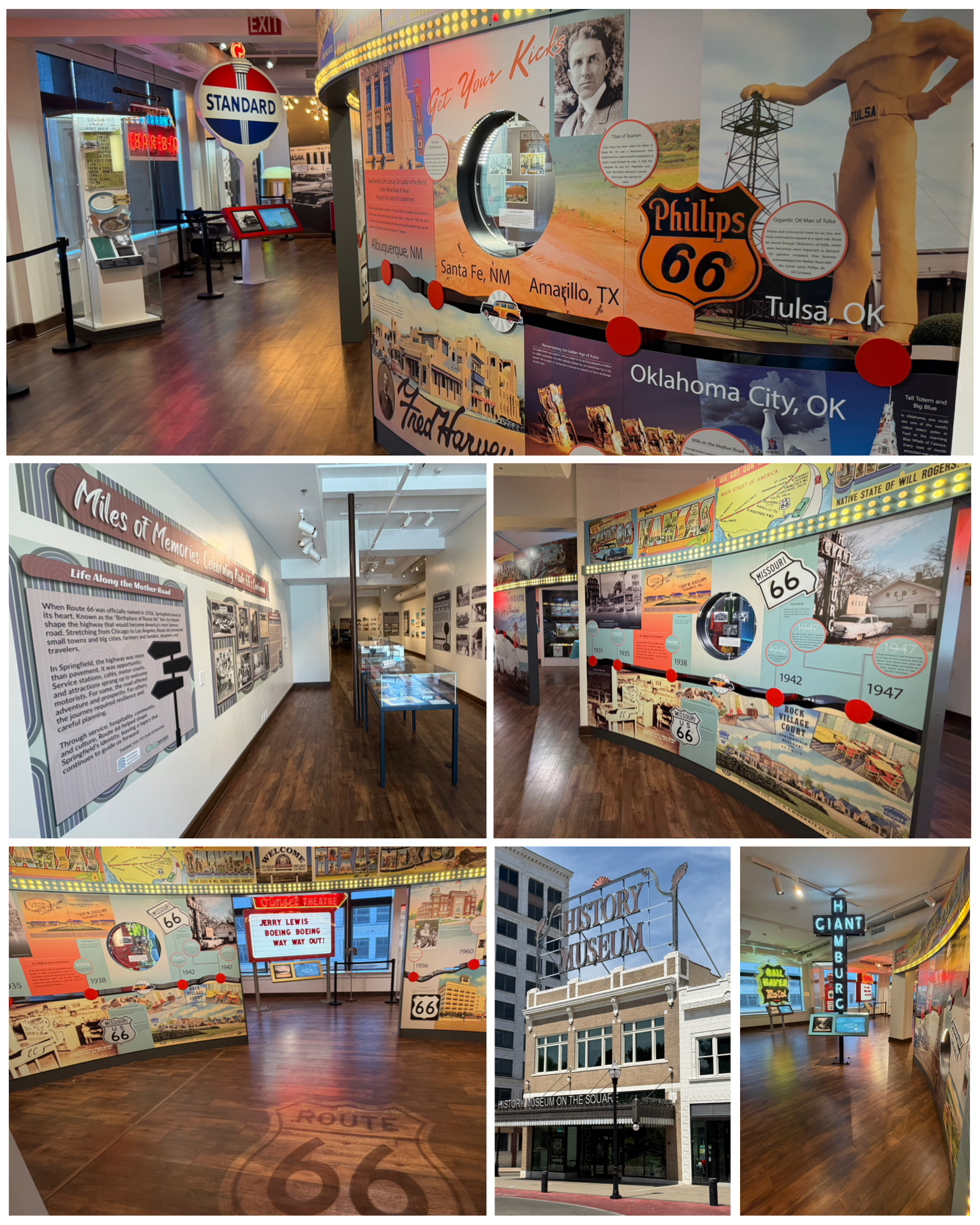
Overlooking the square was a really great town history museum. Filled with Rt 66 history, there was a video telling the John Woodruff story, a gallery of restored and replica Springfield neon signs, a restored gas pump, and lots of pictures and timelines that take you through the road’s history. There were other galleries also that covered Springfield’s Native American history, the Civil War, transportation, and of course the Wild West and Wild Bill. But with limited time available to me, I pretty much only visited the Rt 66 portion of the museum. Nicely done!
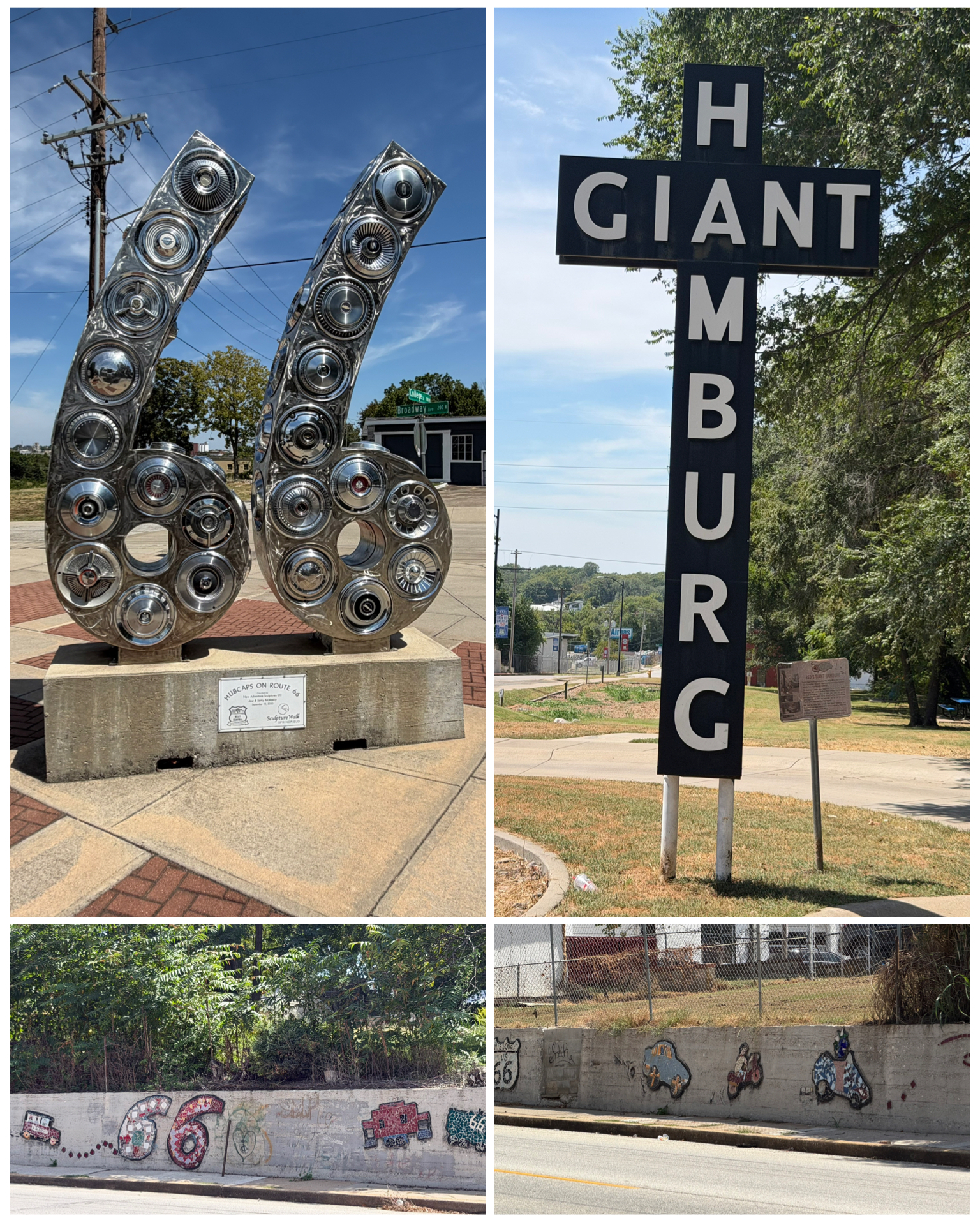 Continuing my tour of Springfield, I come upon this really cool Rt 66 sign bedazzled with hubcaps. Unveiled in September 2020 and known as the “Hubcaps on Route 66”, it’s the creation of artists Joe and Terry Malesky. The concept was to find 66 chrome hubcaps from as many different car models as possible – each representing those brands of vehicles that might have travelled the Mother Road in its heyday. Looks like they met their quota! When Sheldon “Red” Chaney had his Giant Hamburger sign built to place outside his Rt 66 burger stand, he apparently did not take into account the overall height of the sign, and its ultimate infringement with the nearby power lines. So, he had to chop the sign a bit, and it became the iconic Giant Hamburg. Sadly, the stand and its iconic sign were bulldozed in 1997. But Springfield created this replica sign that now sits as the centerpiece in Roadside Park. Also part of this local decor was this really cool wall. Local residents Stan Adam and Carol Ward came up with the idea of decorating the entire length of the 600-foot Rt 66-facing retaining wall with tile mosaics. They would engage the town’s youth to design and install the artworks. This was all to discourage what had been the practice of covering the wall with ugly graffiti. By having a stake in the work, it was believed the young would rather protect it than deface it. It appears to have worked as the wall has a nice collection of mosaics covering everything from Springfield history, to of course some Rt 66 elements. Great idea!
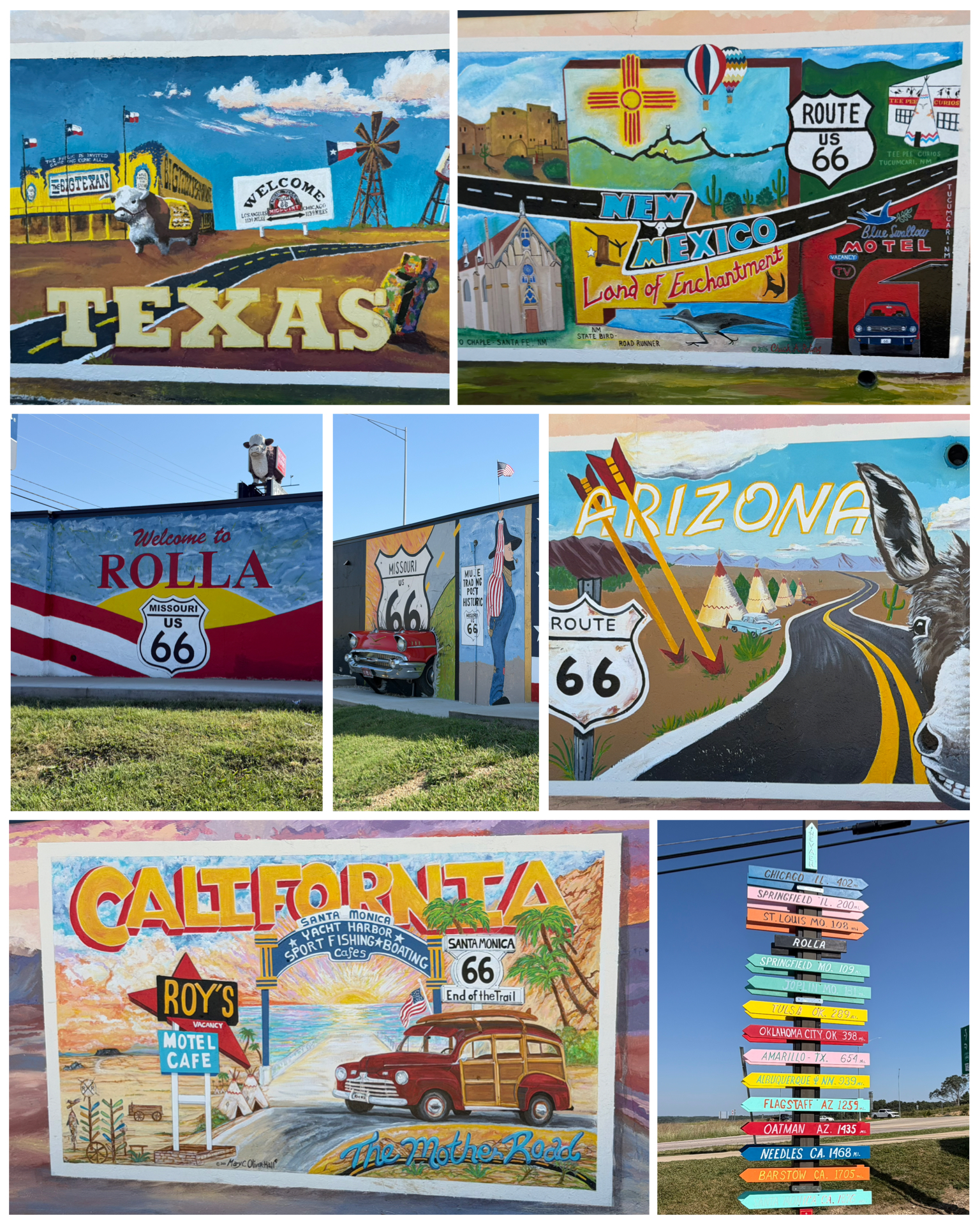 The next day I worked my way in an easterly direction checking out several of the small towns along Rt 66. First up was a visit to Rolla where I came to this amazing large R66 mural wall. There are no less than a dozen beautifully done postcard-like images representing each of the eight states along Rt 66, with each image depicting well-known attractions associated with that state. All done on a short wall that runs along a local motel property. Definitely one of the best mural walls I’ve seen this trip! There was even a mileage signpost with several high-profile Rt 66 town names, and their associated distance in miles from Rolla. Nicely done!
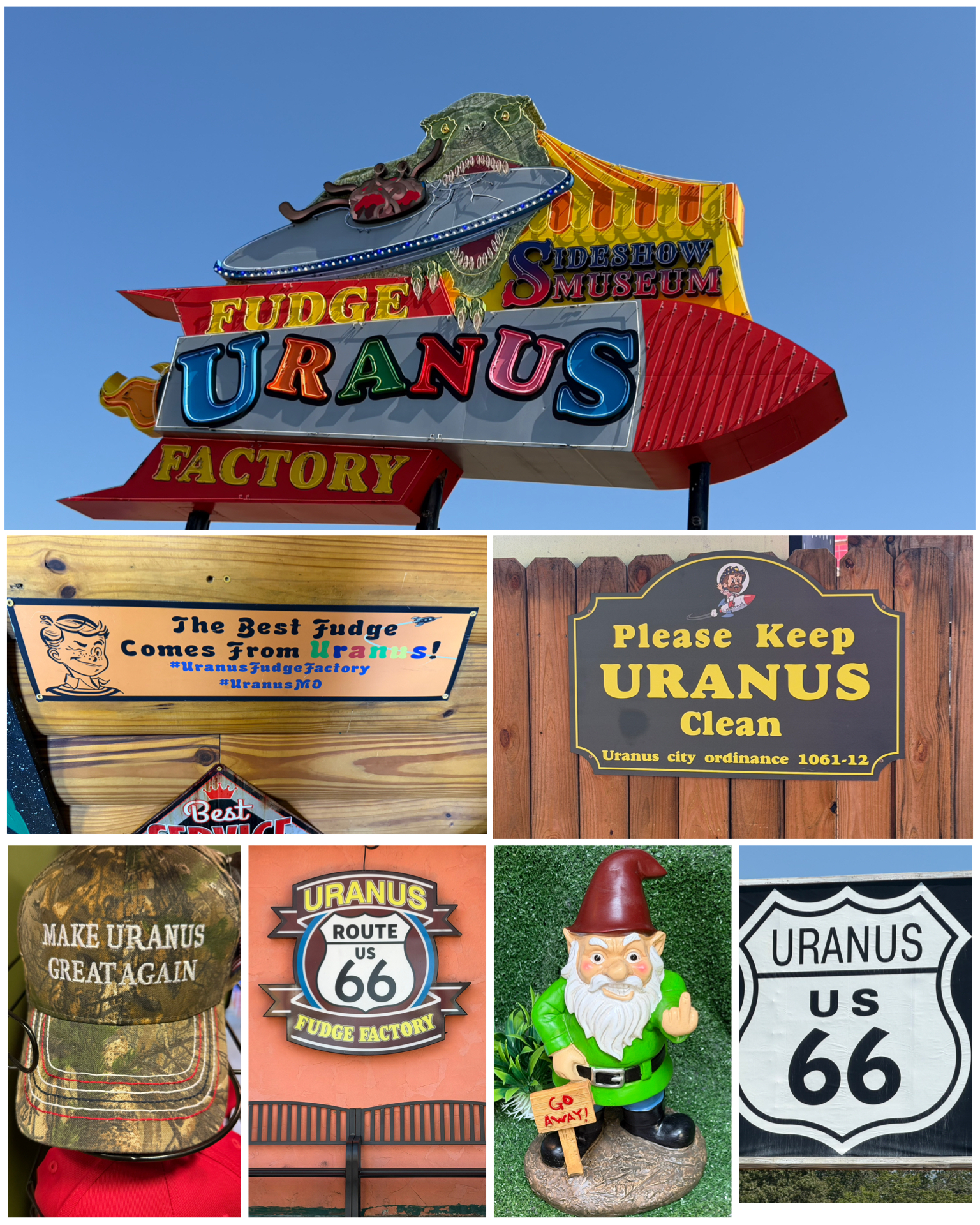 Next, I visit a place that’s been on my bucket list of places to visit ever since I first heard of it – probably something like 6 or 7 years ago. As luck would have it, this place happens to be along Rt 66, so this would be the year for me to check it off the list. One night while out drinking, Louie Keen had a vision to create a tourist town in Missouri called Uranus. He wanted to create a place that people would remember so he got some Rt 66 road frontage and in 2013, began building it. On July 2, 2015, he opened the Uranus Fudge Factory and General Store. Besides featuring some exquisite fudge, the store and surrounding complex are filled with cheesy photo-ops, giant animals and billboards, the largest belt buckle, and ridiculous souvenirs featuring lots of Uranus puns. I have to admit, I found myself regressing to that silly little 8-year-old elementary school boy, giggling at all the crazy Uranus phrases that were featured on signs, hats, t-shirts, and other crazy collectibles. To make things even more comical, each time someone enters the store, the entire work staff yells out “welcome to Uranus”! Too funny! Look at some of the examples pictured here at the left, and see for yourself if you don’t crack a silly smile when reading them! There was even Uranus wine, though I resisted the urge to buy a bottle! I did, however, leave with a pound of assorted fudge which I’m keeping in my freezer for now so that I can share it with friends and family when I get back to Florida. Definitely a fun-filled visit to this zany place!
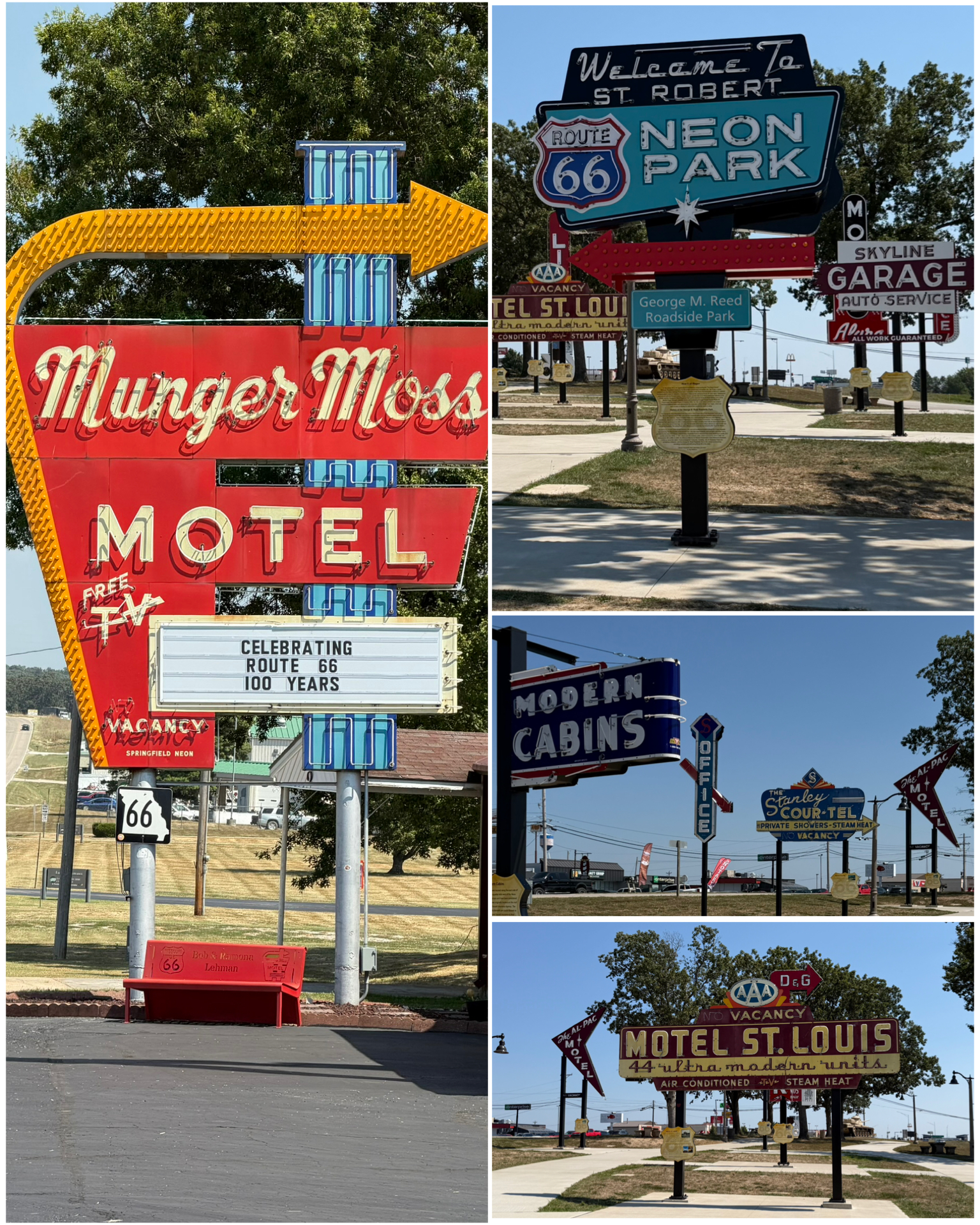 My next stop takes me to Saint Robert, MO – population just over 5,000. However, what they lack in residents, they certainly make up for in enthusiasm! Their welcome/visitor center was in my Rt 66 Passport book, so I had to stop in to get their stamp. It had to be the most welcoming place I’ve ever been. The center worker happily stamped my passport book, then went on to tell me about the town’s history, filled my hands with all sorts of brochures and maps, and highlighted all the places that I must see while I’m in town. Sadly, I was still dealing with the significantly shortened time in the area, so I had to limit my tourist stop to just the neon sign park. But what a beautiful park it was! Opened just recently in June 2025, the George M. Reed Roadside Park features nine original vintage signs that have been fully restored to their mid-century glory, and mounted on poles and placed within the park along a meandering concrete sidewalk. All of these signs were rescued from forgotten fields or recovered after being buried under piles of junk in sheds or warehouses. It was an incredibly well done park, and it’s no wonder why the folks at the visitor center were so proud to tell me about it. I ended the day back in Lebanon to check out several of their Rt 66 offerings – most notably of which is this iconic motel sign (at right, left side). What started out as a Rt 66 BBQ joint in the 1930s expanded to add a Motor Court in the 1940s. The BBQ place was sold off in 1958, and the court became a motel with a brand new neon sign. The sign, fashioned somewhat after the look of Holiday Inn’s advertising of the era, quickly became a Rt 66 favorite. A miniature version of the sign now stands at the entrance to the I-44 Missouri Rt 66 Welcome Center and Rest Area. The hotel just got new owners back in 2024, who have promised to restore and revitalize the hotel, and of course maintain the sign.
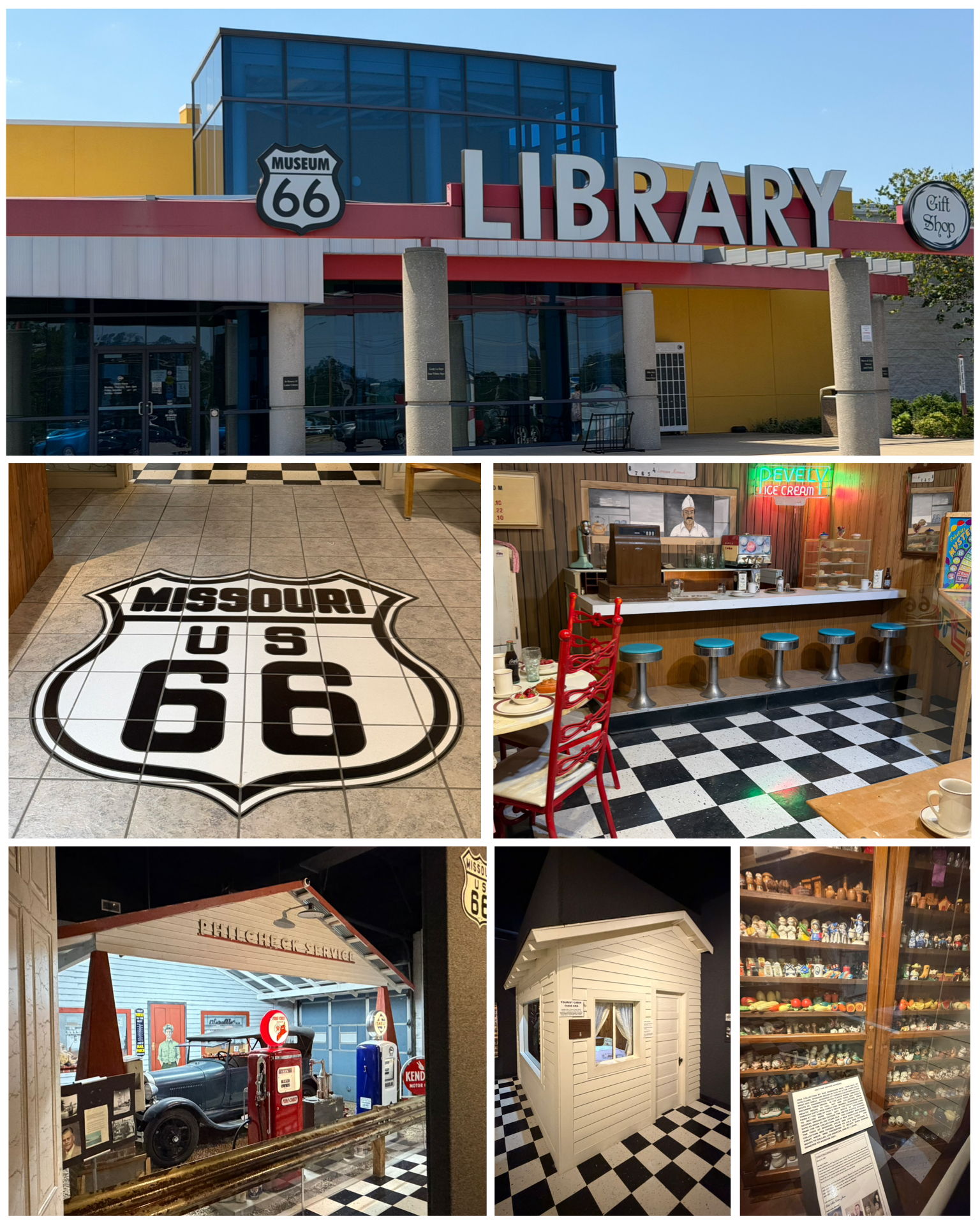 The downtown Lebanon public library building also plays host to the town’s Route 66 Museum. Among its many attractions is a recreated 1930s Rt 66 gas station, a tourist cabin from the 1940s, and a cafe from the 1950s. It even has a collection of over 900 salt and pepper shakers acquired by Mae Bradshaw Pool (1880-1942) – many from venues along Rt 66. She even placed handwritten notes into each one she collected documenting where it came from. The collection was featured in the 1940s and 50s at Missouri state and local fairs as ownership passed down through her family. It eventually made its way to the museum when it was donated in 2007. Another exhibit in the museum pointed out that in the 1920s, the town did not want the route to be 66 – but rather its originally proposed designation as Rt 60. It was believed at the time that route designations ending in “0” were more prestigious. But, as you’ve read previously, it was Springfield that got them to change it to 66. The rest is history!
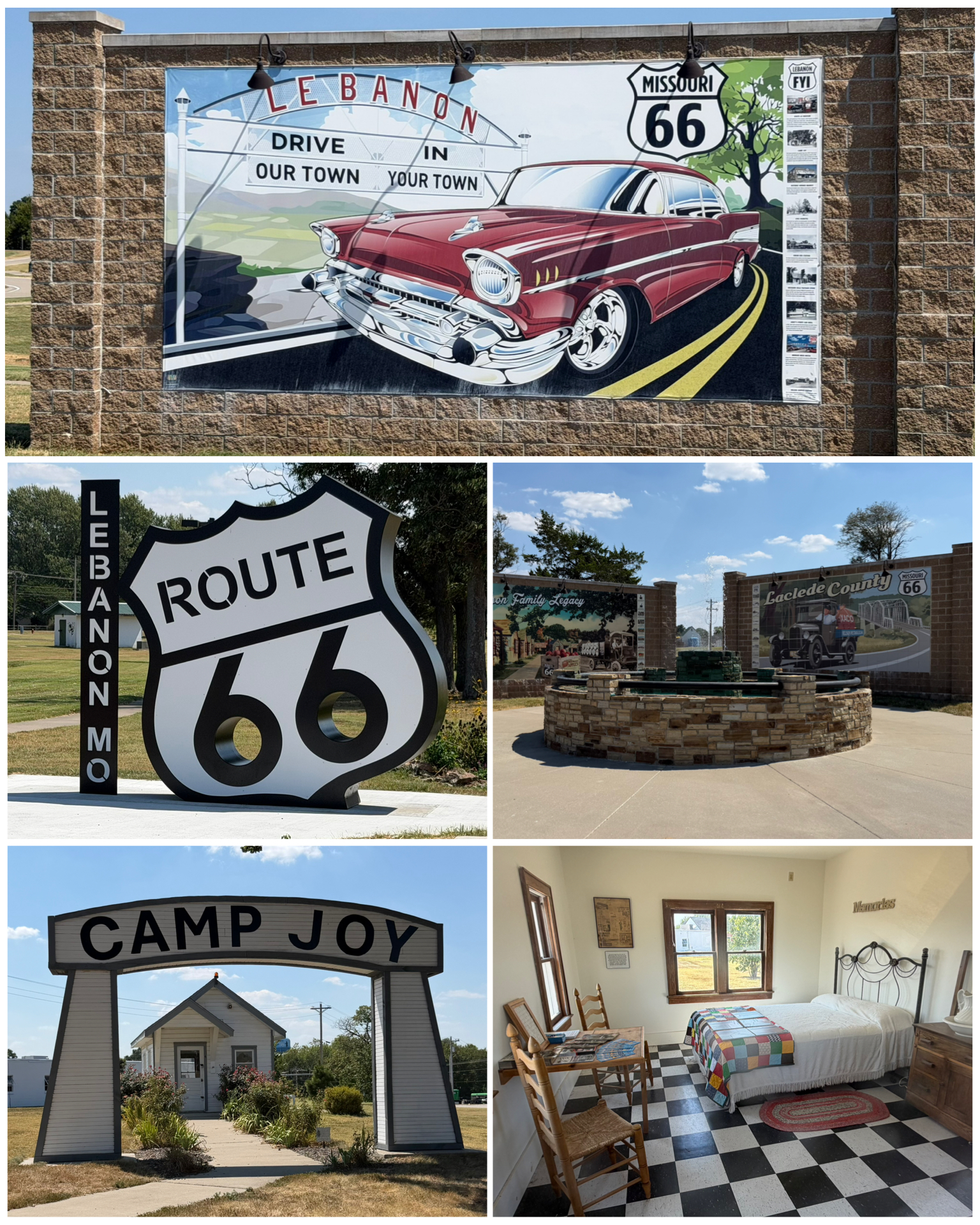 Next in Lebanon was a visit to Boswell Park. Here, three walls were purpose-built so that Rt 66-themed murals could be added onto them. These three murals, made of tiles fired in Spain, were completed in 2018. Two of the mural walls (at right, center right) pay tribute to Col. Arthur T. Nelson, who was instrumental in seeing Rt 66 coming through Lebanon. He did so by donating the land needed for the road, then building thriving businesses along the route. The third mural (at right, top) features a 1957 Chevy cruising down Rt 66 as it passes what was once the town’s welcome arch with the town’s slogan “Drive in Our Town – Your Town”. The final place I visited here was a visit to Camp Joy. Before there were motels and hotels, there were motor tourist courts and motor courts. Camp Joy was one of those early tourist courts from the 1920s and featured these 10×12 standalone buildings (sheds?) where folks traveling along Rt 66 would spend a night. The resting spots came complete with a double bed, side dresser, a wall-mounted swing-up table with chairs, and a wood-burning stove. This last surviving court was fully restored in 2019 and it, along with the rebuilt court’s entry archway, was relocated here to Boswell Park. Looks like some fairly comfortable accommodations!
Final Thoughts
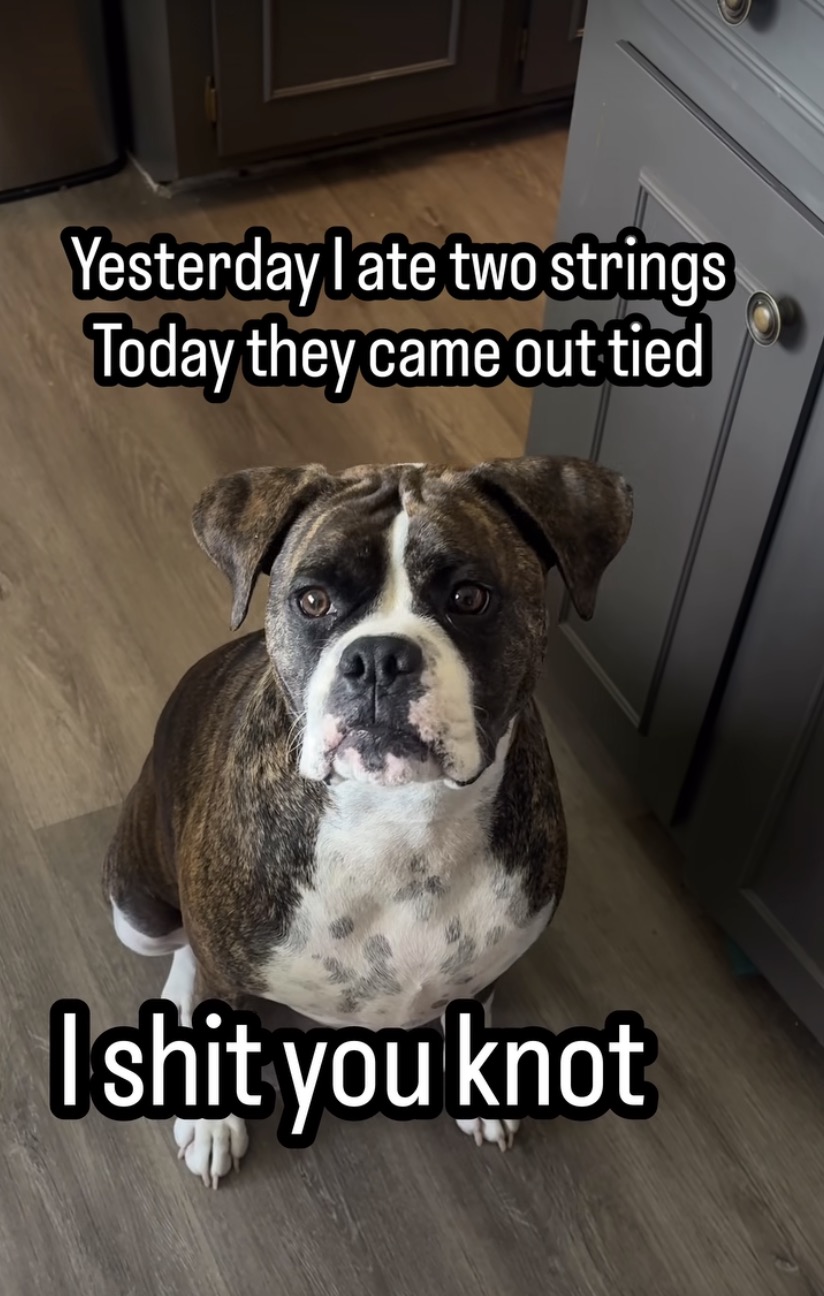
Well, as I speed my way back home to Florida, I’m also catching up on my blog writing and publishing. I’ve probably got one more left to write that will take me to the end of the route in Chicago. I should have that wrapped up in the next week or so. I’ve also begun looking at this year’s trip somewhat retrospectively, and truly believe this has been the perfect culmination of my nine years of RV travel. It is such an iconic journey along this historic route, and doing it at its 100th anniversary just makes it all the more special. I couldn’t have planned this any better! I’ll be home in just under a week – returning to an extended-stay lifestyle along with my community duties of technology support and citizens patrol. It will be nice to be stationary once again – this time perhaps on a permanent basis. And sorry for the somewhat crude meme featured here. I figured with the silly Uranus Fudge storyline, this was a fitting accompaniment. So until next time, be well and safe travels.
I only show a sampling of my adventure pictures here in the blog, and do so mostly in collage format for brevity and ease of reading. If you want to view an album containing individual full fidelity and hi-res images of all my travel pictures related to this specific blog, click the image below. Enjoy!