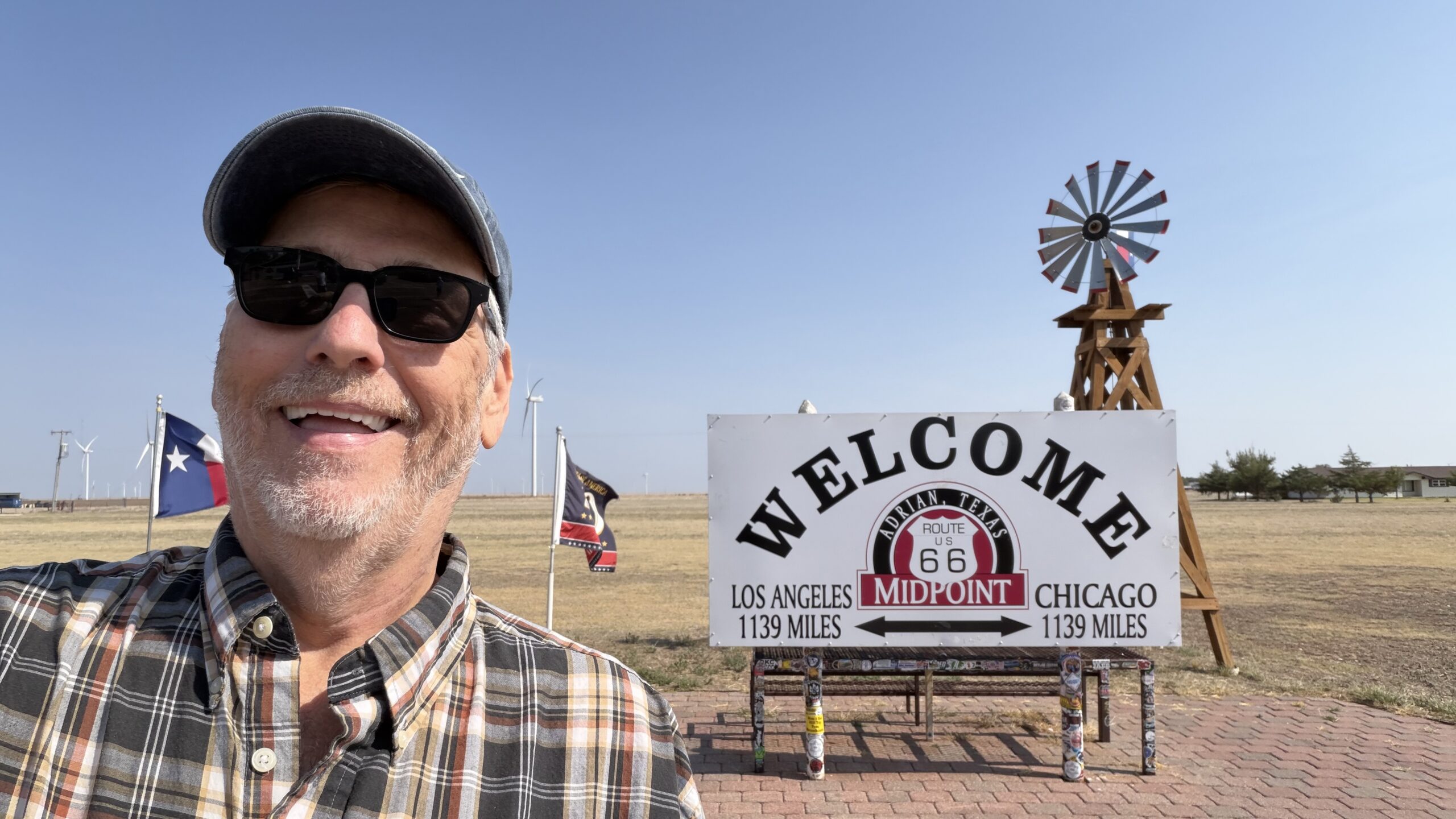
Wahoo! I made it to the somewhat official midpoint of Rt 66. Here in the sleepy little town of Adrian, TX is the purported center point of Rt 66 – with 1,139 miles to the Chicago, IL starting point, and 1,139 miles to the end point in Santa Monica, CA. I began this journey some 8 weeks ago in Santa Monica, with 8 weeks remaining to make my way to Chicago (well, actually less than that due to the significant delay caused by the truck issue). So let’s pickup where we left off to work our way through TX and OK.
Amarillo, TX
So still without my truck and being stuck here in Tucumcari, I wanted to keep things moving forward so I decided to take the dealership loaner vehicle and drive 120 miles to the east to Amarillo – which was originally scheduled to be my next stop. Besides, I was in desperate need to get some prescriptions filled, and this was the closest big town that had the drug stores that I needed. So off I went, stopping to check out the various Rt 66 and Roadside attractions along the way.
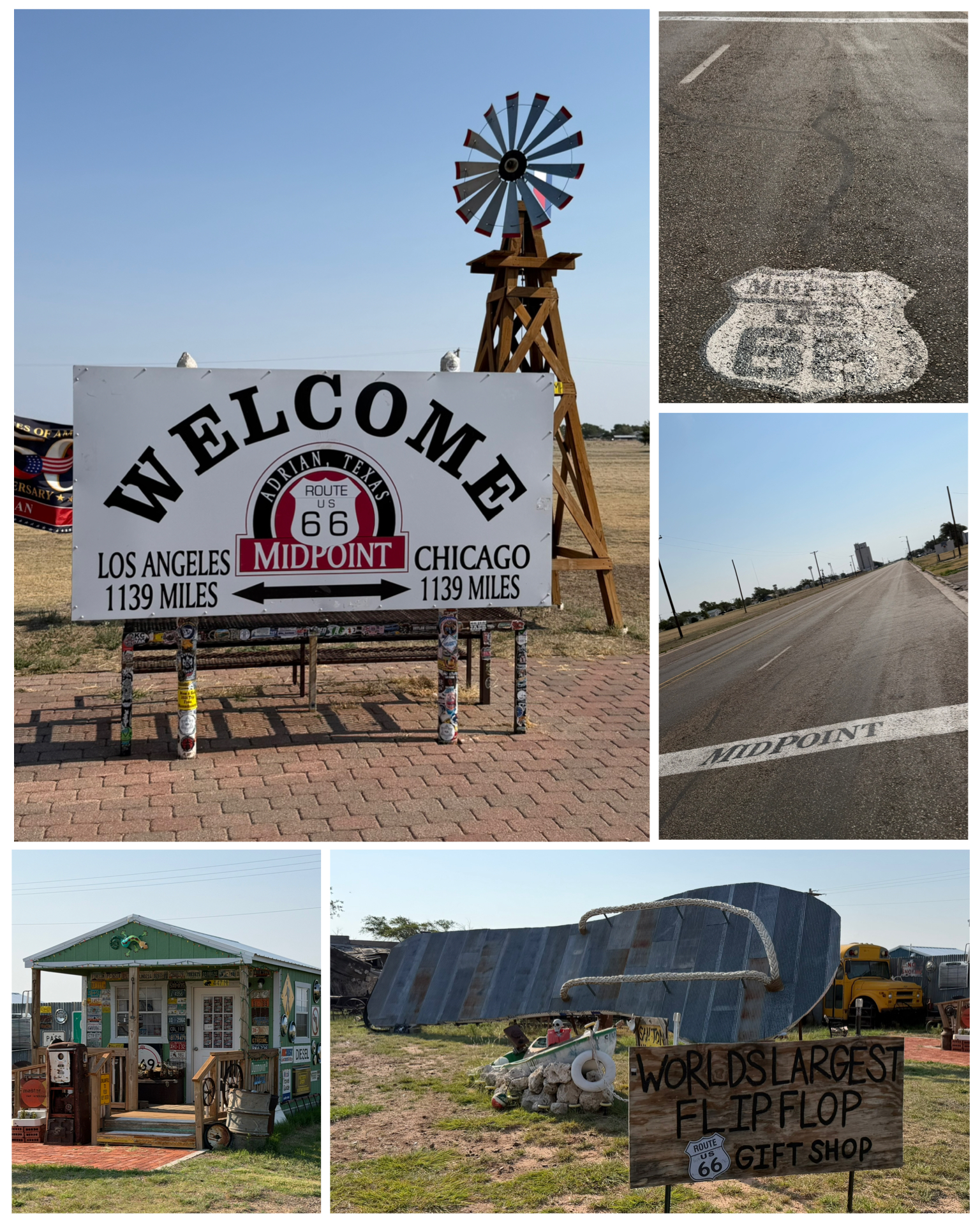 My first stop takes me to San Jon, NM about 20 miles east of Tucumcari. There, I would find this gem – the world’s largest flip-flop! This 40-ft-long 15-foot-wide behemoth is a recent vintage attraction having been built in 2023. It was created by Caryn Grzegonek and Jumah Culhane, fellow fans of Roadside America and roadside attractions in general, and is constructed mostly out of reclaimed wood from pallets. They wanted to add a little something to their Rt 66 roadside gift shop to attract more visitors. I would conclude that this would certainly do it! Next, I continue my travels east another 30 or so miles into Texas, arriving at the small town of Adrian – population 128. Here I would find the proclaimed geographic midpoint of Rt 66. Of course, the reality is that the actual midpoint would be located in various places depending on when it was calculated, and which of the many Rt 66 alignments were being used at the time. This particular spot came about much later in life, somewhere
 around the mid 1990s – long after I-40 had bypassed much of the route. In fact, it was at the suggestion of the US Route 66 Association founder that sort of created the spot.
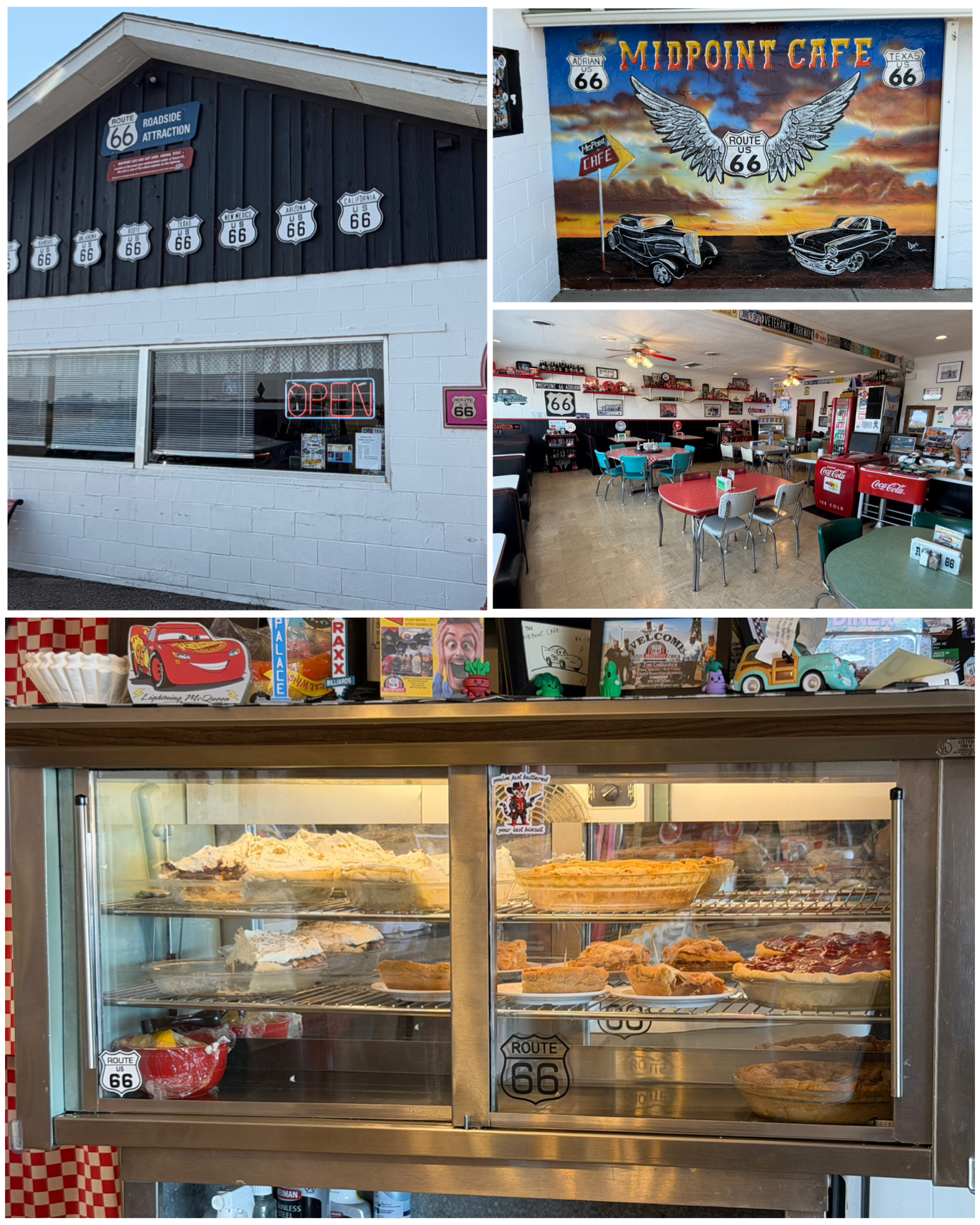
What really made this a most notable stop was the renaming of the local eatery as the Midpoint Café. That happened in the mid 1990s – again at the suggestion of the Route 66 Association founder. The cafe had actually been a staple of Rt 66 going back to the 1920s. Under lots of different ownership and likewise lots of different names, it certainly had succumbed to the loss of visitors when I-40 opened. Today, it’s a thriving destination for all Rt 66 travelers. I stopped here figuring I could have breakfast, but sadly, there had been a water main break a few miles away, and those repairs put the cafe on a water boil notice, so no fresh food could be served. They did, however, have a chill case filled with delicious pies so I had to make the tough sacrifice and have a big slice of peanut butter and banana cream as my breakfast. Ah, the things I do in the name of travel! I washed that down with a nice tall glass of orange juice since tea or coffee would also not be available due to the lack of clean water. Needless to say, I spiked my blood sugar with this stop, but certainly enjoyed the visit. I also inquired about how traffic has been during this centennial celebration year, and was told that it has been awesome! They’ve never been busier. That was really nice to hear compared to what I have observed thus far in my travels, and what I’ve heard from other businesses along the way. At least some venues along the route are getting some good traffic. There were in fact a couple dozen folks here when I arrived – all taking pictures of the midpoint on the road and the sign.
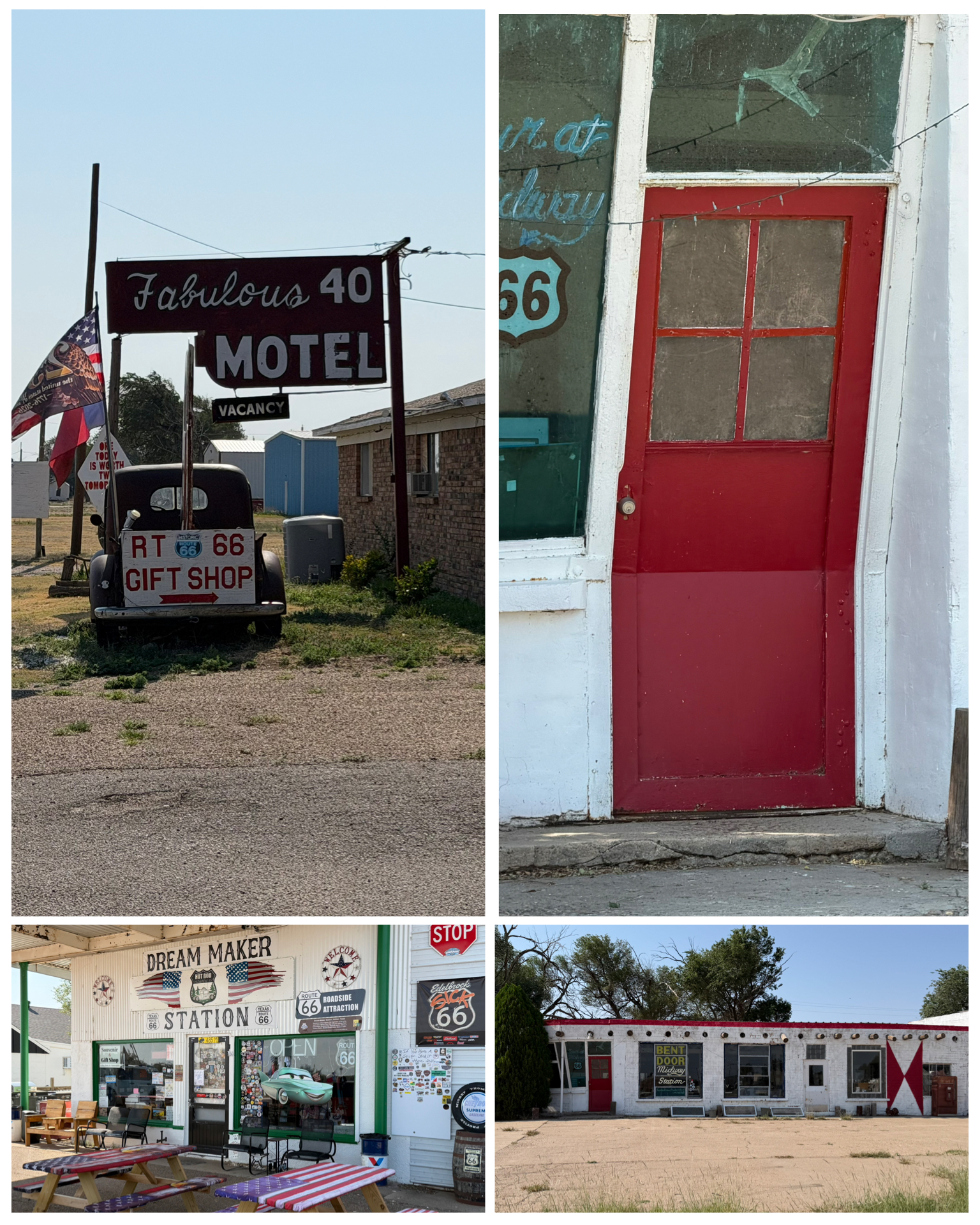 Also here in Adrian near the cafe were a few other remnants of the good ole Rt 66 days. Here, the 1967 built, but oddly named Fabulous 40 Motel was seemingly catering to the I-40 travelers. The owners gave it this name in hopes of luring them from the interstate to stay at their fabulous Rt 66 venue. Obviously, that might have also angered Rt 66 travelers. But alas the hotel is still operational to this day. Next to the cafe on the other side was the Dream Maker Station Route 66 Souvenir & Gift Shop. A cool place to check out all the tourist tchotchkes available for sale. A nice shaded picnic area was also welcoming to route tourists. Last up just a bit down the road was a place built in the late 1940s to be Tommy’s Cafe and Phillips 66 Service station. What makes this place most unusual is the oddly bent and angled bright red door at the front. Supposedly, the door was shaped to match the angled front windows – themselves salvaged from a control tower of a decommissioned World War II Army airfield. It certainly was a Rt 66 oddity for many years. The business closed in the 1970s and sat idle and abandoned for decades thereafter. It was reported to have been purchased in 2006 by the same owners of the Fabulous 40 Motel, who had plans to restore and reopen the place as a restaurant in 2017. Well, that has not happened as of yet, so the future of the building, and its odd-angled red door, remain simply as a photo op to Rt 66 travelers.
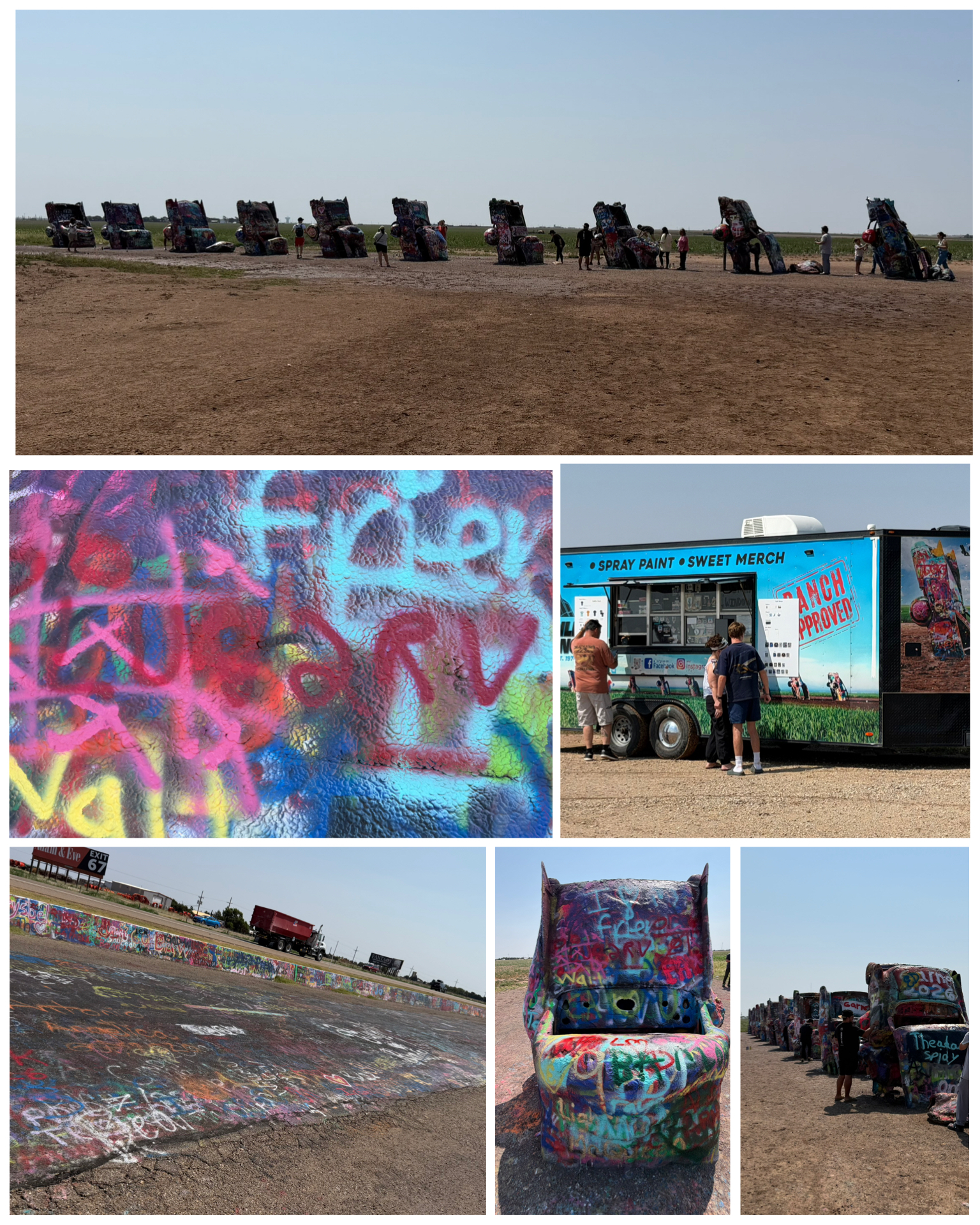 Just before getting into downtown Amarillo from the west, you c0me upon this iconic tourist gem known as Cadillac Ranch. It was the creative idea of young architects and art students Chip Lord, Hudson Marquez and Doug Michels, who themselves were a part of an art group known as Ant Farm. They got the idea from a children’s book titled “The Look of Cars”. After seeking sponsorship and funding, they would connect with millionaire Stanley Marsh of Amarillo who agreed with the plan, and who began advertising in the want ads for used antique Cadillacs. The 10 cars, buried nose down at an angle said to resemble that of the Egyptian Pyramids, were originally built in a wheat field in 1974. In 1997, the cars were relocated 2 miles to the west on the outskirts of town, to a cow pasture along I-40, where they have remained since. Today, it is common to bring (or buy at the handy sales trailer) cans of spray paint to do up your own graffiti on the cars. Also, this expressive painting has expanded to the surrounding access road and road barriers outside of the ranch. It was a fun visit, and I was fortunate to score a mostly empty leftover can of paint with just enough paint to leave my Luv2RV mark on one of the cars (at left, center, and center bottom). It probably didn’t last long before getting painted over. Oh well – at least I had my few minutes of fame!
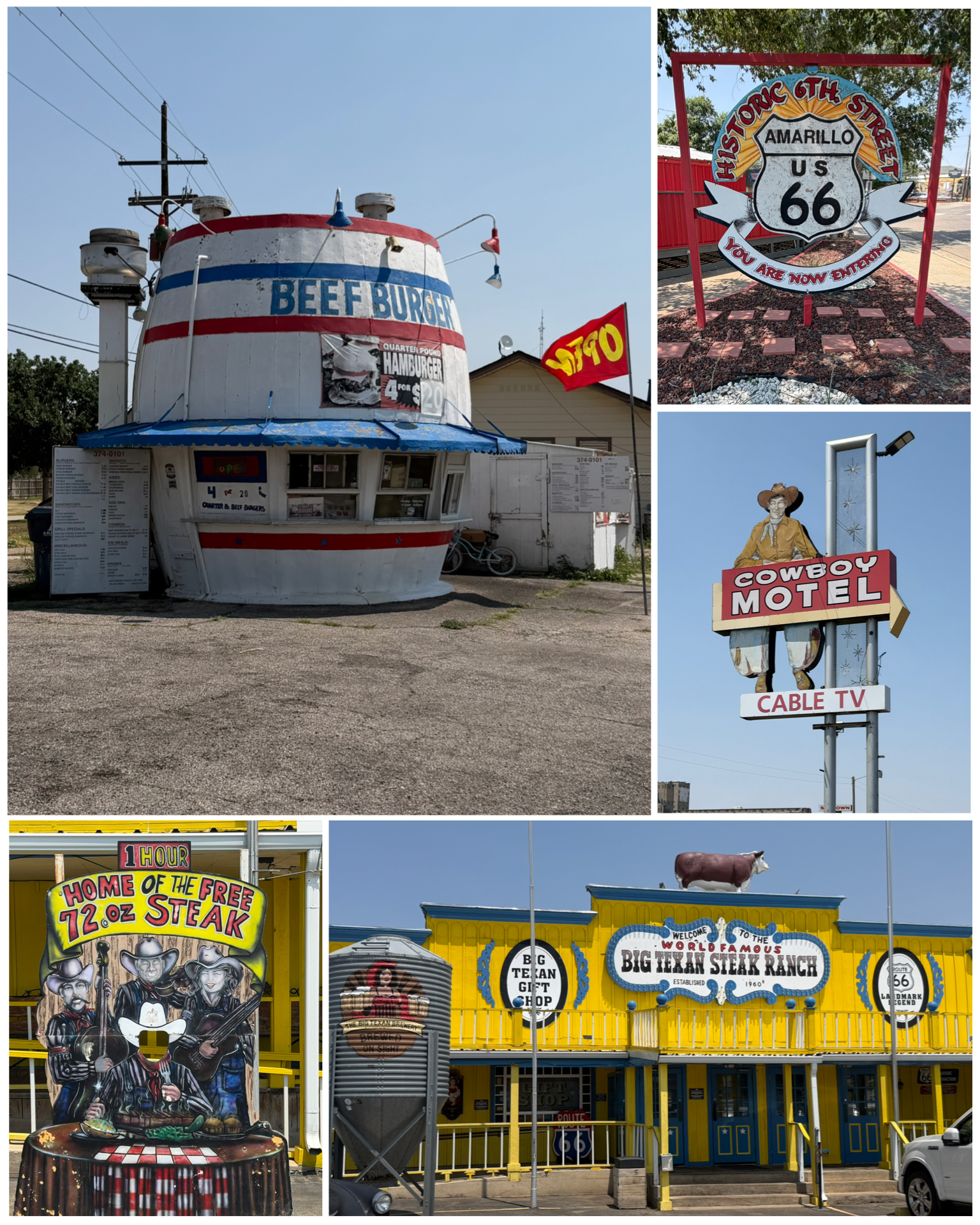 Next I headed into downtown Amarillo and onto the legacy Rt 66 – which in this town meanders its way through W Amarillo Blvd, to SW Ninth Ave, to Bushland Blvd, then onto SW Sixth Ave, then S Fillmore St, then eventually back onto E Amarillo Blvd. So this will be somewhat of a mix between Rt 66 stuff and Roadside America stuff. First up is this giant barrel shaped building known today as the Beef Burger. In the 1930s, two competing root beer companies, A&W and Hires, had built roadside stands serving up their root beer from a giant root beer barrel. This one in Amarillo was one of those originals, but by the 1950s, was rebranded and switched to a generic burger joint. Interestingly, in all my travels, this is the first root beer barrel that I’ve seen despite over a couple dozen of them being listed in Roadside. Next up was this Rt 66 welcome sign (at left, top right) which sits at the entrance to the historic 6th street district – the 13 blocks of Rt 66 that from 1926 to 1953 would be the busiest along the route in all of Texas. This stretch of road included now-defunct tourist camps (forerunners to modern-day motels), gas stations, and other tourist-centric amenities. It wouldn’t be Texas without some sort of cowboy in neon. Sure enough, the Cowboy Motel brings this bit of Texas to Rt 66. The motel dates back to the mid 1950s, and reportedly is in a not-so-great part of town these days. So, a quick photo and I was outa there. Next stop was to the Big Texan Steak Ranch – home to the free 72-oz. steak! That is, assuming you can eat the entire meal non-stop within one hour. The meal consists of a shrimp cocktail, side salad, baked potato, rolls and butter, and of course the 72 oz slab of meat. You pay the meal price of $72 up front, and if you are successful in completing the challenge, the money is refunded to you. They’ve been running this event since 1965 and as of 8/3/26, there have been 102,756 attempts, with 10,716 having succeeded. That’s just a smidge over 10% – not very good odds! I had already stuffed my face with pie and OJ at the Midpoint Cafe a bit earlier, so I was definitely not in the running.
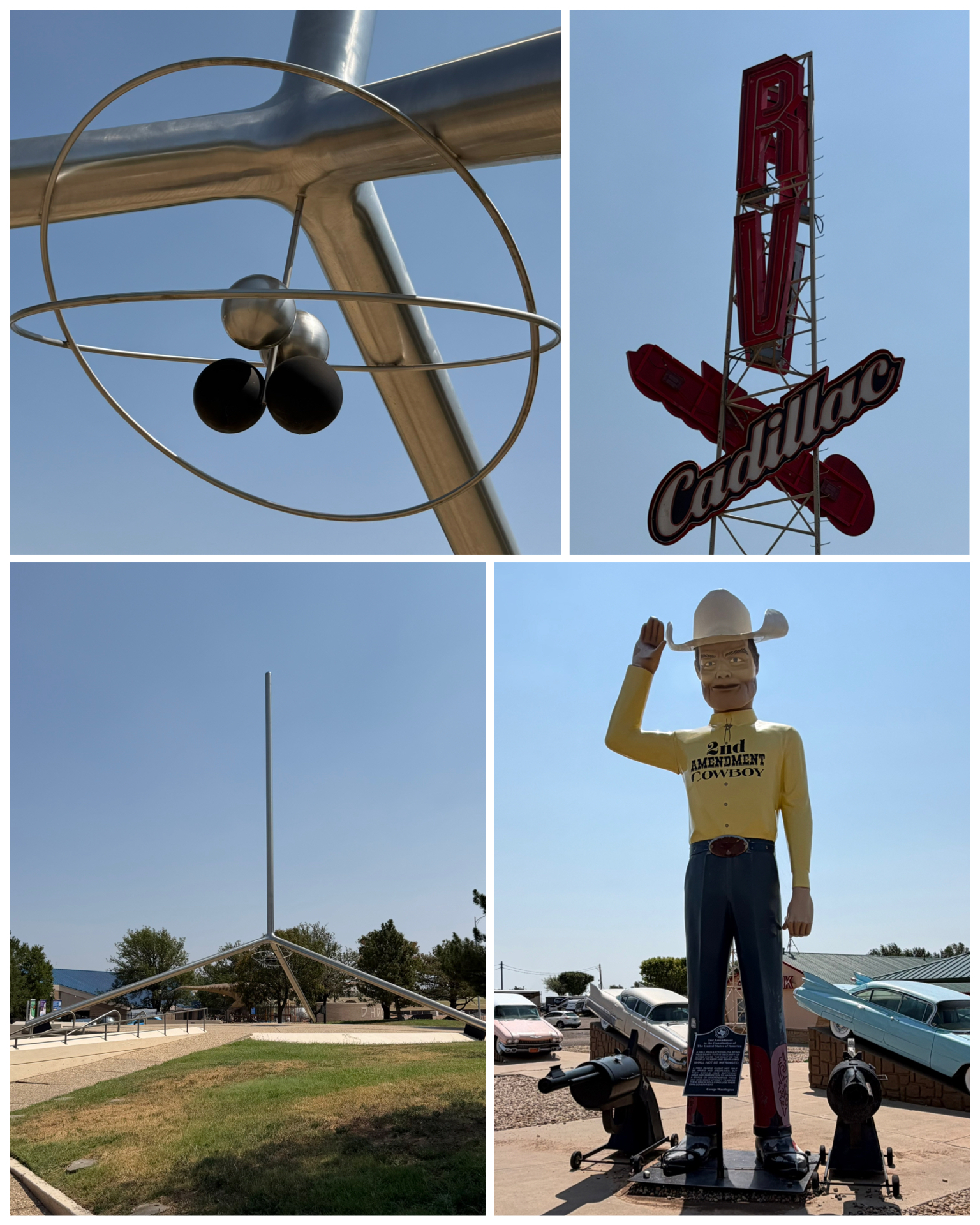 One of the things I learned about Amarillo is that it is the self-proclaimed Helium Capital of the World. The discovery of natural gas particularly rich in helium content in 1918 eventually led the US government to purchase the Cliffside Gas Field in 1927 and the Federal Bureau of Mines began operating the Amarillo Helium plant two years later. The plant was the sole producer of commercial helium in the world for many years, and was the eventual site of the National Helium Reserve. To celebrate Amarillo’s helium history and the centennial discovery of helium in general, this Helium Time Columns monument was erected in 1968 (at right, left side). The monument standing six stories tall features a giant model of a helium atom, with each of its four stainless steel appendages containing a 1968 time capsule. The first time capsule was opened in 1993, while the last one is not scheduled to be opened until the year 2968. The monument was originally located on Rt 66, but was airlifted and moved several miles west to its current location near a children’s science museum. Next, this large Muffler Man variant in a cowboy hat stands
 tall and proud at the Cadillac RV Park in front of several nicely restored Cadillacs. He is flanked by a pair of six-shooters while his shirt bears the title 2nd Amendment Cowboy. Definitely don’t think anyone is gonna mess with this cowboy.
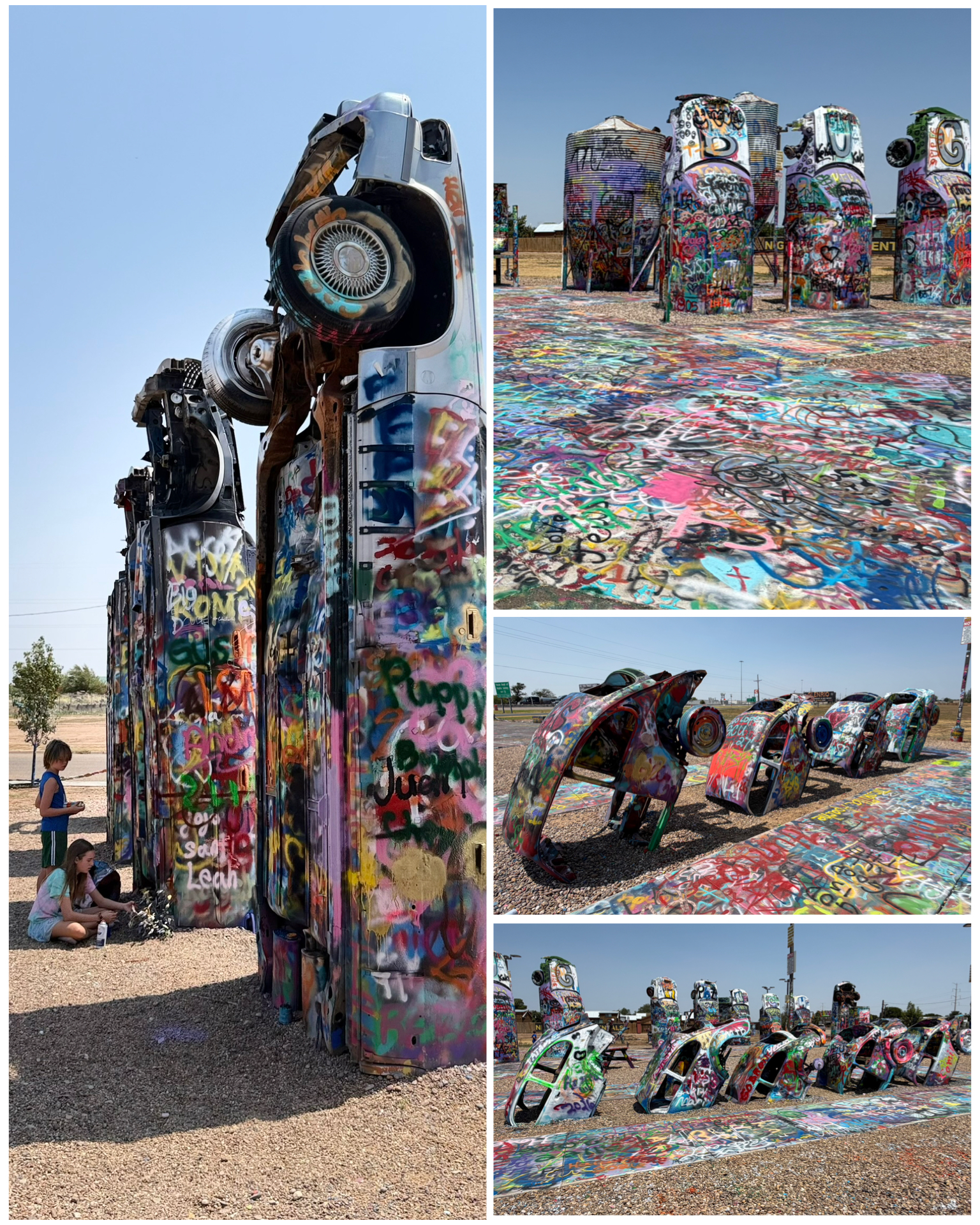
Not to be outdone by the Cadillac Ranch, a new ranch recently popped up known as the Bug Ranch. It actually began life in 2002 as Slug Bug Ranch in Conway, TX some 30 miles to the east of Amarillo, and was made up of five Volkswagen Beetles buried nose down in the ground. It was the creation of owners of a Rt 66 trading post who were trying to generate more tourist traffic to their business. They were successful in their quest to increase tourist traffic, but sadly that did not translate to an increase in revenue, forcing the business to close a year later. The bugs continued to attract tourists for the next couple of decades, then in 2022, the owners of the Big Texan Steak Ranch acquired and moved them to Amarillo. Here they were joined by several additional bugs, and a handful of stretch limousines. The park was completed and opened in mid 2024. Like their Cadillac Ranch cousins, all the vehicles and the surrounding area are thoroughly covered with colorful graffiti from all the tourists spray painting their marks. Yet another interesting place to visit!
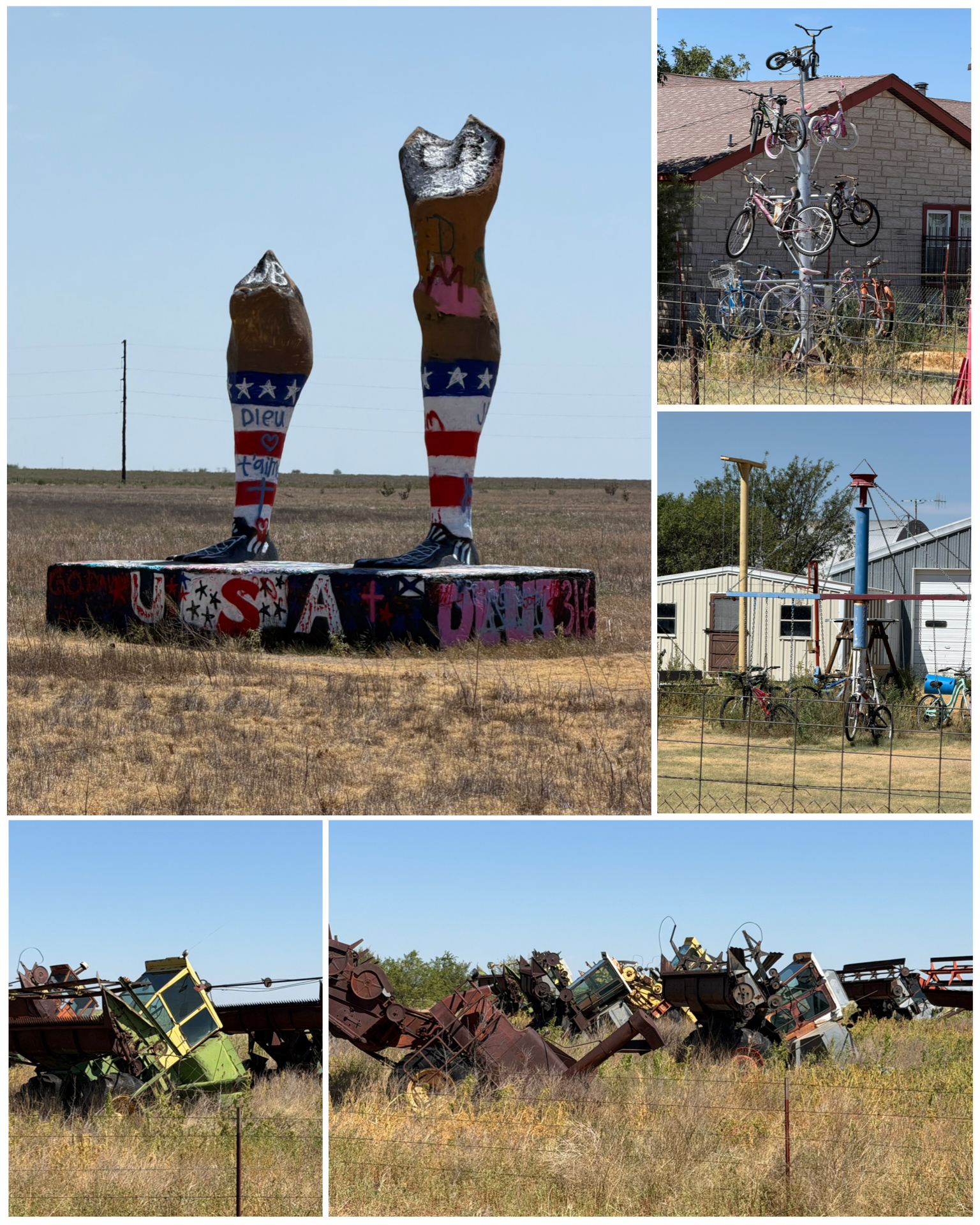 I took another trip out to Amarillo several days later – again using the dealership loaner vehicle (why not put some miles on it!). There were a couple of interesting Roadside America items here in town that I wanted to check out. First up was this pair of Giant Legs – a piece commissioned by eccentric millionaire Stanley Marsh 3rd – the same person responsible for funding Cadillac Ranch. Created in 1997 by artist Lightnin McDuff, these legs once sported simple white athletic socks, but like Cadillac Ranch, are now a blazing full color from graffiti. Next, while driving out in the country heading to my next
 stop, I happened upon this yard with several pieces of art made from bicycles (at right, top and center right). I don’t have any further info about them, and they are not listed in Roadside – at least not yet as I will be submitting them for consideration. Next I arrived at my planned destination to visit Combine City – a collection of a dozen or so retired farming combines stuck in the ground at a slight angle – a likely play on Cadillac Ranch. But unlike their counterpart, these were deep in a field surrounded by barbed wire fencing clearly thought to discourage would-be graffiti artists. But interesting nonetheless.
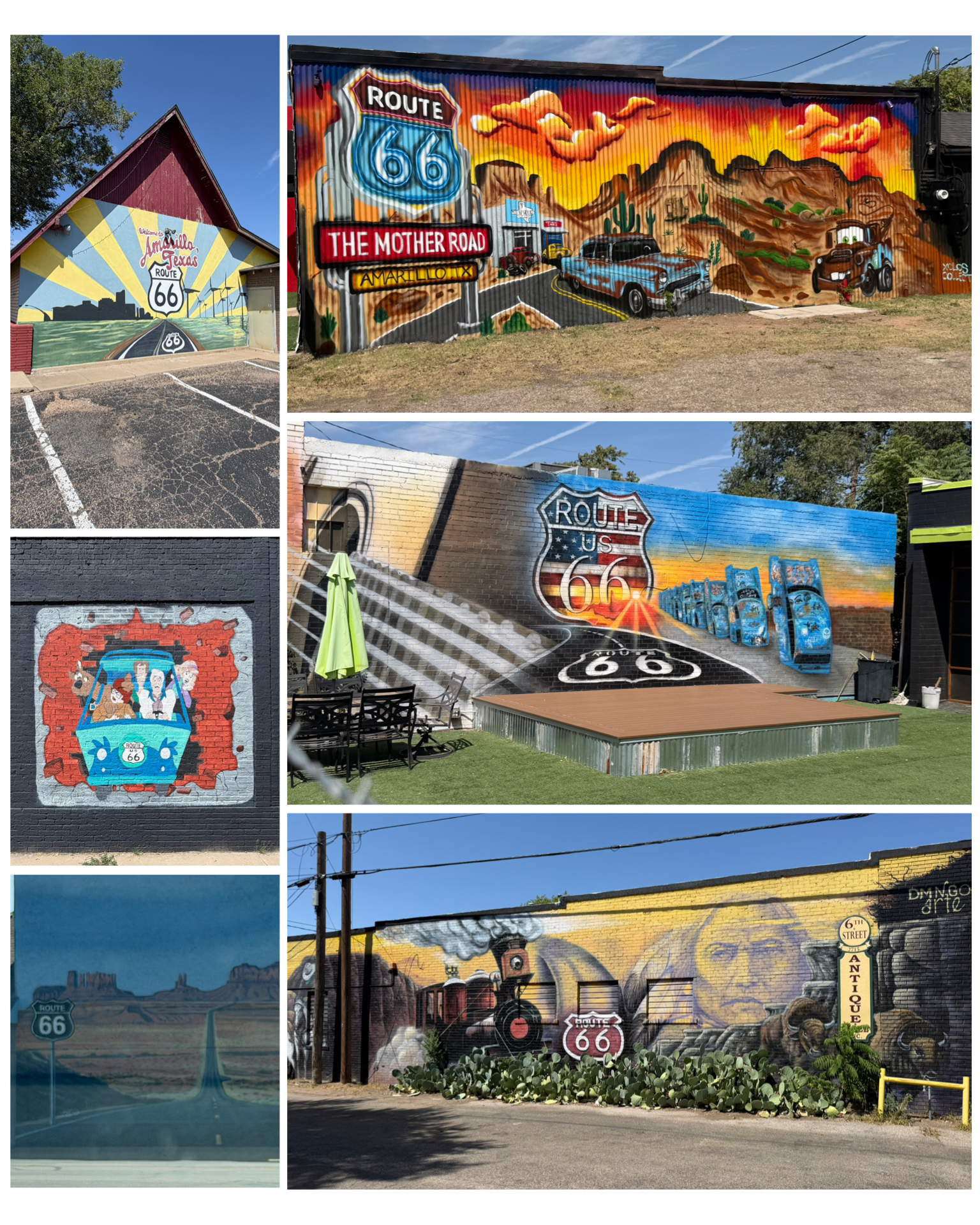
I was impressed with the number and quality of murals all around Amarillo – many paying homage to its Route 66 heritage. Everything from the desert southwest to classic Rt 66 treasures, to even a tribute to Scooby, Shaggy, and the gang in their Rt 66-branded mystery machine van. Beautifully done!
Truck Update
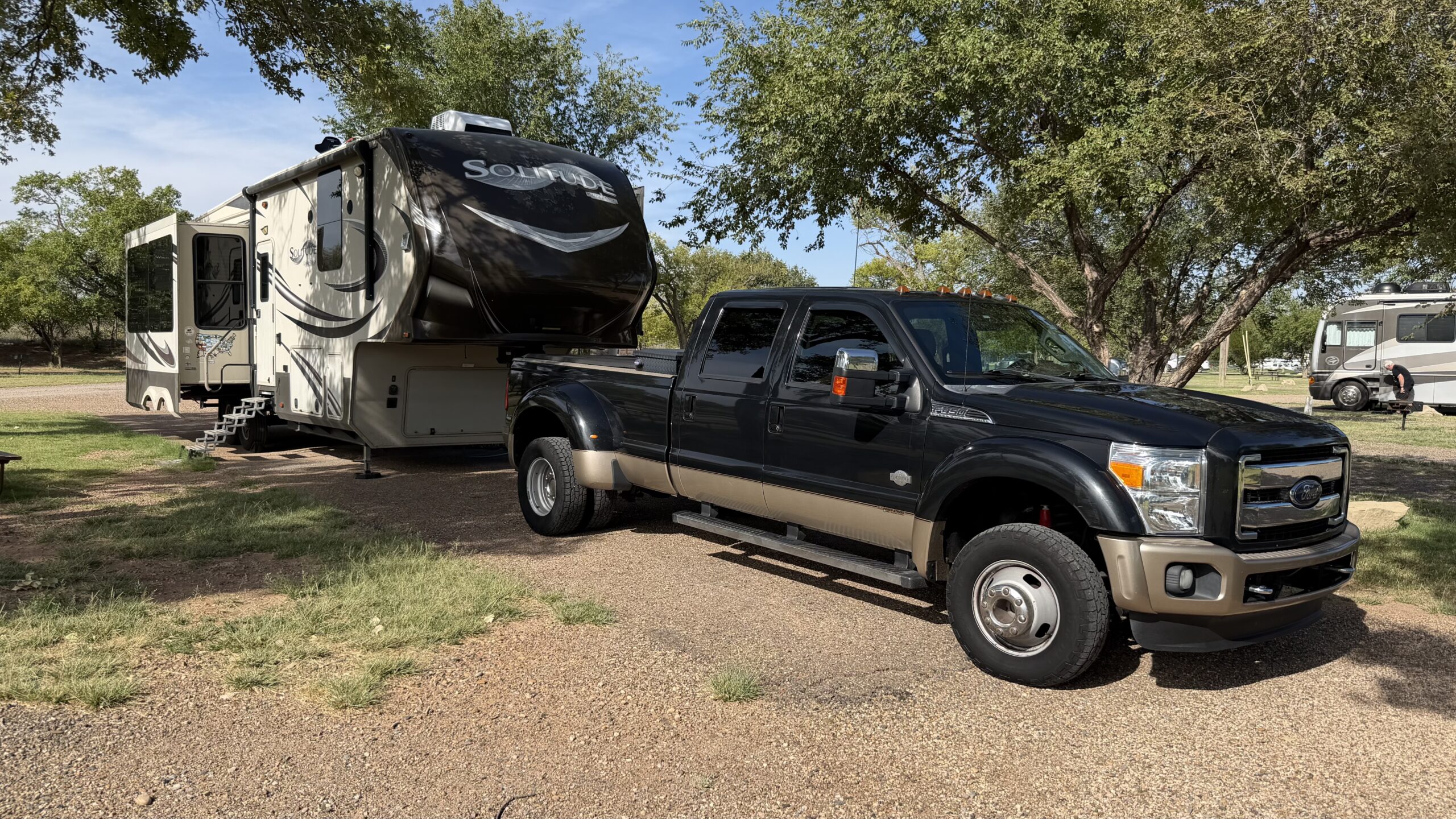 Well, the time finally came that I got my truck back! It was returned to me in the afternoon of August 19th – bringing my total unplanned extended stay in Tucumcari to 30 days. A full month! Once I had it back, I immediately set out to rebook all my future reservations so that I could get back on the road, and salvage as much of my original schedule as possible. Having lost so much time, I had to significantly shorten many of my upcoming stops. In lieu of the planned one full week in each of my next four stops of Amarillo TX, Elk City OK, Bristow OK, and Joplin MO, I could only book two nights each. Then my fifth stop in Lebanon MO was reduced from seven nights to four. From there, I will be back on my regular one week stays for the remaining three stops from there to Chicago. This means I’ll have significantly less time to check out all the sites during those first few stops and will have to make do seeing what I can. It’s gonna be a fast and furious almost two weeks racing through the next five stops. Oh well, what can I do?
So despite having been to Amarillo twice from Tucumcari, I decided to pull the RV there and stay for a couple of nights just to make sure the truck was running great. I didn’t want to venture off too much farther from ABQ in case anything was still amiss. But, all went well and my trip there was smooth and uneventful – just the way I like it!
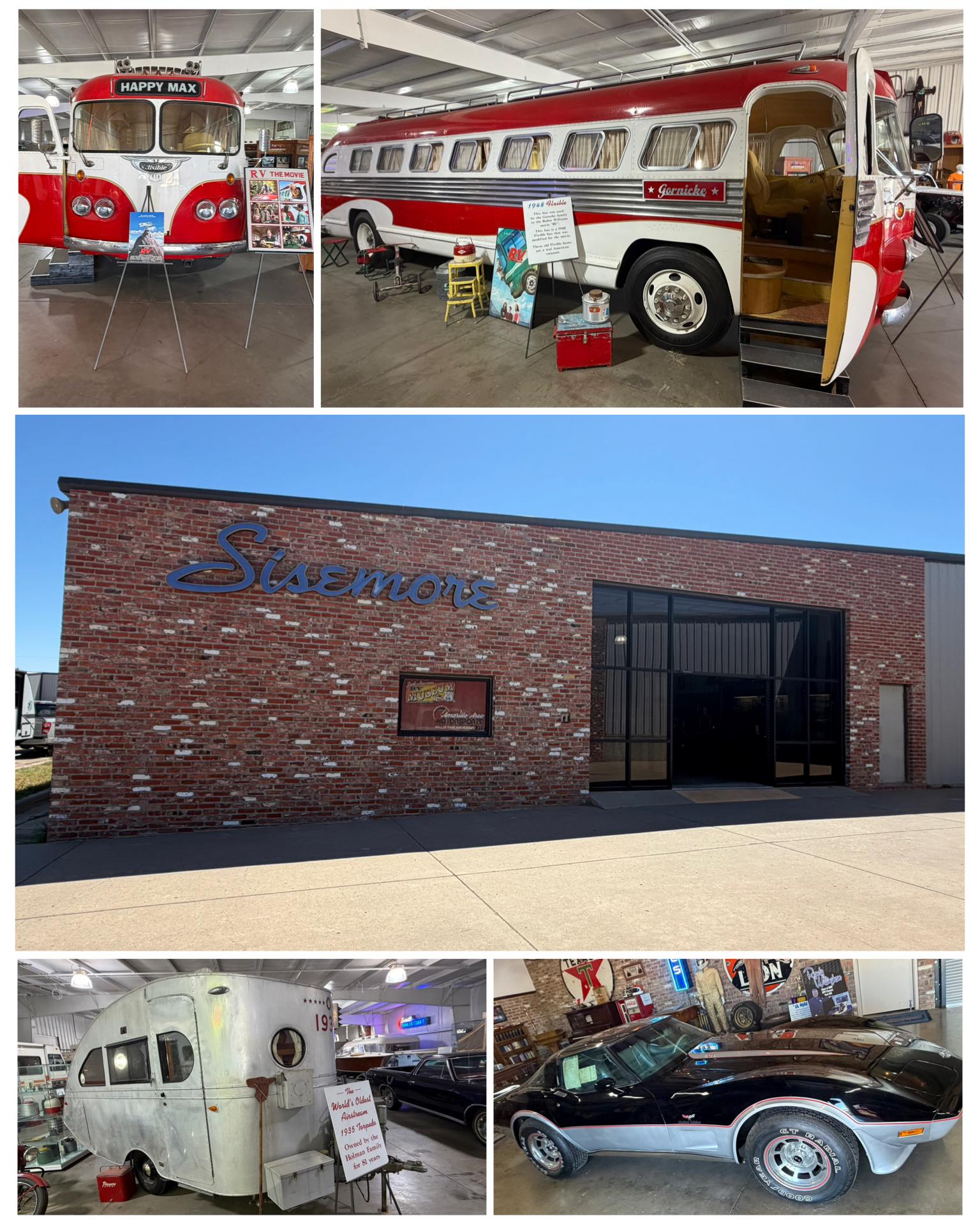 So, since I was to be here in Amarillo for a couple of nights, I may as well see what else there is to see while I’m here. One of the places on my list that I wanted to visit was to the Jack Sisemore RV Museum. In his early years, Jack lived a modest life as an owner of a gas station. He enjoyed camping, but also enjoyed having more of the home comforts to go with it (bathrooms, kitchen, bed, etc). He didn’t have the means to purchase such an RV, so instead he decided to rent one. He enjoyed it so much that he began a side business of renting them to his gas station customers. This turned out to be such a successful endeavor that he eventually owned an RV dealership. A decade later, he and his son Trent (who would later become Amarillo City Commissioner, and then Mayor) began acquiring and restoring vintage RVs. His collection grew so large that he eventually set them up in a 7,000 sqft space and opened it up to the public. This collection spans 50 years, from the 1920s through the 1970s, with everything from a simple pop-up tent trailer to a fully loaded motorhome. He even has the red Happy Max motorhome that was used in the blockbuster film RV starring Robin Williams. What also made this museum kind of unique is that you were free to walk inside pretty much each and every unit for a close-up inspection. Many were decorated with vintage board games and camping gear to really put you back in time. It was a really fun visit to a truly amazing museum. In an adjacent building were several cars that were also part of the family collection. Most notably was this immaculate 1978 black and grey limited edition Chevy Corvette Coupe – complete with its factory sale window sticker sporting its $14,483.21 price. What truly makes this classic Vette a rare collectible is that it has only 14 miles on the odometer. They apparently bought it, then stored it without even having ever driven it. I can’t imagine what this car is worth now!
Elk City, OK
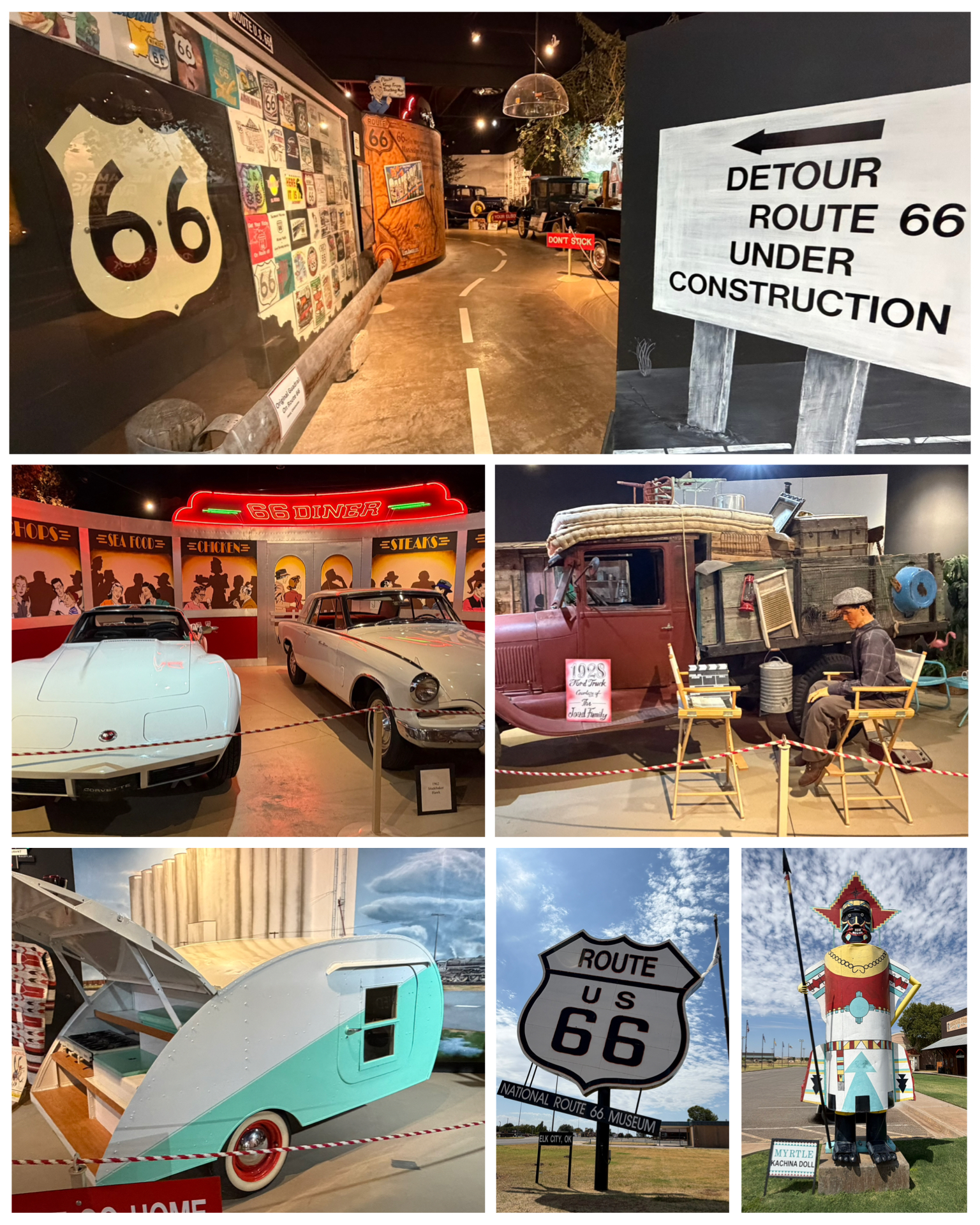 After a couple days in Amarillo, I headed further out to the east to my next stop in Elk City, OK. After getting setup at the new campground and with little time to play tourist, I quickly scouted out what there was in the area, then came up with a game plan to maximize my visit. First up was a visit to the National Rt 66 Museum. It was 1994 in Elk City – a time where pretty much Rt 66 was dead, when local resident Pat Baker had the idea of creating a museum. She sourced federal funding for her idea, and with that got each of the governors from the other 8 states where Rt 66 passes through to agree on letting her call the museum the National Rt 66 Museum. I imagine in hindsight some of those governors might be kicking themselves having given this honor to a small, otherwise insignificant Rt 66 town. It was a very nicely done museum – featuring an actual Rt 66 road that visitors can walk along, taking
 them through the entire stretch from Chicago to the Pacific Coast. It’s not just filled with historic Rt 66 artifacts, but rather period-correct depictions of what travel along Rt 66 might have looked like back in its heyday. Really nicely done! This was actually only one of several museums within the compound, but given my limited time, I opted to skip all the others and only walk through the Rt 66 part. Very worthwhile for sure.
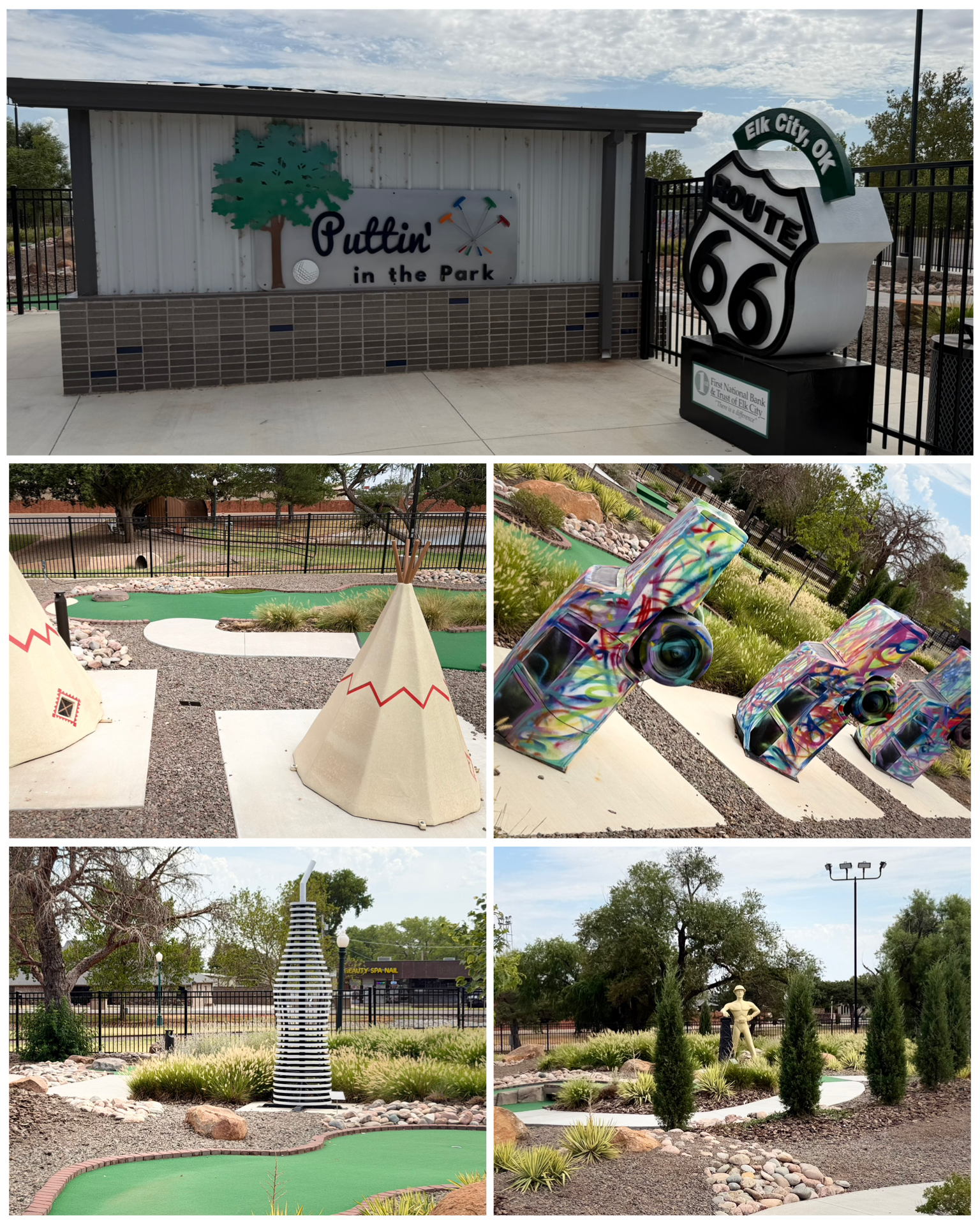
In 2025, a 50-year-old mini golf course on Rt 66 was to be bulldozed, but would be thoughtfully replaced with a new mini golf course that was Rt 66 themed. And from what I saw, it was beautifully done. The 18 holes were filled with miniature versions of iconic Rt 66 attractions which really made this place stand out. Texas’ Cadillac Ranch, Arizona’s Wigwam Motel, Oklahoma’s Golden Driller, and Arcadia’s Pops Soda Bottle were some of the famous attractions featured there. Well done Elk City!
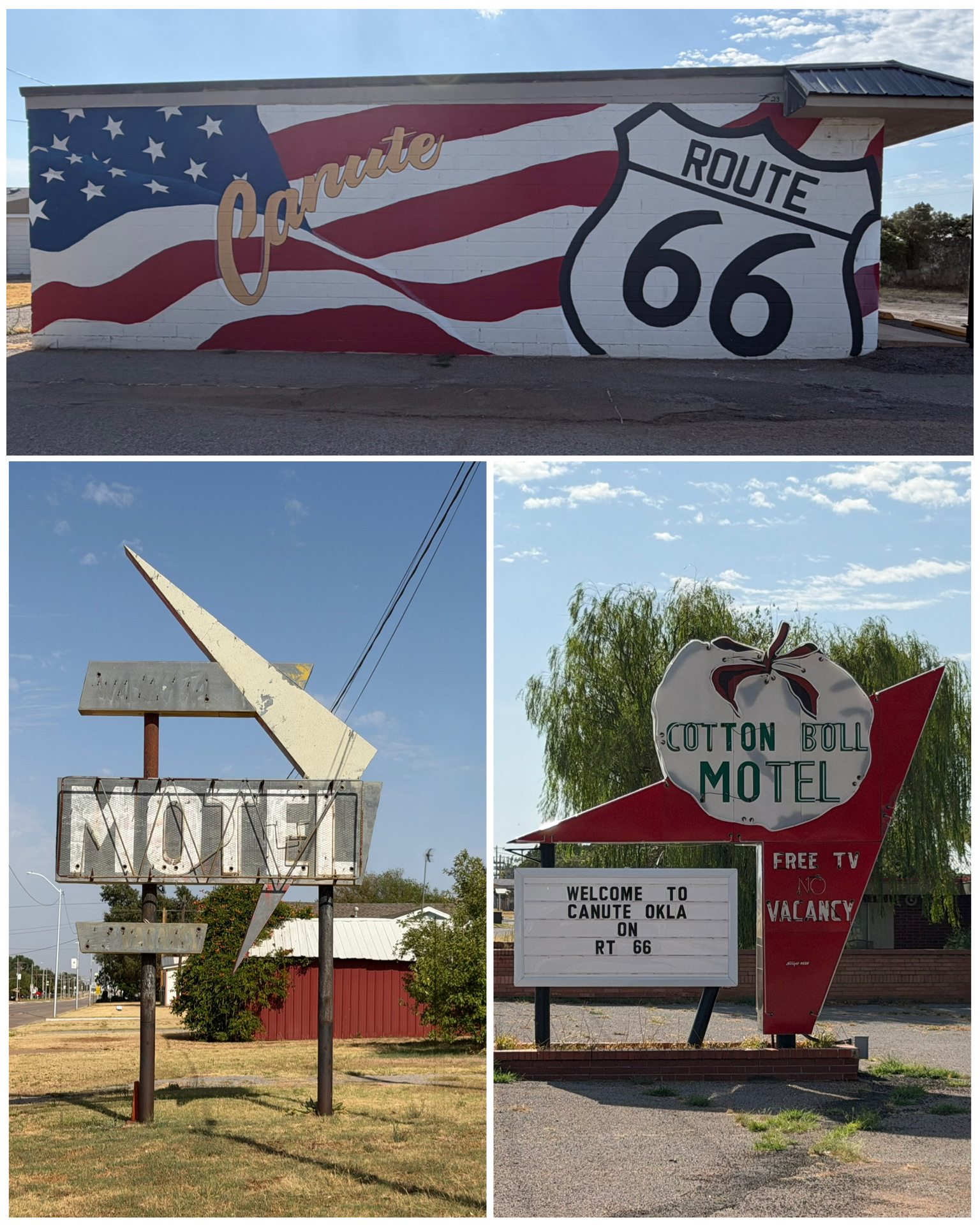 Next I ventured a bit to the east to the cotton farming town of Canute, OK. Here, cotton farmers Woodrow and Viola Penick opened the Cotton Boll Motel on Memorial Day weekend 1960. It was a fairly progressive motel for its time, with each room having wall-to-wall carpet, an AC, and a TV. But it would be the brightly lit neon sign featuring a cotton boll out front that would attract weary Rt 66 travelers. That is until the town was bypassed by the interstate in 1970. Soon thereafter in 1979, the motel closed. It was later purchased in the 1990s by the Webb family who converted it to a private home. They did however, retain the iconic sign out front. Good thinking! Another iconic sign showcasing the Washita Motel was sitting along old Rt 66 in downtown Canute. The hotel, named after the state county in which it resides, was built in the 1960s, but it too closed in the early 1990s and seems to have also transitioned into a private residence.
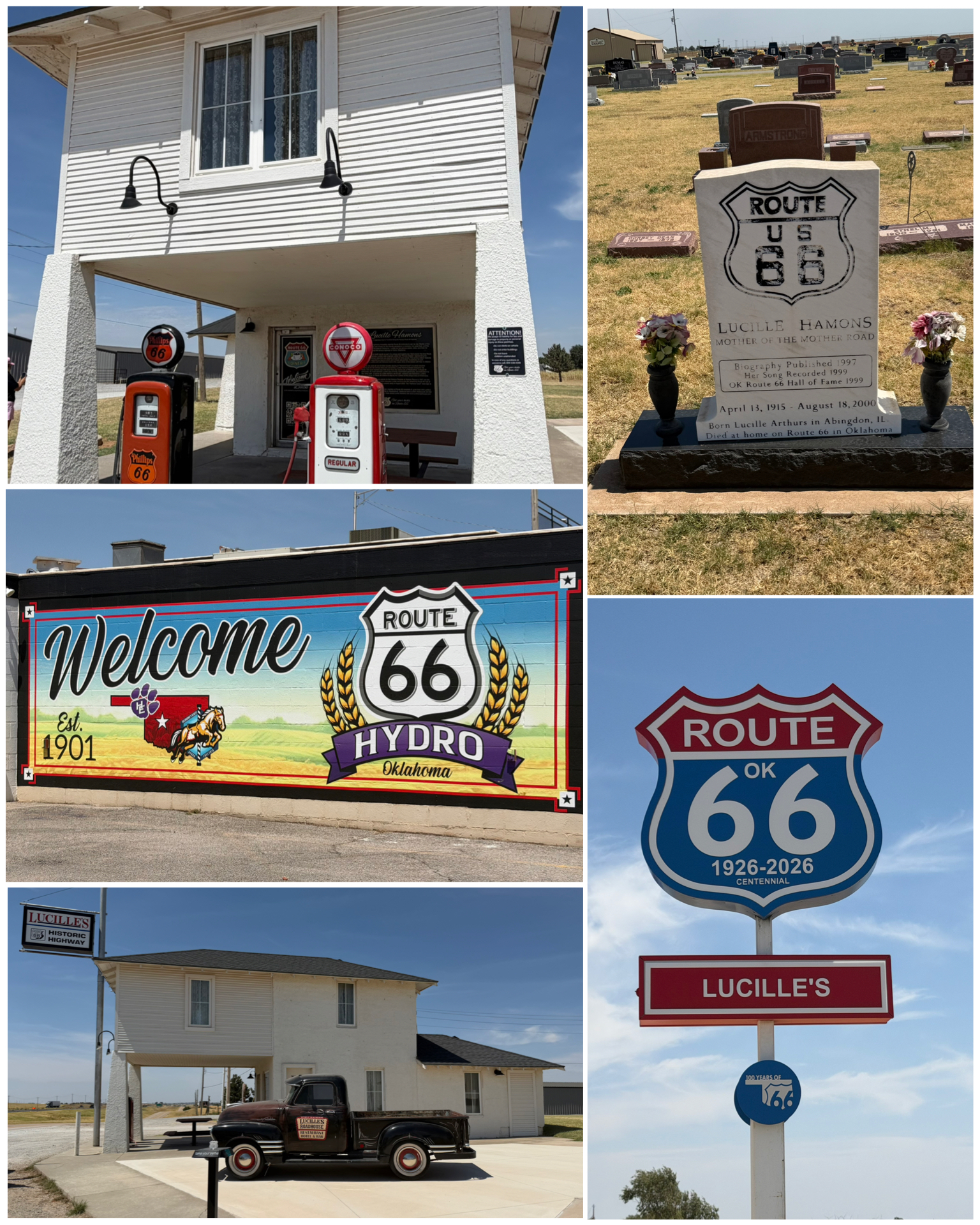 The next day I headed east to visit Rt 66 attractions in that direction from Elk City. My first stop takes me to Hydro, OK. The town of less than a thousand residents was founded in 1901 and originally called Caddo, but was renamed soon thereafter to Hydro to reflect the town’s plentiful supply of well water. There’s not a lot of Rt 66 presence in this small 0.6 square mile town, but what is here is absolutely well represented. It would be Carl and Lucille Hamons who purchased the rural Rt 66 service station in 1941, and where for the next 59 years, Lucille would run the business and live. She was known to have a generous heart to travelers, which would garner her the title of “Mother of the Mother Road”. She passed away in 2000 at the station, and is buried here in town with an appropriately themed Rt 66 Mother of the Mother Road headstone. The station was restored and is maintained by local volunteers. This is notably a popular stop among Rt 66 travelers.
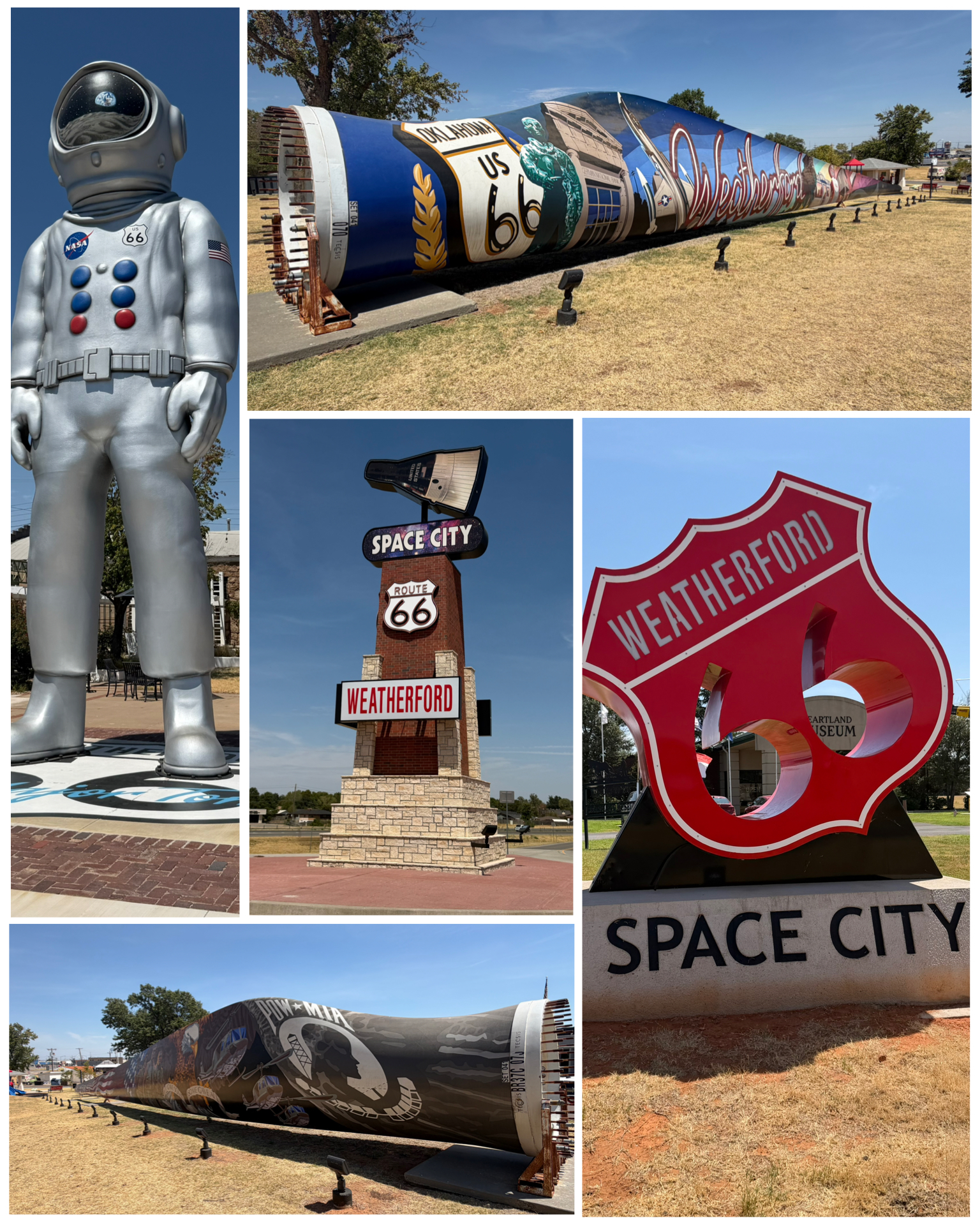 As I continue my travels west back towards Elk City, my next stop takes me to the space town of Weatherford, OK. Self proclaimed Space City, Weatherford is home to the 40K sqft Stafford Air & Space Museum – named for hometown astronaut Thomas Stafford. Stafford is a veteran of four space flights including commander of Gemini 9, Apollo 10, and the Apollo-Soyuz project. The museum is home to the Gemini 6A spacecraft, a Titan II missile, a V-2 Rocket, and a Saturn V engine, along with lots of various space artifacts. I would have loved to have toured this museum, but given my really tight schedule, I had to pass. Besides space, Weatherford is home to several energy companies as well as a wind-power generation. Specifically, a 5,000-acre wind farm consisting of 356 turbines was completed in 2021, producing upwards of 3.8 million megawatt hours of electricity per year – enough to power 300,000 homes. A city park features a 122-foot-long wind turbine blade which is nicely covered with several beautiful murals. Not a lot of Rt 66 specific history here, but lots of town history nonetheless.
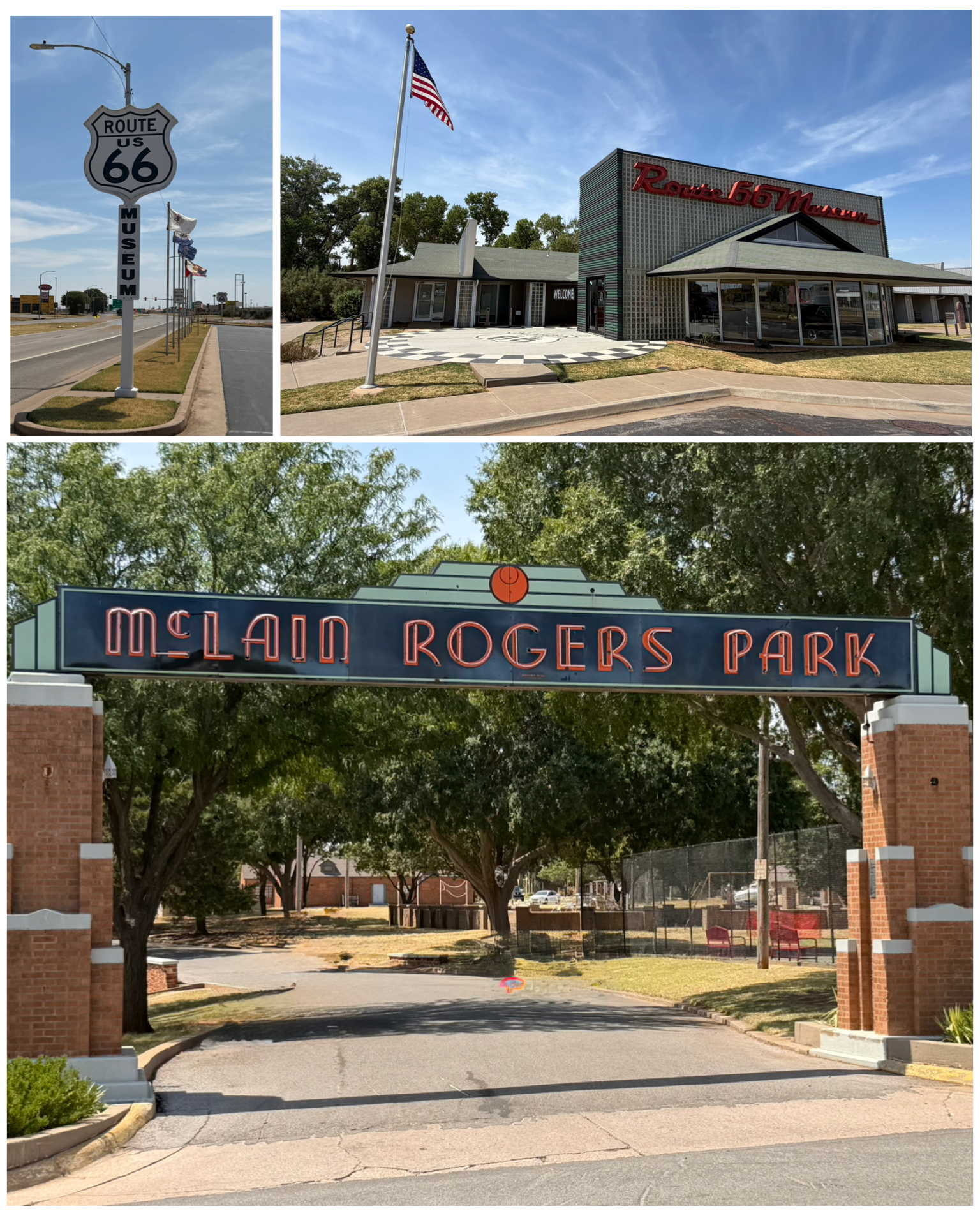 My final stop in this portion of my Rt 66 trip takes me to the town of Clinton, OK – home to a couple of Rt 66 attractions. First up was this beautiful neon sign welcoming visitors at the entrance to McLain Rogers Park. The park was built by federal government workers during the Depression of the 1930s. The project was designed to give the workers a sense of accomplishment, so few limits were placed on their work. This is clearly evident by the beautiful and elaborate art deco styling of the front gateway. Since this entrance sits along what was then Rt 66, all the neon is likely there to pay tribute and fairly compete with all the other neon all along the mother road. Certainly a nice tribute! Next up was yet another museum – the Oklahoma Route 66 Museum. It started life in the mid 1960s as the Museum of the Western Trails, but in the mid 1990s, was repurposed to feature a more modern trail – Route 66. Sadly for me, I arrived on a day when the museum was scheduled to be closed. Normally, if I’d had the full week here, I would have planned to visit on a day that it was open. But again, with my limited time here, I had no opportunity to come back for a visit. Such a loss for me!
Bristow, OK
My next stop takes me about 65 miles to the east of Oklahoma City to the town of Bristow. OKC and surrounding area has lots of Rt 66 and Roadside America attractions. Fortunately for me, I’ve been to OKC before in my travels, and have visited many of those Rt 66 and Roadside attractions. So, given I only have a day and a few hours to explore, I’m going to focus on most of the things I’ve not seen yet. I’ll also avoid going into downtown OKC altogether as that would only serve to consume many of my minimally available hours. It will be the small highways and byways that will get my attention in this leg of my trip.
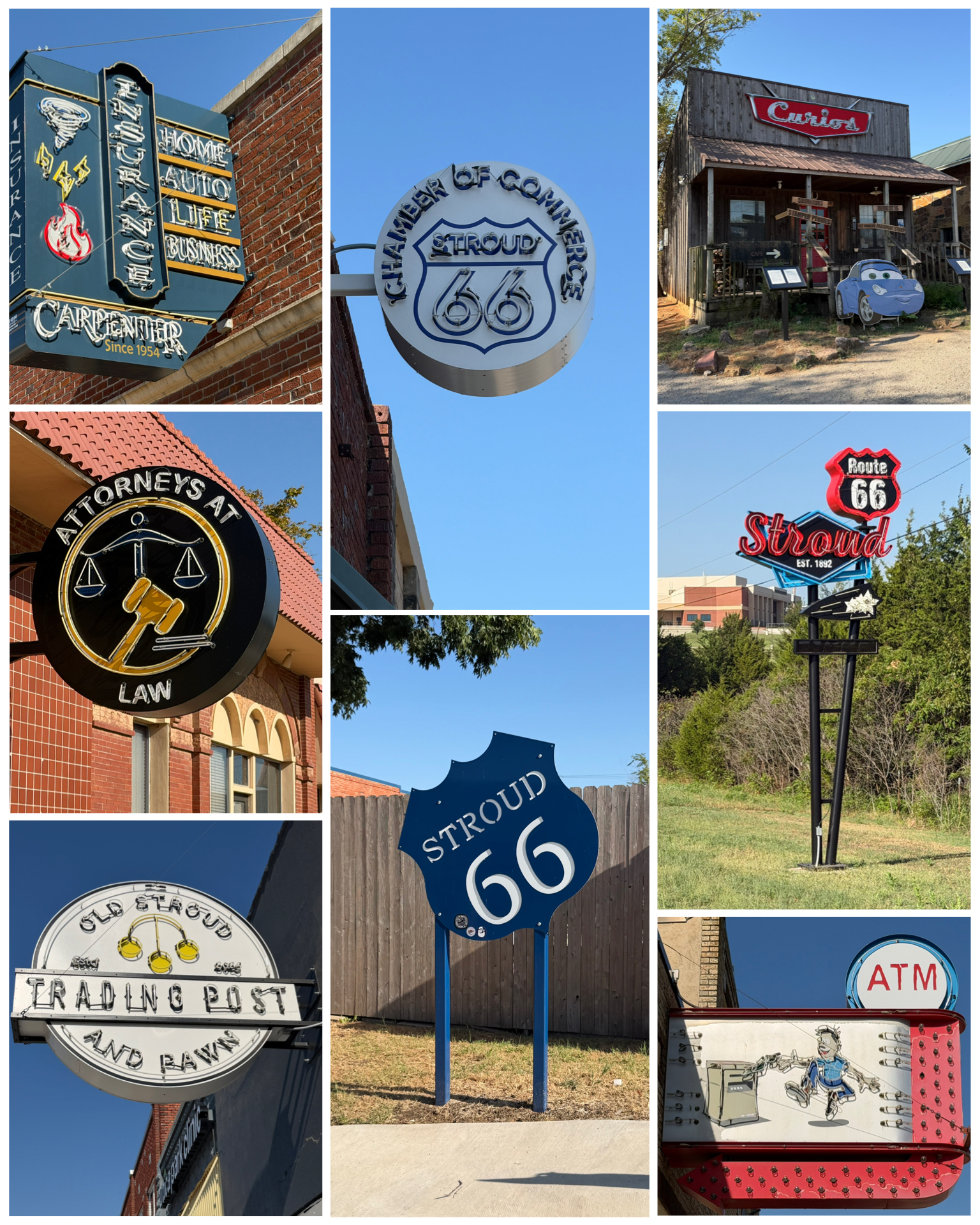 My travel day afternoon will take me to the west along old Rt 66 from Bristow to Arcadia, checking out several small towns along the way. The first town I ran into was Stroud. Like many other Rt 66 towns, Stroud thrived during the route’s heyday, but lost a lot of its traffic when the Turner Turnpike (I-44) was commissioned in 1953. Then in 1999, the town was devastated by tornadoes including the destruction of the 53-store Tanger Outlet Center. But you wouldn’t know it today! Downtown Main Street (Rt 66) looks better than ever – especially its Neon! For the centennial and through various grants, the town revitalized over 40 of their iconic Main St neon signs to create a fresh and colorful downtown. It looked great! Lots of truly unique neon hung proudly advertising various businesses – some still operational, and some not. I can only imagine what it looked like all lit up at night. Well done Stroud!
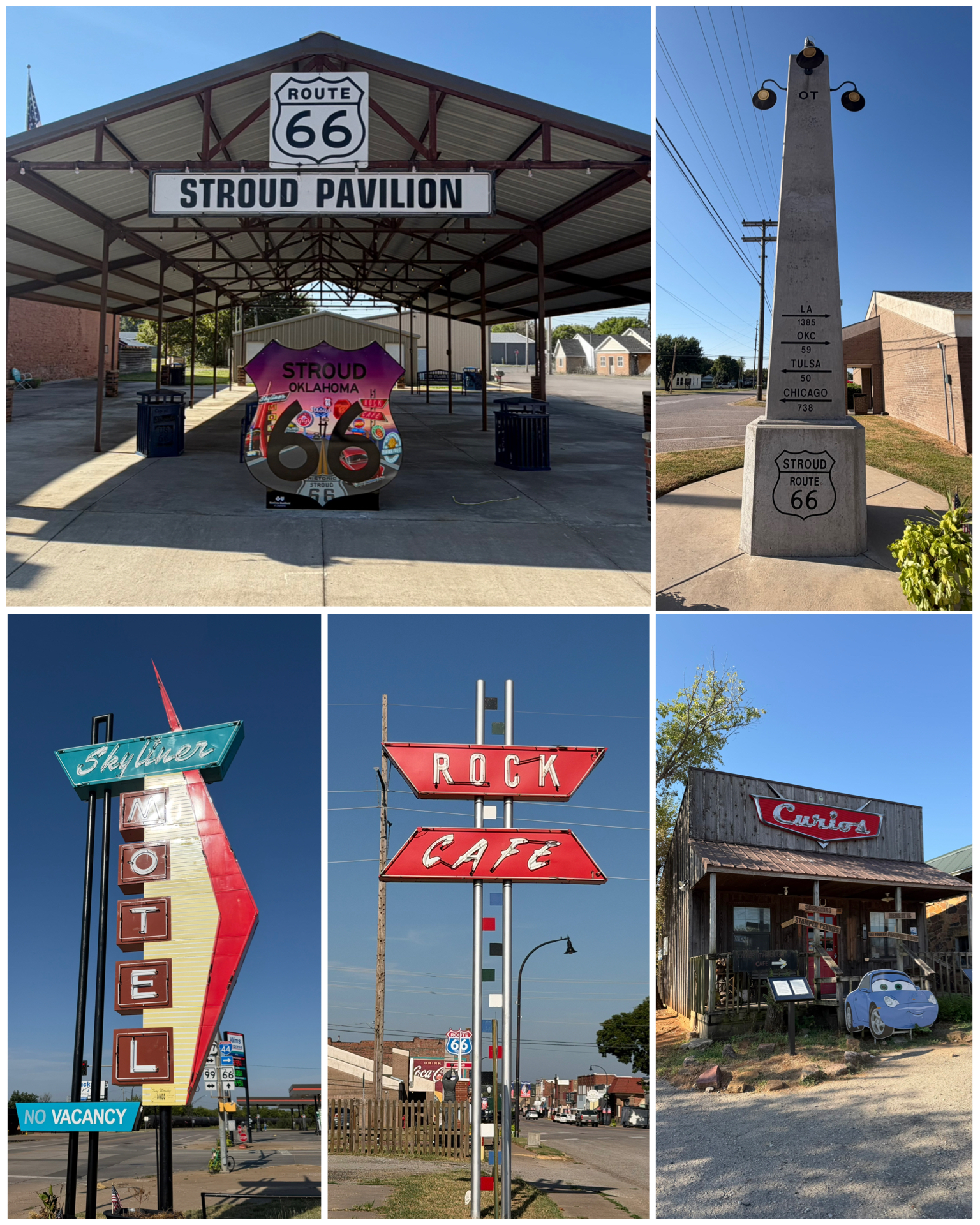 Besides all the neon, there were certainly several interesting places here in town. The most important stop is the Rock Cafe. Opened in 1939, the front of the restaurant is covered in rocks that were excavated as part of the construction of Rt 66. Further, the Porsche character from the Pixar movie Cars was actually based upon the owner of Rock Cafe, Dawn Welch. The restaurant continues to operate today, despite most of it burning to the ground in 2008. Dawn and crew got busy and within a year, had the place rebuilt and back in operation. It is estimated that this burger joint has served upwards of 5 million burgers since its opening in 1939. In the early days of what was once the Ozark Trail, concrete obelisks were placed at key points along the trail, with directional arrows and distances to other major cities engraved in their stone. When the Ozark Trail ceased to exist, the Stroud obelisk became obsolete and disappeared. However, the town of Stroud never forgot about its 21-foot historic landmark, so in 2020 it created an exact replica – this time sitting on and pointing to cities along Rt 66. Pretty cool! No small town on Rt 66 would be complete without a hotel. For Stroud, that would be the Skyliner. Built in 1959, it was a small venue having only 10 rooms but was a classic Route 66 motor court with all the modern comforts of the era: air conditioning, in-room phones, carpeted floors, televisions. Like so many other small-town Rt 66 hotels, it eventually succumbed to the loss of travelers, fell into disrepair, and was shuttered. Fortunately, it was purchased in 2025, went through extensive renovation including the full restoration of its iconic neon sign, and was reopened in 2026 for the centennial. I can only hope it continues to be successful for the future generations of Rt 66 travelers.
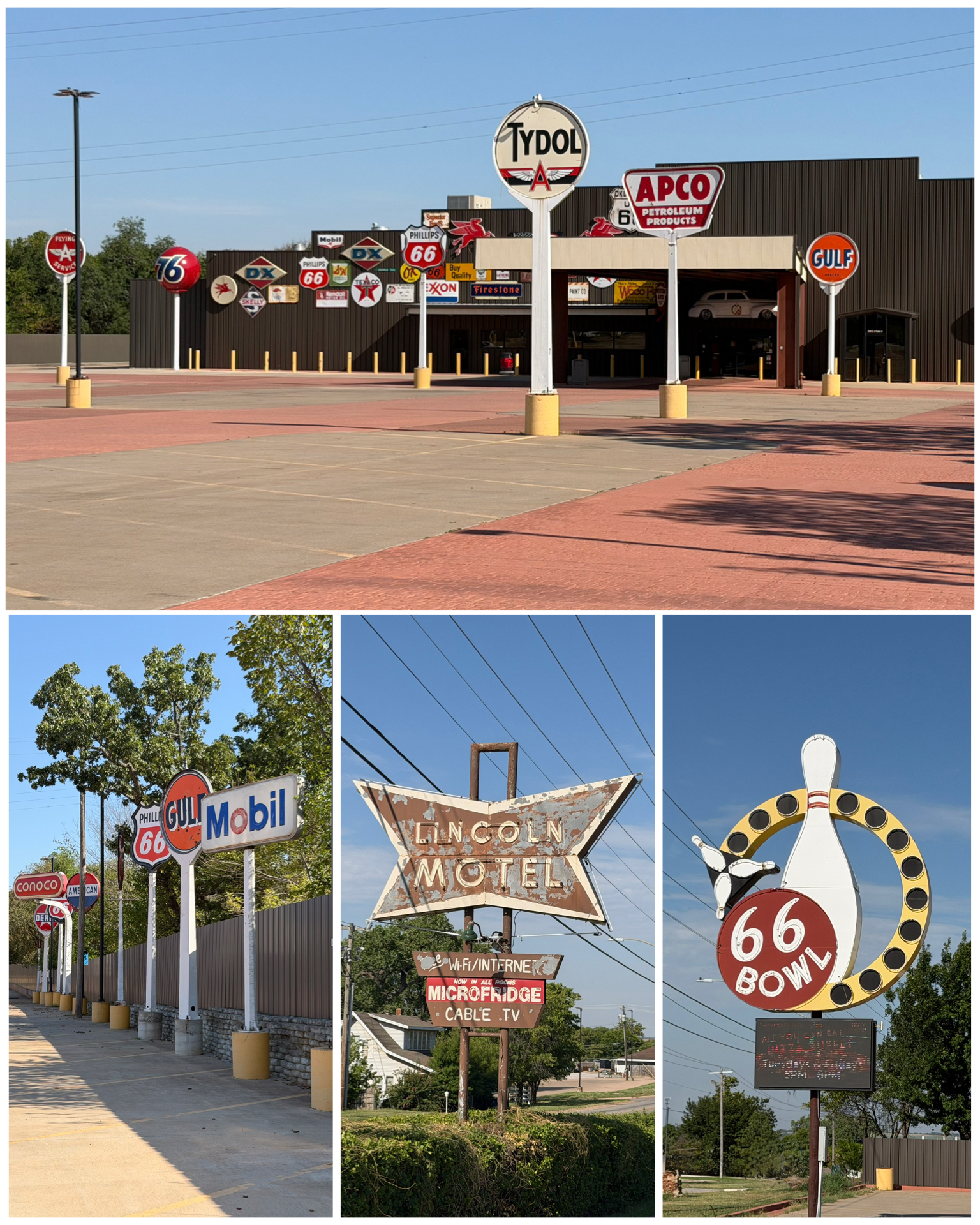 My next stop takes me to Chandler, OK where we find a handful of Rt 66 gems. First up is Rt 66 Bowl. The original bowling venue was opened in 1959, and ran all the way through 2010. The sign was purchased and worked its way to standing tall in front of a new bowling alley that opened in 2021. To make it even more interesting, the owner filled the alley’s parking lot with a bunch of metal gas station signs from the 1950s. And reportedly, the inside of the building includes old license plates, gas pumps, neon signs, and more. No doubt these folks have embraced the historical legacy. Nicely done! Just down the road is the Lincoln Motel. Built in the 1930s and still operating to this day, its Rt 66-styled duplex cottages offer lodging opportunities reminiscent of 80 or more years ago. That would be a pretty cool place to stay!
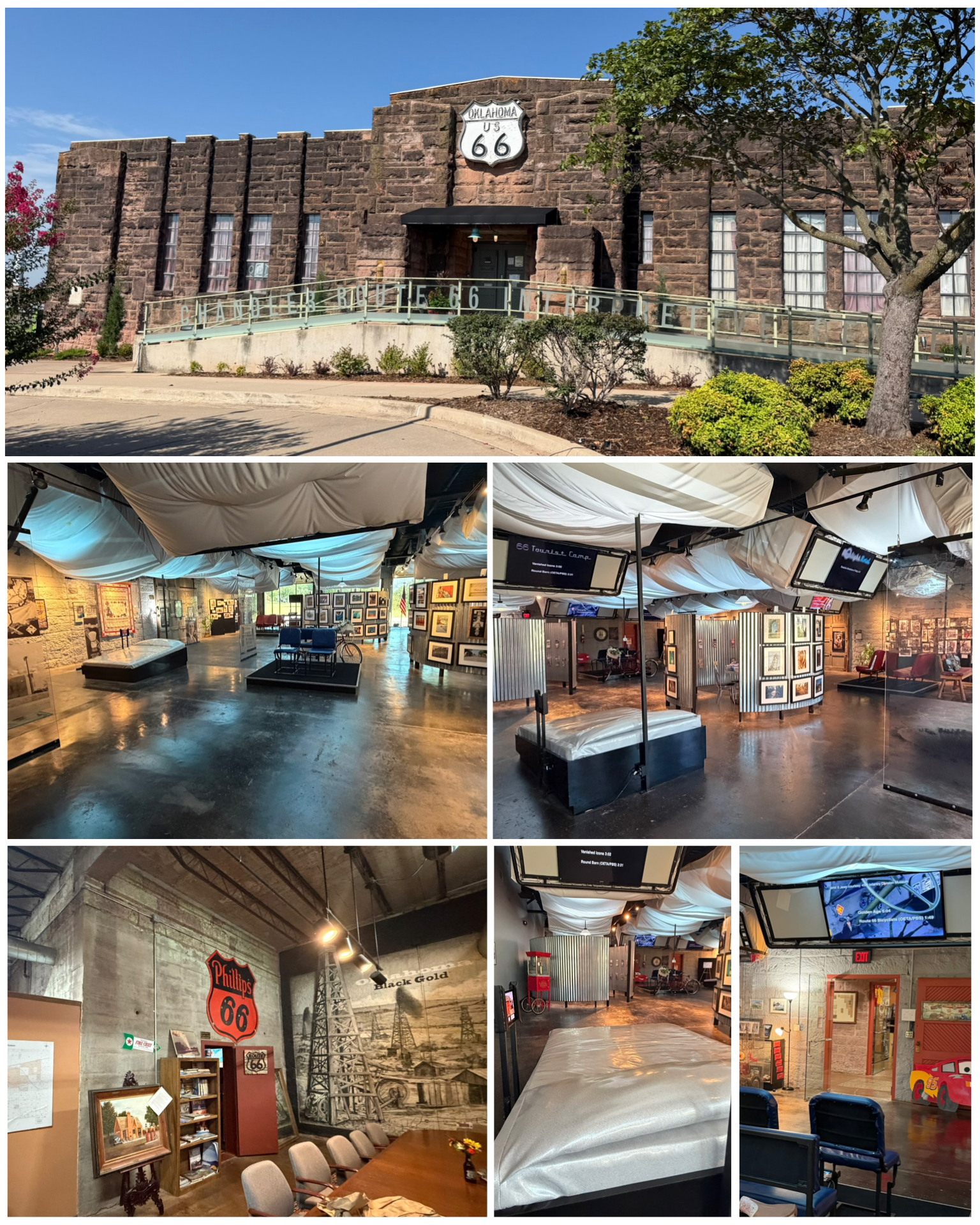 Next I visited the Route 66 Interpretive Center located here in Chandler. Wow – was this place amazing! The Interpretive Center takes visitors through a visually entertaining “drive” from the 1920s through current-day Oklahoma. It’s definitely not your typical Rt 66 museum. While it certainly had its share of common themes such as historical artifacts, Rt 66 timelines, and the like, it was the collection of videos and the way in which much of its information was shared that made it quite unique. There were several video stations throughout that walked you through various periods of history along Rt 66. However, instead of simply offering a bench or chair on which to sit while taking in the movie, they offered beds representative of old motels to lie on to view a ceiling mounted TV, or seats to sit on that came from historic vehicles like a 1965 Mustang. It was quite different! Not to mention, the museum is housed in an armory building built in 1937 that used to be home to the National Guard and included a highly fortified room that once held live ammunition. A really cool museum in a really cool building!
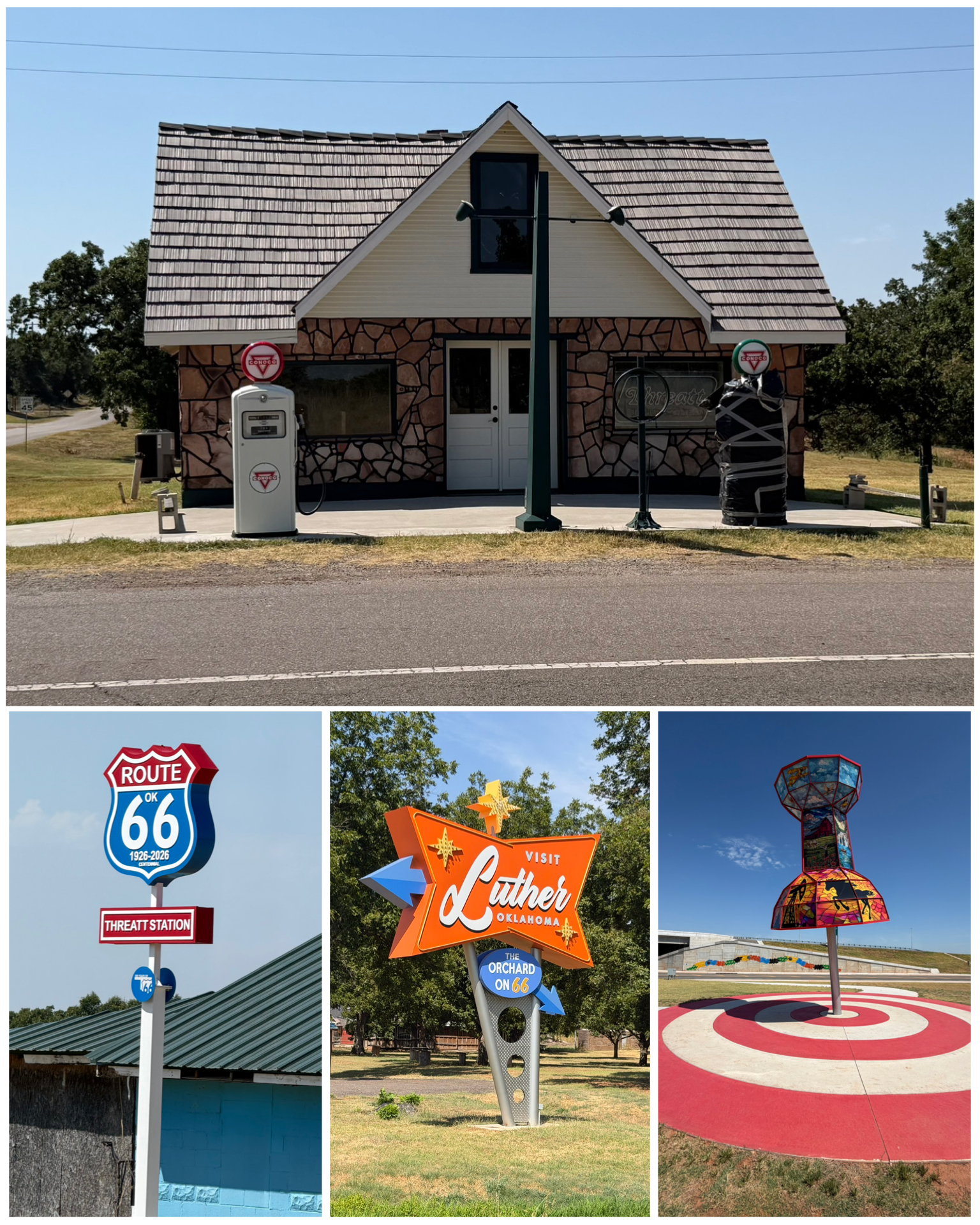 Next stop, Wellston, OK – home to the giant push pin! Just recently unveiled for the centennial in April of 2026, this giant pin pushed into what looks like a bullseye, is the town of Wellston’s claim that they are at the center of Rt 66 – that is the center in the state of Oklahoma. So, it gives route travelers a reason to stop in Wellston as frankly, despite the route going through town, there’s not much else to see here. But they did a really nice job with this giant art piece, and combined it with murals of artsy scenes of Oklahoma along the highway underpass. A cool stop for a quick photo op. Next in Luther, OK we come upon the Threatt filling station sitting mostly alone in what is otherwise open farm land. The farm was 150 acres and included a small sandstone quarry. In 1933 the Threatt family sourced rocks from their quarry to build a house and a gas station. At the time, it is reportedly the only black-owned gas station in along Rt 66. With segregation and prejudice common at that time, the station offered a safe haven for black travelers, and likely would have been featured in the Green Book travel guide that I’ve referenced in a prior blog. Over the years during the high point of Rt 66, the family expanded their services to include a BBQ cafe, store, bar, and even a campground. Business was pretty good up until around 1974, and the farm’s home was occupied with the original owners’ daughter-in-law up through her passing in 2009 at which time the building was abandoned. Fortunately, it has recently undergone a very nicely done restoration and is reportedly set up to be a visitor center – though not open on the day I was there. Last up in this section was a visit to this 30-foot tall Las Vegas-styled sign encouraging would-be Rt 66 travelers to visit the town of Luther. It was built in April of 2025 at a cost of $77k with hopes that it would deliver tourists down the half-mile detour off Rt 66 into Luther so that they may spend some of their tourist dollars there. Well, I only stopped and took a picture of the sign, then proceeded out along Rt 66. So, it certainly didn’t work on me!
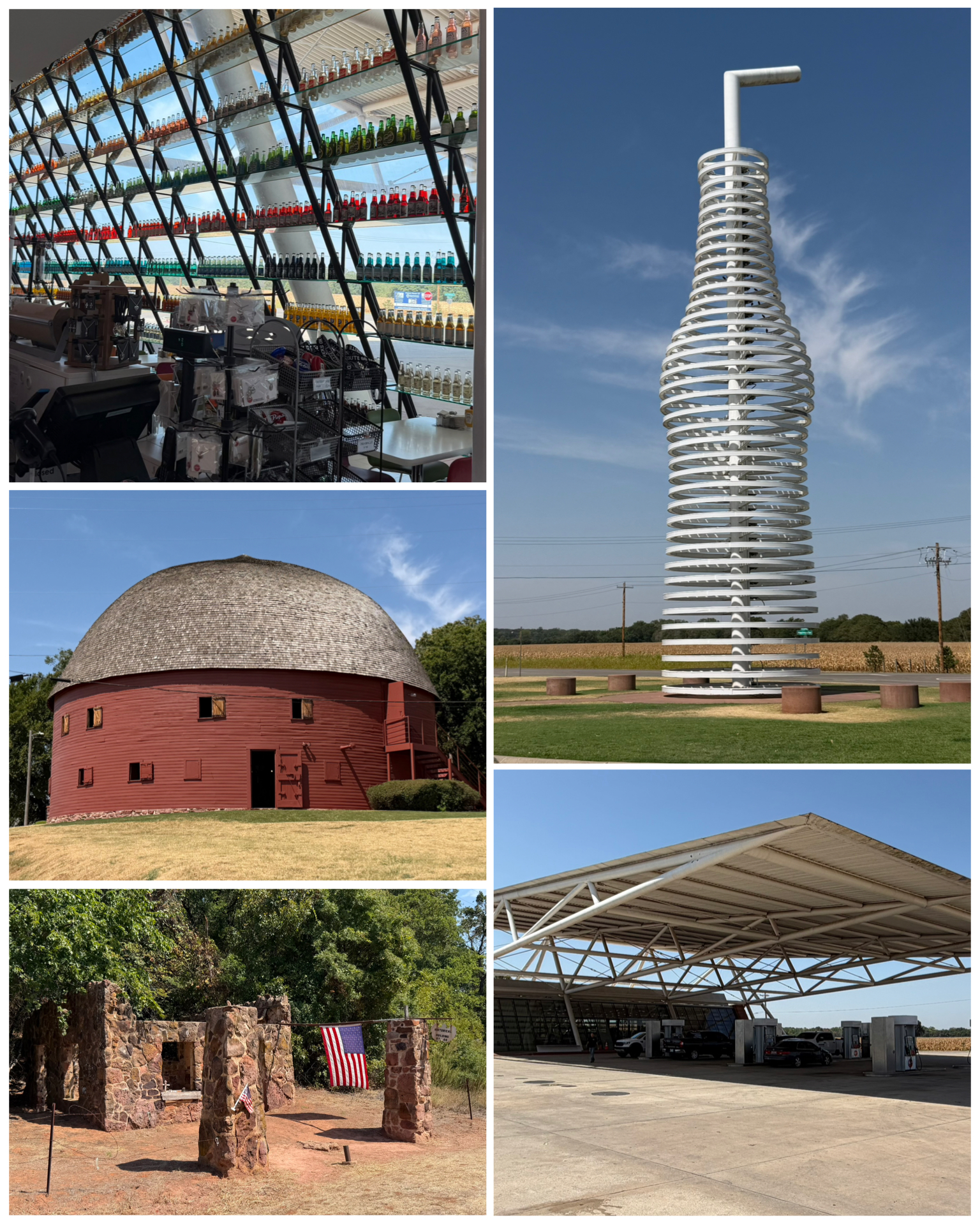 My next town to explore during this day’s tourist adventure takes me to Arcadia, OK. I’ve actually been here before back in May of 2022, and had seen several of these Rt 66 attractions. However, they were unique enough and certainly cool enough for me to make a reprise visit. Being that this was my second visit, I didn’t, for example, go back into the Round Barn, or spend much time at the old historic gas station thought to have been built in the late teens or early 1920s. I did, however, pull into Pops soda place and had lunch there again as I had done back in 2022. Still great food, and still lots of choices for a strangely flavored soda.
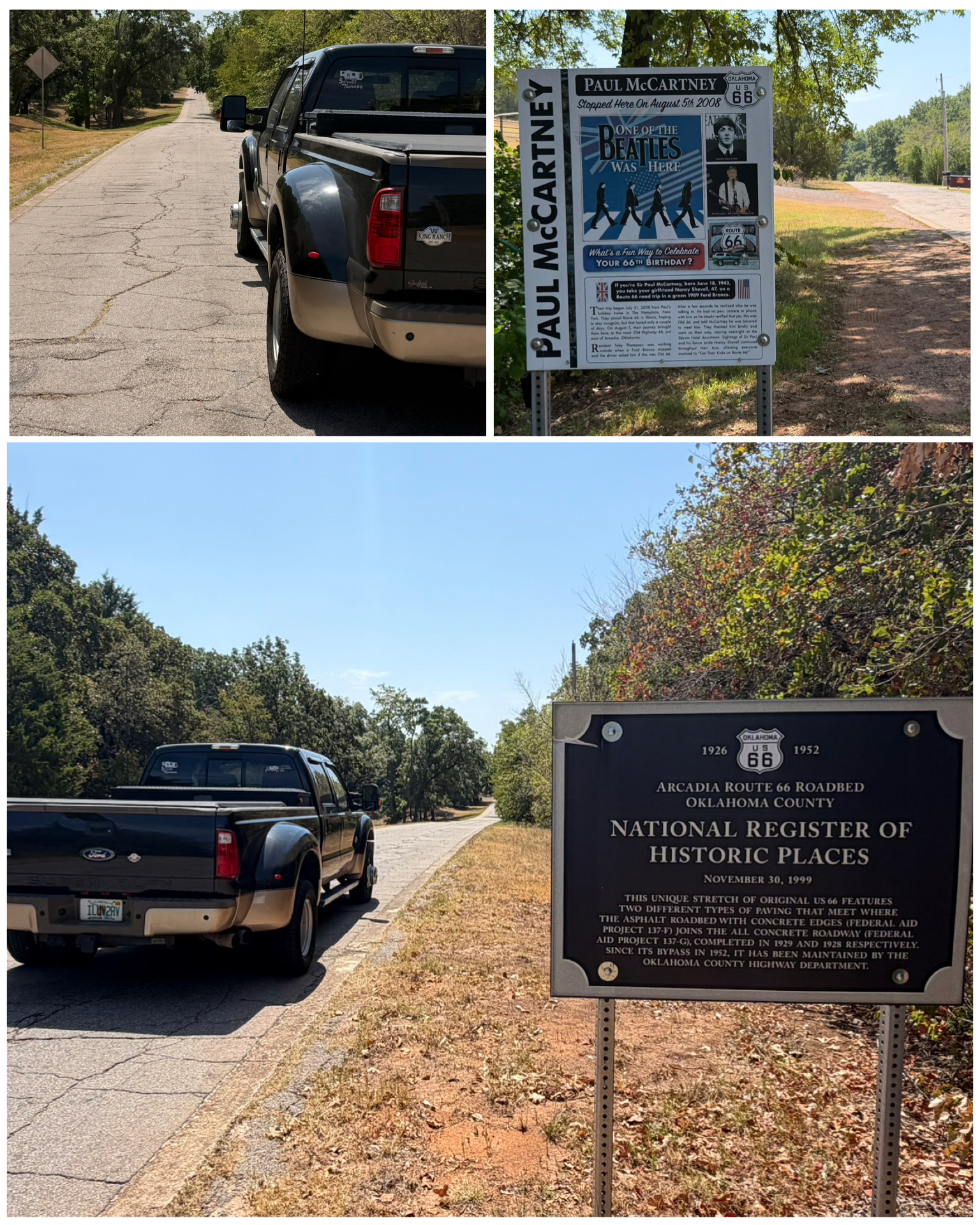 One place that I had not visited the last time was to drive along this small rural section of original Rt 66 roadway and take in its unique architectural pavement history. From the marker to the east, the surface is all concrete and was built in 1928. To the west of the marker, built in 1929 as road technology improved, the section switches to asphalt with concrete edging. Since this slightly less-than-a-mile stretch of Rt 66 was bypassed in 1952, it saw much less traffic and remained in remarkably good condition. So much so that in 1999, it was placed on the National Register of Historic Places. On that same road just down the way a bit was this other interesting history sign. Apparently, in August, 2008, former Beatle Paul McCartney and his future wife, Nancy Shevell, set out on a Route 66 road trip in a 1989 Ford Bronco to celebrate his 66th birthday. It was here that they stopped and asked a local resident if this bit of narrow road was in fact still part of the famous Rt 66. Resident Toby Thompson was working in his yard at the time and confirmed that, “yes”, the narrow road was still part of the famous Rt 66. Apparently Thompson did realize who he was talking to, but didn’t have a camera or pen for a photo or autograph. Instead, he simply confirmed the route and told McCartney it was an honor to meet him. McCartney then continued on toward Oklahoma City. Twelve years later, in 2020, that brief roadside encounter was commemorated with this sign. Certainly a fun and interesting story!
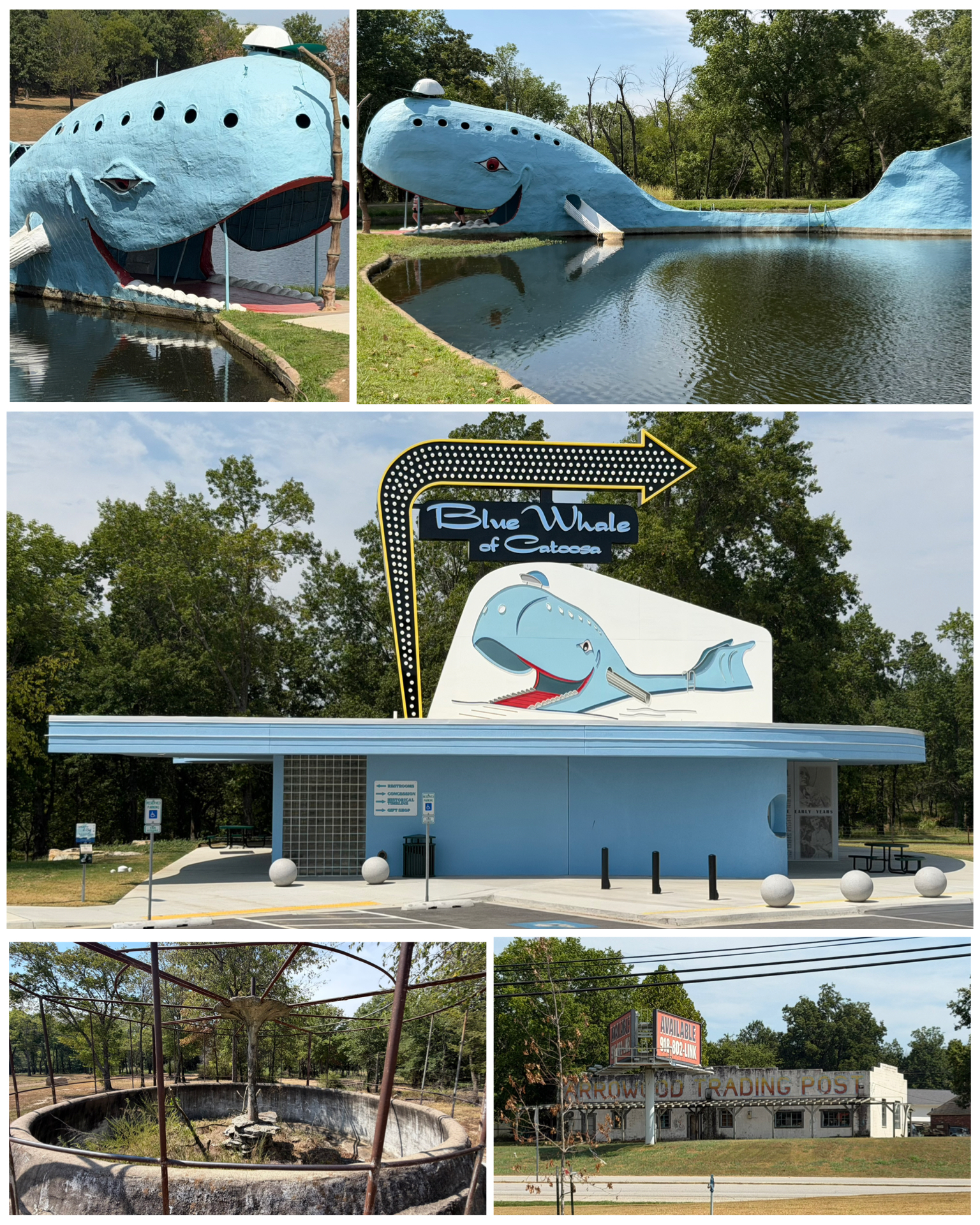 Well, it was late morning by this time, and I had one more stop that I had to make. However, it was 100 miles back to the east from where I was at the time, some 15 miles further east of Tulsa. I’ve been to Tulsa before and saw many of the Roadside items, and a few of the Rt 66 stuff then. Frankly, since I have very little time here in the area to play tourist thanks to the truck issue, I had to make some tough decisions to prioritize my visits. And for me, it was the Blue Whale. So I buckled up and headed to Catoosa, OK. While the whale itself was not an early Rt 66 destination having only been built in 1972, the grounds on which it stands and the businesses that existed there date back to the early Mother Road days. It was Hugh Davis – a photographer, zoologist, and lecturer, who spent most of his career as Director of Mohawk Zoological Gardens, where he worked for 38 years. His wife Zelta Whitlock was a farm girl who loved animals and nature, and met and married Hugh in the 1930s. After retiring from Mohawk, Hugh set out to create Nature’s Acres – a place to share and educate about plants and animals. The venue consisted of an alligator ranch, a snake pit, a prairie dog village, and a replica of Noah’s Ark used to host parties. It became a popular stop among Rt 66 travelers. Hugh would demonstrate the milking of snake venom, while Zelta would wrestle with the alligators. Both had narrowly escaped death many times in various incidents with the reptiles. So, they eventually decided to retire. In the late 60s at the age of 60, Hugh wanted to think about something special he could create for his loving wife. What started out as sketches of a fish, quickly evolved into a full-blown whale. He would spend the next several years constructing the 20-foot-tall, 80-foot-long character, seemingly beached on the shore of what was once one of Nature’s Acres gator ponds. The blue whale features a wide-open mouth, portholes in its head, water slides for fins, and a diving platform on its tail. Hugh officially presented the gift to his wife Zelta on September 7, 1972, on their 34th wedding anniversary. They had originally considered the site to be private – to be used by their grandchildren and other family members. However, its proximity along Rt 66 quickly drew curious visitors and they eventually opened it as a public attraction, making it one of the most loved icons on Rt 66. From 11 am until dark, visitors swam, picnicked, and went fishing. Years passed and by their 50th wedding anniversary, age had caught up with them and so the Blue Whale was closed to the public in 1988. Hugh passed away in 1990, and his wife Zelta in 2001. The Blue Whale had become overgrown, faded, and an overall swampy mess. The Catoosa Chamber of Commerce had done its best to try and keep up with maintenance. By the early 2000s, fans of the Mother Road partnered with the City of Catoosa continuing to restore and preserve the Blue Whale. Finally, in 2020, the City of Catoosa purchased the entire 14-acre property. The city has fully restored the property, adding picnic tables, a small gift shop, and a visitor center. Today the entire site operates as a city park. Nice job Catoosa! Pictured here at left are a couple shots of the whale, a view of the visitor center, and a picture of what remains on the property that I believe to be one of the old snake pits. Also, across the street is the Trading Post that was run by wife Zelta for many years.
Final Thoughts
 Wow – well I’m a few weeks behind in my blogs. I’ll be finishing and publishing this edition around September 20th or so, when in fact these visits were done in mid to late August. Oh well – I’ve been in catch-up mode in my travels, so it is what it is. The truck issue has certainly thrown a monkey wrench into my slow-paced travel plans, but I’ve done my best to see what I can and get back on the original schedule. As for the blog, I’ll try and get caught up in the next couple of weeks or so – mostly as I’m wrapping up my final week of the actual Rt 66 trip, and starting the mad dash back to the home base in Florida. So I’ve got KS, MO and IL left to write about – most of which I’ve already finished visiting. So, stay tuned as I wrap up this year’s RV adventure. Till next time, be well and safe travels.
I only show a sampling of my adventure pictures here in the blog, and do so mostly in collage format for brevity and ease of reading. If you want to view an album containing individual full fidelity and hi-res images of all my travel pictures related to this specific blog, click the image below. Enjoy!
So I wonder what is the fascination in seeing vehicles planted in the ground. To me it makes no real sense but I guess everything means something to someone. A typo or mistake. I believe it should be cotton boll and not ball. Boll is the natural seed pod. Remember the boll weevil?
The Blue whale is one of the landmarks which I most clearly remember visiting.